Sunday, 5 June 2011

Eggs Benedict etc

Hungry...?

Eggs Benedict
Eggs Benedict is a dish that consists of two halves of an muffin topped with ham or bacon, poached egg and hollandaise sauce.


  1. Muffin
  2. Poached Egg (see below for recipie)
  3. Ham
  4. Hollandaise Sauce (see below for recipie)

Eggs Benedict with Laverbread (I guess this would be Wyau Benedict a Bara Lawr)
(c)2011 Ian Oliver
  •  fry laverbread with bacon (fry small pieces of bacon in their own fat, until almost crispy, then add laverbread and fry until that is cooked)
  • place thick slice of ham (real ham!) on a muffin or half bagel
  • place fried laverbread and bacon on top
  • then a poached egg
  • then Hollandaise sauce over the top (seasoned with a little black pepper)
Hollandaise Sauce
A buttery sauce made from egg yolk, butter and a little lemon juice... 
Poached Eggs (properly)
  • boil water with a touch of vinegar and salt (helps keep the egg white together)
  • break egg, drop into boiling water for 2 to 2 1/2 minutes
  • take eggs out using slotted spoon - dry a little to remove excess water (most of which should evaporate)
  • the whites should be cooked and the yolks runny (!!)

Saturday, 21 May 2011

Category Theory, Entropy and Information Theory

Just for reference, but this looks awfully relevant..

n-Category Cafe May 10, 2011 's entry: Entropies vs. Means (Tom Leinster) as a start, which then takes us to Entropy as a functor and specifically A characterization of entropy in terms of information loss.

This takes us neatly to Reyni's paper A. Rényi, Measures of information and entropy, in Proceedings of the 4th Berkeley Symposium on Mathematics, Statistics and Probability 1960, pp. 547–561.

The thesis being:

Given an ontology, we can calculate the entropy of a set of attributes/classes from that ontology, ie, the entropy of a function that selects a sub-set of that ontology. This is of course complicated by dependencies between attributes within that ontology, eg: star-sign <---> date-of-birth  etc.

For each sub-set we can construct a further set of functions that partition the ontology as above - thus creating a partial ordering of functions (and a semi-lattice where all functions can be ground to a bottom value by a function f O -> _|_ which effectively removes everything giving an entropy of 1, ie: pure randomness and loss of all information.

A privacy preserving function is one that introduces more entropy, ie: obfusicates or anonymised any data passing through. However, There are certain other properties that need to be investigated, such as aspects over the original ontology - not all information is PII etc. Does this imply some weighting in the entropy calculation or something more exotic such as a matrix structure.

This might fit in nicely with some earlier work on trajectories of information....

Thursday, 19 May 2011

Dawn

A somewhat forgotten (or badly marketed) mission to investigate asteroids Vesta and Ceres. Anyway, Dawn has captured its first image of Vesta:


JPL Press Release

NASA's Dawn spacecraft illustrated in this artist's concept
This image shows the first, unprocessed image obtained by NASA's Dawn spacecraft of the giant asteroid Vesta in front of a background of stars. Image credit: NASA/JPL-Caltech/UCLA/MPS/DLR/IDA
Enlarge Image
May 11, 2011 - PASADENA, Calif. -- NASA's Dawn spacecraft has obtained its first image of the giant asteroid Vesta, which will help fine-tune navigation during its approach. Dawn is expected to achieve orbit around Vesta on July 16, when the asteroid is about 188 million kilometers (117 million miles) from Earth.

Friday, 6 May 2011

Signs of dark matter from Minnesota mine

Possible evidence for WIMPs reported, supporting claims of Italy-based experiment
 
By Ron Cowen Web edition : Tuesday, May 3rd, 2011
An experiment in Minnesota is the first to bolster a long-contested claim that detectors a continent away have found evidence of particles called WIMPs.
WIMPs are theorized particles considered to be leading candidates for dark matter, invisible material believed to make up more than 80 percent of the matter in the universe.  In the Minnesota experiment, called COGENT, a hockey puck–sized chunk of germanium deep in a former iron mine attempts to record rare collisions with WIMPS.
In 15 months’ worth of data, COGENT researchers detected a seasonal variation in the collision rate — higher in summer and lower in winter — similar to that seen for 13 years by a larger experiment, using different detectors, in Italy. Researchers with that experiment, DAMA/LIBRA, have attributed the results to the Earth’s motion through a cloud of WIMPs (for weakly interacting massive particles) (SN: 5/10/08, p. 12). But many physicists have doubted that interpretation because, until now, no other experiment had found similar results.

And an earlier article on this from the same author. And the obligatory Wikipedia reference to WIMPs.

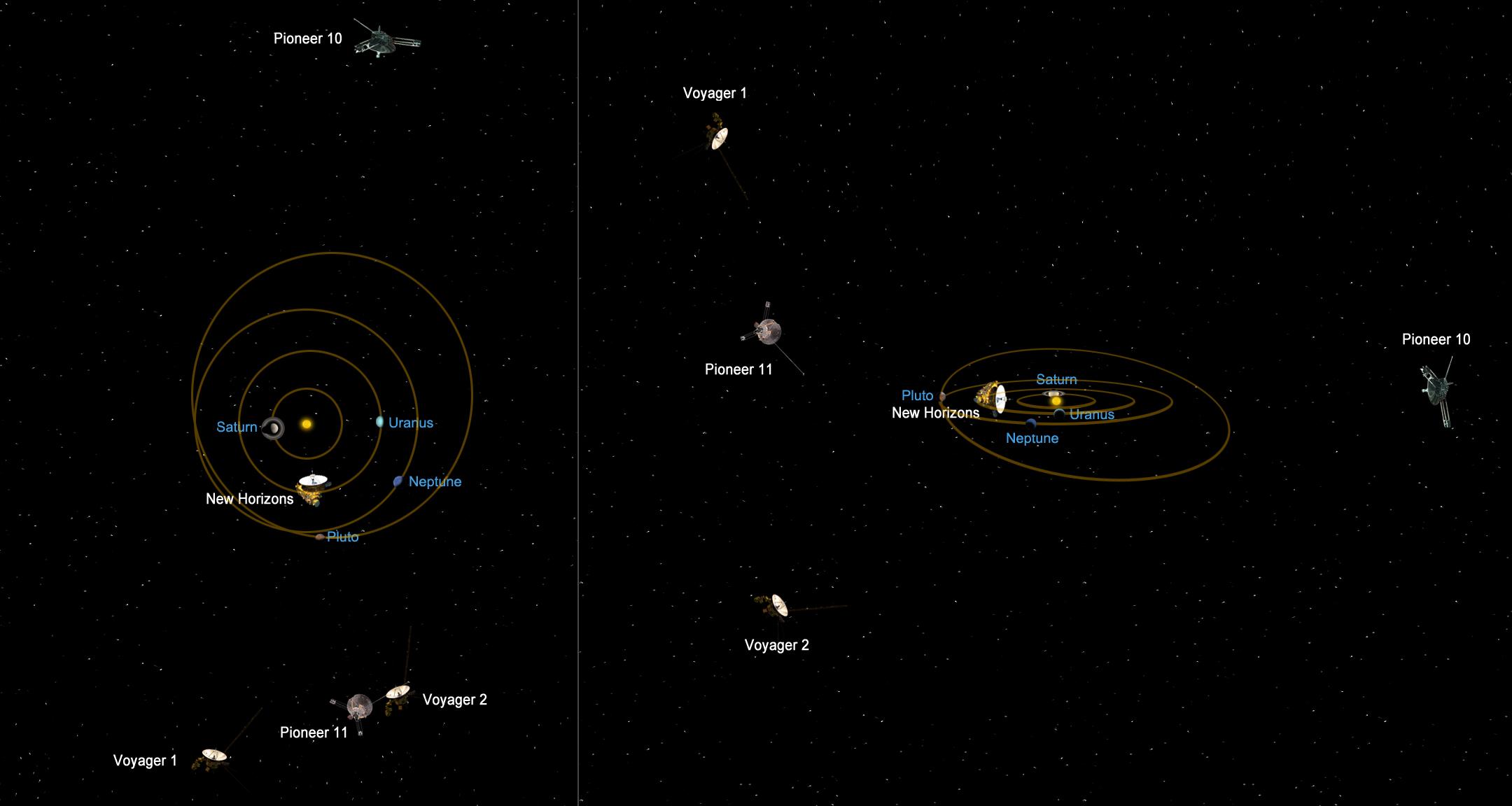
Pioneers, Voyagers and New Horizons

Very nice diagram showing the positions of Pioneers 10 and 11, Voyagers 1 and 2 and New Horizons from AOPD (6 May 2011)

Thursday, 5 May 2011

Graphs...

Seen this particular structure before somewhere (another story...), but something to keep an eye on:

Enso Introduction by William Cook (via LtU)
Ensō is a theoretically sound and practical reformulation of the concepts of model-driven software development. Ensō is based on first-class structural descriptions, invertable transformations, generic operations and interpretation.


Structures in Ensō are a specialized kind of graph, whose nodes are either primitive data or collections of observable properties, whose values are either nodes or collections of nodes. From a programming language viewpoint this may seem an odd choice for data representation. However, it is essentially the Entity-Relationship (ER) model, also known as Information Models, which is widely used in the design of relational databases and is also the basis for Class Diagrams in the Unified Modeling Language (UML), which describe the structure of networks of objects. The key point is that structures in Ensō are viewed holistically as graphs, not as individual values or traditional sums-and-products data structures.

and...

Peter Hawkins et al, Data Representation Synthesis (also via LtU)

We consider the problem of specifying combinations of data structures
with complex sharing in a manner that is both declarative
and results in provably correct code. In our approach, abstract data
types are specified using relational algebra and functional dependencies.
We describe a language of decompositions that permit the
user to specify different concrete representations for relations, and
show that operations on concrete representations soundly implement
their relational specification. It is easy to incorporate data
representations synthesized by our compiler into existing systems,
leading to code that is simpler, correct by construction, and comparable
in performance to the code it replaces.

Sunday, 24 April 2011

Higgs?

Rumours of the Higgs boson being found at LHC...

Not Even Wrong has this:

This Week’s Rumor

A commenter on the previous posting has helpfully given us the abstract of an internal ATLAS note claiming observation of a resonance at 115 GeV. It’s the sort of thing you would expect to see if there were a Higgs at that mass, but the number of events seen is about 30 times more than the standard model would predict. Best guess seems to be that this is either a hoax, or something that will disappear on further analysis. But, since spreading well-sourced rumors is more or less in the mission statement of this blog, I think I’ll promote this to its own posting.

and Live Science has this:

Scientists Abuzz Over Controversial Rumor that God Particle Has Been Detected

Date: 22 April 2011 Time: 05:37 PM ET


A rumor is floating around the physics community that the world's largest atom smasher may have detected a long-sought subatomic particle called the Higgs boson, also known as the "God particle."
The controversial rumor is based on what appears to be a leaked internal note from physicists at the Large Hadron Collider (LHC), a 17-mile-long particle accelerator near Geneva, Switzerland. It's not entirely clear at this point if the memo is authentic, or what the data it refers to might mean — but the note already has researchers talking.

So, it is quite possible that ATLAS has detected Higgs at around 115GeV ... somewhere in line with the various theories of Higgs, now a long wait and much experimentation and sifting back through massive amounts of stored results. Would be quite something if it has been found, especially this far into the LHC's operation and long before 14TeV collisions - some exciting physics coming up and possible confirmation of the Standard Model (to some degree)!

Sunday, 20 March 2011

Fermat's Last Theorem

Currently residing on YouTube - possible the greatest documentary every made and a link to Simon Singh's superb book.

Part 1 is here:


and links to Part 2, Part 3, Part 4 and Part 5 .

Some more links:
And a link to the original papers.

Despite(!) the papers being presented in June 1993 and finally published in 1995, this still stands are probably one of the greatest pieces of mathematics every. Not much is going to top this in terms of breadth and depth - maybe proofs of P=NP (or not) or the continuum hypothesis?

Saturday, 19 March 2011

Fukushima - sanity in the media?

After days of speculation, disaster predictions, another Chernobyl etc, the BBC finally reports something approaching sanity and with a hint of science...


Japan nuclear plant power 'close'


As it was almost bound to do at some point, Japan's nuclear safety agency has uprated its assessment of the Fukushima power station incident from a level four to a level five.

Firstly, 99.999% (or more) people have no idea what the nuclear power incident scale actually means, but at least the above report makes a hint at explaining it...though not well.

One of the "best"  reports comes from The Register:

Fukushima one week on: Situation 'stable', says IAEA
Shameful media panic very slowly begins to subside
By Lewis Page • Get more from this author
Posted in Physics, 18th March 2011 12:56 GMT

The situation at the Fukushima Daiichi nuclear powerplant in Japan, badly damaged during the extremely severe earthquake and tsunami there a week ago, continues to stabilise. It is becoming more probable by the day that public health consequences will be zero and radiation health effects among workers at the site will be so minor as to be hard to measure. Nuclear experts are beginning to condemn the international hysteria which has followed the incident in increasingly blunt terms.

Anyway, anything to do with anything "nuclear" makes great, sensationalist reading and sells news papers or generates hits on news websites...and unfortunately that's where most people get their information and exposure to science.

Here're links to Wikipedia about Radiation, Iodine-131, Caesium-137, Uranium, Plutonium and Nuclear Power. There's an interesting graph onthe Iodine-131 page about radiation exposure in the USA after the Nevada Tests in the 50's and 60s - which dwarf anything Fukushima, Windscale, 3 Mile Island or even Chernobyl output.

There's a good, un-biased (at the moment) write-up of the accident also on Wikipedia.

Friday, 18 March 2011

Messenger in orbit around Mercury

Finally! Seems a long time since launch and one of the first postings here about Messenger, but finally she's in orbit as of last night... From the Messenger site a NASA:

MESSENGER Begins Historic Orbit Around Mercury
MESSENGER MOI

NASA’s MESSENGER spacecraft successfully achieved orbit around Mercury at approximately 9 p.m. EDT Thursday. This marks the first time a spacecraft has accomplished this engineering and scientific milestone at our solar system's innermost planet.

For the next several weeks, APL engineers will be focused on ensuring the spacecraft’s systems are all working well in Mercury’s harsh thermal environment. Starting on March 23, the instruments will be turned on and checked out, and on April 4 the mission's primary science phase will begin.

Tuesday, 15 March 2011

Monday, 14 March 2011

The Daily Mail really does talk bollocks

Just two websites keeping track of just a small amount of dangerous, utter bollocks printed in The Daily Mail...

http://thedailymailoncologicalontologyproject.wordpress.com/

http://kill-or-cure.heroku.com/

Friday, 4 March 2011

30 years of the ZX81

Sinclair ZX81: 30 years old tomorrow
All hail the pioneer of UK home computing
By Tony Smith • Get more from this author
4th March 2011 11:45 GMT

Tomorrow, 5 March 2011, marks the 30th anniversary of the arrival of the machine that did more to awaken ordinary Britons to the possibilities offered by home computing: the Sinclair ZX81.


While its successor, the Sinclair Spectrum, got the nation playing computer games, the ZX81 was the tipping point that turned the home computer from nerd hobby into something anyone could buy and use.