Showing posts with label Neptune. Show all posts

Thursday, 21 March 2013

Has space exploration become boring?

At the expense of evoking Betteridge's Law of Headlines - obviously space exploration isn't boring - and with Voyager 1 maybe leaving the Solar System, I was wondering what happened to the romance of space exploration.

Does anyone anymore sit up until the early hours of the morning as I did when Giotto encountered Halley, being amazed at Uranus' bizarre collection of moons, fascinated with the existence of nitrogen geysers on Triton, volcanoes on Io; does anyone (other than scientists working at NASA, ESA, JAXA etc) get overly excited these days at pictures from Mercury, Vesta etc?

Does anyone dream of what the Ice Giants explorer might have found at Uranus, or what creatures might live under the icy crust of Europa's ocean?

I remember (pre internet days) desperately waiting for pictures of Neptune, Triton, Miranda, Titan etc to appear in newspapers, books, news broadcasts. Even back in 1992 the joy of connecting to NASA ftp servers to download Voyager and Pioneer pictures of Saturn and it enigmatic, orange cloud enveloped moon Titan on the only Sun workstation with a colour display the university had, over a slow internet link. Watching in fascination as line-by-line the picture was displayed and possibly imagining oneself at JPL watching those raw pictures being received at Earth.

The Register has an article from yesterday on Voyager 1 (yes, still going since its launch in 1977!) which has the paragraph (emphasis mine):

Probably the most-loved survivor of 1970s space optimism, Voyager, has sent back signals indicating that it's left the heliosphere.

Maybe this is it, in the 1970s we were optimistic - there were many missions planned: Pioneers 10 and 11, followed by Voyagers 1 and 2 to complete the Grand Tour of the Solar System; later with the first missions to comets, landers on Venus and Mars.

Maybe science just took center stage for a brief moment only to be replaced with the need for fame and appearing on X-Factor? Maybe a picture of the creme brulee surface of Titan from a small lander piggybacked on a probe that made a multi-billion mile tour via Venus, Earth, the Moon, an asteroid or two, Jupiter and finally to Saturn, just don't complete against today's media offerings?

How can you not be amazed by pictures like this - think about what you're looking at and what it took to get those pictures for a moment!
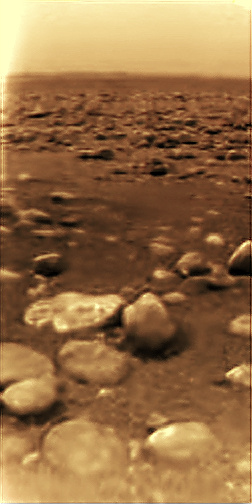

Wikimedia Commons, see: here

On the other hand a grainy picture of Titan from one of the Voyager probes offered mystery and a challenge to be solved - what is under those clouds? - now we get picture of sand grains on Mars. Have we accidentally removed the mystery? Or, have we lost the big exciting picture to a mass audience? A third possibility is that science is either not understood, or just can't complete with a crass, exploitative talent show...

Space exploration in any form is exciting...just listing some of the current probes:
  • Dawn is on its way to Ceres after a successful encounter with Vesta.
  • Messenger has completed mapping all of Mercury's surface and turned up just one or two (or freaking lots!) of major mysteries
  • Cassini is still going strong around Saturn
  • Juno on its way to Jupiter
  • Venus Express still examining Earth's "twin"
  • Numerous orbiters around Mars and not forgetting two (yes TWO!) working rovers on the surface
  • Rosetta is still on its journey to 67P/Churyumov–Gerasimenko.
  • China's moon probe made a detour to visit a near-Earth asteroid
  • Hayabusa returning samples from an asteroid
  • New Horizons still speeds to its all too rapid fly-by of Pluto and its now five moons (incidentally traveling at approx 15km per second or 34000mph)
  • etc etc...
  • oh, not forgetting Voyager 1 and the rest...
Now tell my what that isn't exciting? Maybe our media needs to reacquire its love affair with exploration and science and stop feeding minds with talentless shows...

Sunday, 11 December 2011

Mission to Europa

Space.com have an article about NASA sending a lander to Europa, or at least a proposal thereof:


Jupiter's Moon Europa Is Target for Possible NASA Lander
by Mike Wall, SPACE.com Senior Writer
Date: 09 December 2011 Time: 03:22 PM ET


SAN FRANCISCO — NASA is considering dropping two robotic landers on the surface of Jupiter's moon Europa, a body that many scientists regard as the solar system's best bet for harboring life beyond Earth.

Researchers at NASA's Jet Propulsion Laboratory (JPL) in Pasadena, Calif., are developing a concept mission that could launch in 2020 and deliver the landers to Europa about six years later. The chief goal would be to investigate whether life could ever have existed on the huge moon, which likely hosts an ocean of liquid water beneath its icy shell.

This I think should be a priority, and should have been the mission flown rather than the relatively boring Juno probe. Europa is extremely interesting from the point of view that it probably, or even more than likely, has life due to its icy surface and liquid water ocean underneath. The only other places that have these possibilities (as we understand at present) are Enceladus and Titan - the latter having been visited by the truely amazing Huygen's lander by ESA.

So this gets me thinking, space probes are extraordinarily expensive as they tend to be one off constructions. However building on mass production techniques would it be possible (almost certainly economically better) to mass produce probes. Make them light-weight with a small RTG, standardised components: visible light cameras, IR cameras, magnetometer, various particle detectors etc.

Make two batches, one orbiter and one lander and take advantage of systems such as SpaceX which provide low cost launching facilities. There needs to be done work on getting the launchers to provide the capabilities to get the things out of Earth orbit.

Now if you built, say, ten or even twenty (NASA's Surveyor programme made seven landers of a standardised design)  you could quite easily send two or more to whatever target, or maybe just one to the "easy" targets and two to the "harder" ones.

So my list:
Just a thought....but might be an interesting method of fiscial stimulus and jobs for tech workers, not to mention the increase in interest for science and exploration this might provoke.


Monday, 19 September 2011

Neptune (in infrared)

Skymania has an article on Neptune taken with the Keck 10m telescope in infrared. Given the distance to Neptune the quality of the pictures is incredible especially if compared with the Voyager 2 pictures from 1989.

Stunning snaps of Neptune and Triton

Posted by on September 18th, 2011
Infrared image of Neptune
Infrared image of Neptune (Credit: Mike Brown/CalTech)
Here are a couple of views of Neptune as you have probably never seen the planet before. They were captured earlier today by astronomer Mike Brown using a 10-meter (33 ft) telescope at the W. M. Keck observatory on Hawaii.

This also appeared on the Bad Astronomy blog: Neptune is *really* far away...which also explains something about the distance to Neptune and the difficulties of taking pictures...


Wednesday, 31 August 2011

1 Neptunian Year since discovery

Fascinating article by way of The Guardian this morning, tomorrow is 1 year since the discovery of Neptune 167 Earth years ago...

http://www.guardian.co.uk/science/2011/jul/10/neptune-orbit-anniversary-astronomy

Sunday, 10 July 2011

Neptune's Discovery

Fascinating article by way of The Guardian this morning, tomorrow is 1 year since the discovery of Neptune 167 Earth years ago...

Neptune's first orbit: a turning point in astronomy

As Neptune nears a historic orbit around the Sun, Robin McKie recalls the dramatic story of how the icy world was discovered
  • Neptune
    Neptune rising: although discovered in 1846, we didn’t get a glimpse of this alien world until Voyager 2 swept past in 1989. Photograph: Corbis
    Astronomers will celebrate a remarkable event on 11 July. It will be exactly one year since the planet Neptune was discovered. Readers should note a caveat, however. That year is a Neptunian one. The great icy world was first pinpointed 164.79 years ago – on 23 September 1846. And as Neptune takes 164.79 Earthly years to circle the sun, it is only now completing its first full orbit since its detection by humans. Hence those anniversary celebrations.