Showing posts with label Higgs. Show all posts

Wednesday, 4 July 2012

Higgs Found

Fantastic news from Cern regarding the Higgs this morning - congratulations to all involved. Here's the press released:

CERN experiments observe particle consistent with long-sought Higgs boson

Geneva, 4 July 2012.

 At a seminar held at CERN1 today as a curtain raiser to the year’s major particle physics conference, ICHEP2012 in Melbourne, the ATLAS and CMS experiments presented their latest preliminary results in the search for the long sought Higgs particle. Both experiments observe a new particle in the mass region around 125-126 GeV.

...(see link above for full release)


Tuesday, 13 December 2011

Higgs

A wonderful moment in physics:

We may have glimpsed the Higgs boson, say Cern scientists

Physicists have seen strong hints the Higgs boson exists, but a firm discovery may not come before the end of 2012

Scientists could have caught their first glimpse of the Higgs boson, the curious particle thought to underpin the subatomic workings of nature.

Hundreds of physicists crowded into a seminar room at Cern, the European particle physics laboratory near Geneva on Tuesday, breaking into applauseas Fabiola Gianotti and Guido Tonelli, who lead separate teams at Cern's Large Hadron Collider (LHC), revealed evidence for the particle amid the debris of hundreds of trillions of proton collisions at the machine.

Tuesday, 6 December 2011

Higgs for Christmas?

Rumours abound of Higgs...maybe as a Christmas present?

A 125-126 GeV Higgs?

Posted on December 2, 2011 by woit
Some more detail on Higgs rumors I’ve been hearing recently. Evidently the latest ATLAS data shows an excess in the gamma-gamma channel around 126 GeV, of the size expected if the Higgs is there, and CMS is also seeing an excess (2 sigma?) around 125 GeV in the same channel.

What would a Higgs at 125 GeV tell us?

The rumours tell us that next week ATLAS and CMS will announce a strong but inconclusive signal for the Higgs boson at about 125 GeV. This may be wrong and even if it is right there may be other candidate signals to think about, and it will take much more data to verify that the signal is indeed correct for the Higgs, but if it is right, what then are the implications of the Higgs at this mass?

Is the Higgs boson real?

Rumours abound that Cern scientists have finally glimpsed the long-sought Higgs boson. We asked physicists to share their thoughts on the elusive entity

Saturday, 19 November 2011

Higgs by Christmas?

Maybe Christmas 2011...Nature has an article - Higgs Hunt Enters Endgame - about analysing the final set of data that may, or may not, prove the existance of Higgs:

I'd like to have posted a little of the article, but while (and I applaud this!) Nature allows a small text extract, it does require that I sign up to Rightslink ... so much for citation and reasonable use...


New Physics?

First hints of "the new physics"?  At least these results are becoming more public but still not at the statistical level where they become official, however news of CP violation at this magnitude is extremely interesting. First the BBC's report on this (readable by the layman):


LHC reveals hints of 'new physics' in particle decays
15 November 2011 Last updated at 12:18 GMT
By Jason Palmer Science and technology reporter, BBC News

Large Hadron Collider researchers have shown off what may be the facility's first "new physics" outside our current understanding of the Universe. Particles called D-mesons seem to decay slightly differently from their antiparticles, LHCb physicist Matthew Charles told the HCP 2011 meeting on Monday.  The result may help explain why we see so much more matter than antimatter. The team stresses that further analysis will be needed to shore up the result. At the moment, they are claiming a statistical certainty of "3.5 sigma" - suggesting that there is less than a 0.05% chance that the result they see is down to chance. The team has nearly double the amount of data that they have analysed so far, so time will tell whether the result reaches the "five-sigma" level that qualifies it for a formal discovery

and the report from CERN itself:

Charming surprise
The Bulletin - Issue No. 45-46/2011 - Monday 7 November 2011

The CP violation in charm quarks has always been thought to be extremely small. So, looking at particle decays involving matter and antimatter, the LHCb experiment has recently been surprised to observe that things might be different. Theorists are on the case.

The study of the physics of the charm quark was not in the initial plans of the LHCb experiment, whose letter “b” stands for “beauty quark”. However, already one year ago, the Collaboration decided to look into a wider spectrum of processes that involve charm quarks among other things.

The LHCb trigger allows a lot of these processes to be selected, and, among them, one has recently shown interesting features. Other experiments at b-factories have already performed the same measurement but this is the first time that it has been possible to achieve such high precision, thanks to the huge amount of data provided by the very high luminosity of the LHC. “We have observed the decay modes of the D0, a particle made up of a charm quark plus a u antiquark”, explains Pierluigi Campana, LHCb Spokesperson. “In particular, we have studied and combined the decay rates of the D0 and its antiparticle. According to the theory of the Standard Model, we should have measured a very small value of a parameter known as Delta ACP that is calculated using these decay rates and is related to the properties of matter and antimatter. We found that Delta ACP is around 0.8% instead of the predicted 1‰ (or less). Although making precise evaluations in processes involving charm quarks is difficult, the Delta ACP parameter appears to be much higher than expected”.

Finally, Ars Technica has an overall write-up on the FTL neutrinos, CP violation and Higgs:


It has been a busy week in the world of particle physics, with attention focused on the home of the LHC: CERN. This year, the LHC generated five inverse femtobarns worth of data—nearly half the amount generated during the entire lifetime of the Tevatron—before shutting down the proton program a few weeks ago. From now until its scheduled winter shutdown, the LHC will be doing lead ion collisions to examine the quark-gluon interactions that dominated the Universe immediately after the Big Bang.

Wednesday, 31 August 2011

Higgs?

This Week’s Rumor from Not Even Wrong

A commenter on the previous posting has helpfully given us the abstract of an internal ATLAS note claiming observation of a resonance at 115 GeV. It’s the sort of thing you would expect to see if there were a Higgs at that mass, but the number of events seen is about 30 times more than the standard model would predict. Best guess seems to be that this is either a hoax, or something that will disappear on further analysis. But, since spreading well-sourced rumors is more or less in the mission statement of this blog, I think I’ll promote this to its own posting.

Tuesday, 30 August 2011

More Higgs and an explanation...

Excellent explanation of what Higgs is and why it matters (link to PDF slide set):
The Higgs Boson Lecture
Physics and Art Summer Institute 2010
Derek Robbins
August 4, 2010
and a host more interesting lectures and presentations here.


Sunday, 28 August 2011

End of a theory? Sypersymmetry and the LHC

Now this really could change things, as reported via the BBC:

LHC results put supersymmetry theory 'on the spot'
By Pallab Ghosh, Science correspondent, BBC News
Results from the Large Hadron Collider (LHC) have all but killed the simplest version of an enticing theory of sub-atomic physics. Researchers failed to find evidence of so-called "supersymmetric" particles, which many physicists had hoped would plug holes in the current theory.

As sympersymmetry (SUSY) or or correctly in this case the Minimal Supersymmetric Standard Model seems not to be true then we're in for some radical changes in particle physics.

Recently, LHC narrowed the range of the mass of Higgs to 115-140GeV which itself is suggesting that the Higgs mechanism might have to have change or that there could be a number of Higgs in there. Some are now even pushing the claim that Higgs might not exist at all which in the light of the M-SUSY results would radically change our understanding of physics.


Trouble is, SUSY and the standard model have a long history, very beautiful mathematics and very good predictive powers...and who said science was boring?

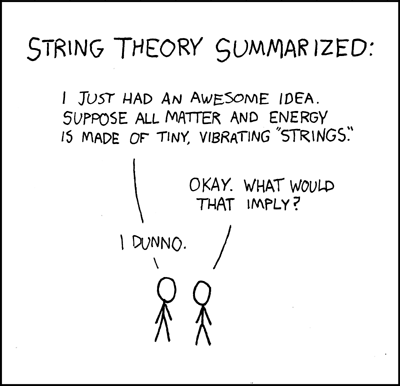
Next in the firing line: string theory ..... ( XKCD


Sunday, 24 April 2011

Higgs?

Rumours of the Higgs boson being found at LHC...

Not Even Wrong has this:

This Week’s Rumor

A commenter on the previous posting has helpfully given us the abstract of an internal ATLAS note claiming observation of a resonance at 115 GeV. It’s the sort of thing you would expect to see if there were a Higgs at that mass, but the number of events seen is about 30 times more than the standard model would predict. Best guess seems to be that this is either a hoax, or something that will disappear on further analysis. But, since spreading well-sourced rumors is more or less in the mission statement of this blog, I think I’ll promote this to its own posting.

and Live Science has this:

Scientists Abuzz Over Controversial Rumor that God Particle Has Been Detected

Date: 22 April 2011 Time: 05:37 PM ET


A rumor is floating around the physics community that the world's largest atom smasher may have detected a long-sought subatomic particle called the Higgs boson, also known as the "God particle."
The controversial rumor is based on what appears to be a leaked internal note from physicists at the Large Hadron Collider (LHC), a 17-mile-long particle accelerator near Geneva, Switzerland. It's not entirely clear at this point if the memo is authentic, or what the data it refers to might mean — but the note already has researchers talking.

So, it is quite possible that ATLAS has detected Higgs at around 115GeV ... somewhere in line with the various theories of Higgs, now a long wait and much experimentation and sifting back through massive amounts of stored results. Would be quite something if it has been found, especially this far into the LHC's operation and long before 14TeV collisions - some exciting physics coming up and possible confirmation of the Standard Model (to some degree)!