Showing posts with label Physics. Show all posts

Saturday, 29 September 2012

Solar Flare Video

Found this via Phil Plait's amazing Bad Astronomy blog*:

On August 31st the Sun produce an immense solar flare:  click here for a picture from Nasa with the Earth to scale or better still just go straight to the 1900x1200 version. I've made a crop of the picture below just to give a teaser:**


Now Nasa and the Goddard Space Flight Center have released a video of the event:


Make it full-screen and switch to 1080p, sit back and be impressed....


* You really should read this blog every day
** Using NASA Imagery and Linking to NASA Web Sites

Wednesday, 4 July 2012

Higgs Found

Fantastic news from Cern regarding the Higgs this morning - congratulations to all involved. Here's the press released:

CERN experiments observe particle consistent with long-sought Higgs boson

Geneva, 4 July 2012.

 At a seminar held at CERN1 today as a curtain raiser to the year’s major particle physics conference, ICHEP2012 in Melbourne, the ATLAS and CMS experiments presented their latest preliminary results in the search for the long sought Higgs particle. Both experiments observe a new particle in the mass region around 125-126 GeV.

...(see link above for full release)


Tuesday, 15 May 2012

Dimensional Analysis of Information


I’ve been looking at dimensional analysis as a technique to use for analyzing information flows, specifically for privacy.

After developing various taxonomies for information classification and some of the superstructure behind these (see here). One of the problems we have seen is trying to evaluate information content from ontologies and data schemata and deciding whether in ontology X, the field “name” has the same (or similar) semantics to a similarly named field in ontology Y.

Inspired by the technique of dimensional analysis, one idea is to consider each ontology as you would a system of units of measurement, eg: imperial units versus metric units. What dimensional analysis does is to abstract away from the units of measurement and into a small set of base or fundamental aspects. Typically these are length, mass and time denoted [L][M] and [T].

For example, acceleration has dimensions [L][T]-2  which using a system of measurements might be expressed as: metres per second per second or furlongs per day per aeon (just to mix things up).

When working with information systems and especially in the case of privacy where we need to classify information we can construct a set of “dimensions”. Choice of these is somewhat arbitrary – or at least they should have some aspect of orthogonality (I said this was inspired by dimensional analysis!).

The dimensions I chose were: Personal, Financial, Health, Time, Location, Identity and Content

Aside: To save on space an hint to the dimensional analysis inspiration, I'll use the first letter of the dimension name inside square brackets [ and ]...

We can have huge debates (and we did) about whether these are truly orthogonal and what happens when data elements or types are mapped to more than one 'dimension' - I don't think it matters too much at the moment, so let's put some of those difficulties aside.

Actually each of these is a top-level class in a taxonomy of information classification. For example, dimension the [P] breaks down into Demographics ([P_D]) and Contact ([P_C]), other classes follow similarly – as shown in the diagram below:

Information Type Taxonomy
Given a data schema we can map this schema into its dimensions in much the same was as done with physical quantities, for example the schema:

UserID x DeviceID x CellID x Timestamp x Age

Would be mapped to: [I]3[T][P]   meaning 3 units of identifiers, one of time and one of personal information. Actually as I stated earlier we actually have a hierarchy of dimensions so we might break down to: [I_P][I]2[T][P_D]  where [I_P] is a personal identifier and [P_D] is demographics, each being a sub classification of the [I] and [P].

The kinds of analysis that can be made are the quick identification of critical information content issues, such as in the above case we have a mix of identities which allows for potentially very precise identification. We have time involved which might allow profiling or tracking and an element of personal (demographic) information.

Furthermore we even have the chance that one identifier can be mapped to a location: CellIDs can easily be transformed into GPS coordinates and over time fairly easily be triangulated, especially when in an area densely populated by mobile base stations. Actually the above example could be mapped as [I]2[L][P] and indeed for a given data-schema being expressably in more than one dimensional form does raise some interesting concerns.

If we have some functions that process data, say a function that anonymises identities (we can have the discussion what anonymisation means later – please don’t mention hashing functions!) then application of this might result in our original dimensions [I]3[T][P] being mapped via that anonymisation function to [I]2[T][P] – an improvement in terms of moving towards anonymity maybe.

And so on....now whether this is really is dimensional analysis is another thing altogether, I doubt it largely in the current form and certainly I've made no major effort into properties of dimensional analysis such as commensurability or other mathematical properties. I'm also wondering if that other favorite of mine - entropy - can be put in here somewhere, as a coefficient to the dimension possibly? I think that might be taking things too far and is ultimately confusing concepts.

I've had some successes in terms of applying this to data-flow modelling of information flows and a couple of interesting results when we've discussed things such as legal consents, the application of a content to data and processing of that data. For example, take the humble IP address or CellID from the above example....the dimension of these is [I] (actually I have some subclass of Identity which deals with machine addresses), however both can be mapped to [L] fairly easily. Things such as expressing in a consent that we don't identify the source of information could mean mapping such things to other 'types' in other dimensions and actually end up not preserving privacy or even accidentally revealing more semantically interesting content...

Tuesday, 13 December 2011

Higgs

A wonderful moment in physics:

We may have glimpsed the Higgs boson, say Cern scientists

Physicists have seen strong hints the Higgs boson exists, but a firm discovery may not come before the end of 2012

Scientists could have caught their first glimpse of the Higgs boson, the curious particle thought to underpin the subatomic workings of nature.

Hundreds of physicists crowded into a seminar room at Cern, the European particle physics laboratory near Geneva on Tuesday, breaking into applauseas Fabiola Gianotti and Guido Tonelli, who lead separate teams at Cern's Large Hadron Collider (LHC), revealed evidence for the particle amid the debris of hundreds of trillions of proton collisions at the machine.

Tuesday, 6 December 2011

Higgs for Christmas?

Rumours abound of Higgs...maybe as a Christmas present?

A 125-126 GeV Higgs?

Posted on December 2, 2011 by woit
Some more detail on Higgs rumors I’ve been hearing recently. Evidently the latest ATLAS data shows an excess in the gamma-gamma channel around 126 GeV, of the size expected if the Higgs is there, and CMS is also seeing an excess (2 sigma?) around 125 GeV in the same channel.

What would a Higgs at 125 GeV tell us?

The rumours tell us that next week ATLAS and CMS will announce a strong but inconclusive signal for the Higgs boson at about 125 GeV. This may be wrong and even if it is right there may be other candidate signals to think about, and it will take much more data to verify that the signal is indeed correct for the Higgs, but if it is right, what then are the implications of the Higgs at this mass?

Is the Higgs boson real?

Rumours abound that Cern scientists have finally glimpsed the long-sought Higgs boson. We asked physicists to share their thoughts on the elusive entity

Saturday, 19 November 2011

Higgs by Christmas?

Maybe Christmas 2011...Nature has an article - Higgs Hunt Enters Endgame - about analysing the final set of data that may, or may not, prove the existance of Higgs:

I'd like to have posted a little of the article, but while (and I applaud this!) Nature allows a small text extract, it does require that I sign up to Rightslink ... so much for citation and reasonable use...


New Physics?

First hints of "the new physics"?  At least these results are becoming more public but still not at the statistical level where they become official, however news of CP violation at this magnitude is extremely interesting. First the BBC's report on this (readable by the layman):


LHC reveals hints of 'new physics' in particle decays
15 November 2011 Last updated at 12:18 GMT
By Jason Palmer Science and technology reporter, BBC News

Large Hadron Collider researchers have shown off what may be the facility's first "new physics" outside our current understanding of the Universe. Particles called D-mesons seem to decay slightly differently from their antiparticles, LHCb physicist Matthew Charles told the HCP 2011 meeting on Monday.  The result may help explain why we see so much more matter than antimatter. The team stresses that further analysis will be needed to shore up the result. At the moment, they are claiming a statistical certainty of "3.5 sigma" - suggesting that there is less than a 0.05% chance that the result they see is down to chance. The team has nearly double the amount of data that they have analysed so far, so time will tell whether the result reaches the "five-sigma" level that qualifies it for a formal discovery

and the report from CERN itself:

Charming surprise
The Bulletin - Issue No. 45-46/2011 - Monday 7 November 2011

The CP violation in charm quarks has always been thought to be extremely small. So, looking at particle decays involving matter and antimatter, the LHCb experiment has recently been surprised to observe that things might be different. Theorists are on the case.

The study of the physics of the charm quark was not in the initial plans of the LHCb experiment, whose letter “b” stands for “beauty quark”. However, already one year ago, the Collaboration decided to look into a wider spectrum of processes that involve charm quarks among other things.

The LHCb trigger allows a lot of these processes to be selected, and, among them, one has recently shown interesting features. Other experiments at b-factories have already performed the same measurement but this is the first time that it has been possible to achieve such high precision, thanks to the huge amount of data provided by the very high luminosity of the LHC. “We have observed the decay modes of the D0, a particle made up of a charm quark plus a u antiquark”, explains Pierluigi Campana, LHCb Spokesperson. “In particular, we have studied and combined the decay rates of the D0 and its antiparticle. According to the theory of the Standard Model, we should have measured a very small value of a parameter known as Delta ACP that is calculated using these decay rates and is related to the properties of matter and antimatter. We found that Delta ACP is around 0.8% instead of the predicted 1‰ (or less). Although making precise evaluations in processes involving charm quarks is difficult, the Delta ACP parameter appears to be much higher than expected”.

Finally, Ars Technica has an overall write-up on the FTL neutrinos, CP violation and Higgs:


It has been a busy week in the world of particle physics, with attention focused on the home of the LHC: CERN. This year, the LHC generated five inverse femtobarns worth of data—nearly half the amount generated during the entire lifetime of the Tevatron—before shutting down the proton program a few weeks ago. From now until its scheduled winter shutdown, the LHC will be doing lead ion collisions to examine the quark-gluon interactions that dominated the Universe immediately after the Big Bang.

Friday, 18 November 2011

Neutrinos

Neutrinos are wierd things (see here) ... and the faster-than-light results from last month have been reanalysed and new experiements taken place...with the same results.

Possibly, there are still some questions regarding gravitational effects but this second set of experiements is still showing the same results.

Now, I wonder when Higgs will turn up?


Wednesday, 31 August 2011

Higgs?

This Week’s Rumor from Not Even Wrong

A commenter on the previous posting has helpfully given us the abstract of an internal ATLAS note claiming observation of a resonance at 115 GeV. It’s the sort of thing you would expect to see if there were a Higgs at that mass, but the number of events seen is about 30 times more than the standard model would predict. Best guess seems to be that this is either a hoax, or something that will disappear on further analysis. But, since spreading well-sourced rumors is more or less in the mission statement of this blog, I think I’ll promote this to its own posting.

Tuesday, 30 August 2011

More Higgs and an explanation...

Excellent explanation of what Higgs is and why it matters (link to PDF slide set):
The Higgs Boson Lecture
Physics and Art Summer Institute 2010
Derek Robbins
August 4, 2010
and a host more interesting lectures and presentations here.


Sunday, 28 August 2011

End of a theory? Sypersymmetry and the LHC

Now this really could change things, as reported via the BBC:

LHC results put supersymmetry theory 'on the spot'
By Pallab Ghosh, Science correspondent, BBC News
Results from the Large Hadron Collider (LHC) have all but killed the simplest version of an enticing theory of sub-atomic physics. Researchers failed to find evidence of so-called "supersymmetric" particles, which many physicists had hoped would plug holes in the current theory.

As sympersymmetry (SUSY) or or correctly in this case the Minimal Supersymmetric Standard Model seems not to be true then we're in for some radical changes in particle physics.

Recently, LHC narrowed the range of the mass of Higgs to 115-140GeV which itself is suggesting that the Higgs mechanism might have to have change or that there could be a number of Higgs in there. Some are now even pushing the claim that Higgs might not exist at all which in the light of the M-SUSY results would radically change our understanding of physics.


Trouble is, SUSY and the standard model have a long history, very beautiful mathematics and very good predictive powers...and who said science was boring?

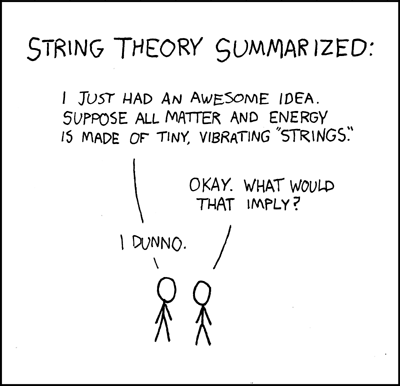
Next in the firing line: string theory ..... ( XKCD


Monday, 31 January 2011

Atomic disguise makes helium look like hydrogen - physics-math - 28 January 2011 - New Scientist

Atomic disguise makes helium look like hydrogen
Atomic disguise makes helium look like hydrogen - physics-math - 28 January 2011 - New Scientist

18:37 28 January 2011 by Kate McAlpine

In a feat of modern-day alchemy, atom tinkerers have fooled hydrogen atoms into accepting a helium atom as one of their own. The camouflaged atom behaves chemically like hydrogen, but has four times the mass of normal hydrogen, allowing predictions for how atomic mass affects reaction rates to be put to the test.

Thursday, 7 January 2010

Physics, Topology, Logic and Computation: A Rosetta Stone

This has been around for a while in the draft form, but now there's a (re)post on Lambda the Ultimate for the forthcoming book(?):
Physics, Topology, Logic and Computation: A Rosetta Stone
John C. Baez and Mike Stay, 2009.
Mentioned in the discussions are two other papers linked here:

Saturday, 19 December 2009

PC World...

Its well known that the staff in major PC retailers aren't the most qualified when it comes to computers (its a favourite pasttime of computer science students to bait these guys for fun on a Saturday afternoon), so I'm not sure whether this story from the immimical NewsBiscuit is truth or irony...

Nobel Prize for Physics awarded to part-time PC World assistant

Posted: Dec 19th, 2009 by roybland

Mr Ward, who works at his local PC World at weekends, said he was ‘gob smacked’ on receiving the letter informing him of his success. ‘It was awesome,’ he told journalists. ‘I knew I’d done something pretty cool, but I didn’t think I had a chance of a Nobel Prize. But, looking back, I suppose it was pretty groundbreaking for a PC World guy to give out correct technical information.’