
A collection of discussions, links, stories, news and whatever else I find interesting in the fields of computing, information, science, privacy, semantics, mathematics and so on...
Showing posts with label Science. Show all posts
Showing posts with label Science. Show all posts
Tuesday, 15 November 2016
Privacy Engineering for Today - DIMECC Presentation
Here is my presentation from the DIMECC 9th Annual Seminary on Business innovation in Finland.


Wednesday, 10 February 2016
Horses Understand Human Emotions
A paper from the University of Sussex that shows that horses 'understand' human emotions [1] has been published - a layman's version can be found on the BBC. To some degree this is probably quite well known by horse people, even taking into account that humans tend to project their emotions and anthropomorphise their pets.
While you could take the cynical, sensationalist approach by a certain UK newspaper (if you read the comments to the article then this is a crisis in the equine world brought on my left-wing, migrant, EU bureaucrats seeks to steal UK jobs and entitlements), this actually is quite fascinating research.
For a start, looking at this piece of work then it confirms a number of facts about horses, namely that being a domesticated animal they have either evolved an ability, or, used an innate ability (due to their existence as herd animals) to understand humans; in much the same way as dogs.
In a more general sense it also confirms some aspects that we've suspected about how the brain works regarding how emotions are processed. Though more interestingly while it answers some questions it opens up a whole new set of questions about how the brain works.
When reading work such as this, the experiment might be very small and limited in nature, it does open huge questions about, in this case, emotion processing in the brain, the evolution of cross-species communication, whether emotions (or certain emotions) are fundamental in nature, aspects of the human-horse relationship since early domestication etc.
References
[1] Amy Victoria Smith, Leanne Proops, Kate Grounds, Jennifer Wathan, Karen McComb (2016)
Functionally relevant responses to human facial expressions of emotion in the domestic horse (Equus caballus). Biology Letters Published 10 February 2016.DOI: 10.1098/rsbl.2015.0907
While you could take the cynical, sensationalist approach by a certain UK newspaper (if you read the comments to the article then this is a crisis in the equine world brought on my left-wing, migrant, EU bureaucrats seeks to steal UK jobs and entitlements), this actually is quite fascinating research.
For a start, looking at this piece of work then it confirms a number of facts about horses, namely that being a domesticated animal they have either evolved an ability, or, used an innate ability (due to their existence as herd animals) to understand humans; in much the same way as dogs.
In a more general sense it also confirms some aspects that we've suspected about how the brain works regarding how emotions are processed. Though more interestingly while it answers some questions it opens up a whole new set of questions about how the brain works.
When reading work such as this, the experiment might be very small and limited in nature, it does open huge questions about, in this case, emotion processing in the brain, the evolution of cross-species communication, whether emotions (or certain emotions) are fundamental in nature, aspects of the human-horse relationship since early domestication etc.
References
[1] Amy Victoria Smith, Leanne Proops, Kate Grounds, Jennifer Wathan, Karen McComb (2016)
Functionally relevant responses to human facial expressions of emotion in the domestic horse (Equus caballus). Biology Letters Published 10 February 2016.DOI: 10.1098/rsbl.2015.0907
Friday, 23 October 2015
Historial Navigation Techniques in the US Navy
This is an interesting development: a reintroduction of an "historical" technique to ostensibly address a problem introduced by a technology to make things simple(r).
The same techniques guided ancient Polynesians in the open Pacific and led Sir Ernest Shackleton to remote Antarctica, then oriented astronauts when Apollo 12 was disabled by lightning - the techniques of celestial navigation.
A glimmer of the old lore has returned to the Naval Academy.
Officials reinstated brief lessons in celestial navigation this year, nearly two decades after the full class was determined outdated and cut from the curriculum.
That decision, in the late 1990s, made national news and caused a stir among the old guard of navigators.
Maritime nostalgia, however, isn't behind the return.
Rather, the escalating threat of cyberattacks has led the Navy to dust off its tools to measure the angles of stars.
After all, you can't hack a sextant.
Putting the political aspects of the GPS system aside, it is a single point of failure for navigation, at least until Galileo and GLONASS are properly supported by navigation devices. Furthermore, as the article mentions, the GPS system is open to attack from various vectors. The use of "legacy" (I love that word - It doesn't mean obsolete!) technologies such as the sextant address many of these issues.
For me the main thing here is that the sextant forces understanding of navigation - quite literally how coordinates are calculated which is something missing from GPS.
In other words, don't rely upon technology, or if you do, you'd better know how to drop back a level of automation...sounds familiar...it is the basic premise of the 'Children of the Magenta' talk by American Airlines (see here for an earlier blog posting, the video might be available on YouTube somewhere).
In other words, don't rely upon technology, or if you do, you'd better know how to drop back a level of automation...sounds familiar...it is the basic premise of the 'Children of the Magenta' talk by American Airlines (see here for an earlier blog posting, the video might be available on YouTube somewhere).
Wednesday, 21 October 2015
Happy Time Travelling Day
As today is the day when Marty McFly arrives in the future (or present as it is now - at least until tomorrow) I thought it might be fun to reference back to the only thing that makes Titanic a bearable film...the fact that it is a prequel to Terminator.
If Jack hadn't saved Rose then the ship would have turned around in search for her, thereby avoiding the collision with the iceberg...and all the things that would have entailed from that.
Obviously Jack's mission was to save Rose - presumably she's somehow related to Sarah Connor - and unfortunately 1500 people die in the collateral damage.
Don't believe me, go read the thread on Reddit
I particularly like the idea that Jack is really The Doctor rescuing a relation to a future potential companion...Rose... :-)
Now scientists have searched for time travellers making comments on social media, apparently without success. But then again time travellers might have very strict rules about such things...as seen in the 1992 film Timescape.
However there is evidence that Twitter featured on the cover of Amiga magazine in April 1988! Well, not quite..but you never know...
Anyway, next week's lottery numbers are 4,7,14,19,22,34 ... I think, sorry can't read my handwriting...
...oh, and I shouldn't say this, but next week James Cameron told me last week he was a time traveller....
#ICanChangeThePast2
#ICannotChangeThePast2
If Jack hadn't saved Rose then the ship would have turned around in search for her, thereby avoiding the collision with the iceberg...and all the things that would have entailed from that.
Obviously Jack's mission was to save Rose - presumably she's somehow related to Sarah Connor - and unfortunately 1500 people die in the collateral damage.
Don't believe me, go read the thread on Reddit
I particularly like the idea that Jack is really The Doctor rescuing a relation to a future potential companion...Rose... :-)
Now scientists have searched for time travellers making comments on social media, apparently without success. But then again time travellers might have very strict rules about such things...as seen in the 1992 film Timescape.
However there is evidence that Twitter featured on the cover of Amiga magazine in April 1988! Well, not quite..but you never know...
Anyway, next week's lottery numbers are 4,7,14,19,22,34 ... I think, sorry can't read my handwriting...
...oh, and I shouldn't say this, but next week James Cameron told me last week he was a time traveller....
#ICanChangeThePast2
#ICannotChangeThePast2
Thursday, 24 September 2015
Pluto in colour
Just released colour image of Pluto...and you thought last week's image was incredible...

http://www.nasa.gov/sites/default/files/thumbnails/image/crop_p_color2_enhanced_release_small.png

Thursday, 19 March 2015
Messenger at Mercury .. the "end game"
A long time ago, and probably one of the reasons I started writing this blog, Messenger arrived, or more correctly made a fly-by of Mercury. Now after many years NASA plan some audacious manoeuvres before they finally crash Messenger into Mercury.
Sad to see Messenger's mission end, but the results have been amazing. You can read about the planned hovering and low passes at Science Daily.
Sad to see Messenger's mission end, but the results have been amazing. You can read about the planned hovering and low passes at Science Daily.
Tuesday, 30 September 2014
Wither the Privacy Hero...
The Hero in computing is a well known phenomena - think of the lone programmer, sysadmin or hacker for example. However the hero also occurs in all domains including privacy. The privacy hero is the one who has hand crafted the privacy policy, set down in stone a lengthly list of privacy requirements and compliance activies without consulting the engineers and users who have to implement and use these.
As many disciplines, especially that of medicine, have discovered, the hero is the most dangerous person there is. By working against the odds, he (or she) usually creates a victory where all is solved [1]. Be it uring a patient or creating the rules by which the company is saved from an inglorious admission of a data breach. Even if there is a breach or the patient later dies, it can't be the hero's fault, but the others such as the failed care of the nurses or the engineers who never listened. In reality the nurses and the engineers are usually patching the damages caused by the hero.
Our current cultural setups in privacy, and especially now we're starting to get engineers actively involved in the privacy debate, needs to change from the Privacy Heros to a much tightly integrated team of experts.
In [2], Atul Gawande clearly states that the nurses, technicians and other personel "work for" the hero doctor. In privacy we still have the same attitude, software engineers "work for" the Privacy Officers.
We suffer from a huge lack of teamwork - the privacy hero's word is the Truth and that's it. Within the current culture of privacy, the engineers who are battling to implement or even comprehend privacy requirements written and explained at a completely different level of asbtraction than is necessary do not play any major part in those requirements.
Consider the defintions of personal data or PII for example, have these even been properly grounded in the undelying mathematical theories of what information is; or even for that matter in terms that can be properly understood by software engineers in their domain. Even within the legal domain, these terms have been defined in such a way that they are underspecified and open to legal interpretation.
In order to move from a highly ineffective privacy priesthood to a true, all encompasing and all relevant discipline based on a mutually supporting combination of legal, scientific and engineering principles we must change our culture from that of the Hero to that of the Team.
References
[1] Suzanne Gordon, Patrick Mendenhall and Bonnie Blair O'Connor. Beyond the Checklist
[2] Atul Gawande, Better
[3] Ian Oliver. Privacy Engineering: A Dataflow and Ontological Approach.
As many disciplines, especially that of medicine, have discovered, the hero is the most dangerous person there is. By working against the odds, he (or she) usually creates a victory where all is solved [1]. Be it uring a patient or creating the rules by which the company is saved from an inglorious admission of a data breach. Even if there is a breach or the patient later dies, it can't be the hero's fault, but the others such as the failed care of the nurses or the engineers who never listened. In reality the nurses and the engineers are usually patching the damages caused by the hero.
Our current cultural setups in privacy, and especially now we're starting to get engineers actively involved in the privacy debate, needs to change from the Privacy Heros to a much tightly integrated team of experts.
In [2], Atul Gawande clearly states that the nurses, technicians and other personel "work for" the hero doctor. In privacy we still have the same attitude, software engineers "work for" the Privacy Officers.
We suffer from a huge lack of teamwork - the privacy hero's word is the Truth and that's it. Within the current culture of privacy, the engineers who are battling to implement or even comprehend privacy requirements written and explained at a completely different level of asbtraction than is necessary do not play any major part in those requirements.
Consider the defintions of personal data or PII for example, have these even been properly grounded in the undelying mathematical theories of what information is; or even for that matter in terms that can be properly understood by software engineers in their domain. Even within the legal domain, these terms have been defined in such a way that they are underspecified and open to legal interpretation.
In order to move from a highly ineffective privacy priesthood to a true, all encompasing and all relevant discipline based on a mutually supporting combination of legal, scientific and engineering principles we must change our culture from that of the Hero to that of the Team.
References
[1] Suzanne Gordon, Patrick Mendenhall and Bonnie Blair O'Connor. Beyond the Checklist
[2] Atul Gawande, Better
[3] Ian Oliver. Privacy Engineering: A Dataflow and Ontological Approach.
Sunday, 3 August 2014
Messenger 10 year Anniversary
One of the first posts I made on this blog was about the Messenger probe to Mercury - at the time it had just made the 3rd fly-by before orbit insertion about 18 months later. On 1st August it celebrated 10 years since its launch.
So a large beer to all involved!
So now we have Messenger at Mercury, Venus Express performing dangerous aerobraking manoeuvres in Venus' atmosphere, a fleet robots trundling over Mars - not forgetting a small fleet of satellites around the planet, Juno on its way to Jupiter and venerable Cassini still going strong around Saturn.
Then there are the three that I'm most anticipating:

So a large beer to all involved!
So now we have Messenger at Mercury, Venus Express performing dangerous aerobraking manoeuvres in Venus' atmosphere, a fleet robots trundling over Mars - not forgetting a small fleet of satellites around the planet, Juno on its way to Jupiter and venerable Cassini still going strong around Saturn.
Then there are the three that I'm most anticipating:
- Dawn's arrival at Ceres in February 2015
- New Horizons arrival, or rather fly-by, of Pluto in July 2015
Can't wait!
In the meantime:

Monday, 28 July 2014
Privacy Engineering Book
Privacy Engineering
A dataflow and ontological approach
An essential companion book for those of us who have to model systems from small mobile apps to large, cloudified BigData system from the perspective of privacy and personal data handling.
Available via Amazon (US, UK and all Amazon worldwide sites), CreateSpace and selected bookstores such as Barnes and Noble. Kindle version available, also with Kindle Match Book enabling you to the Kindle version for just 2.99USD when purchasing the paperback.

- Introduction
- Case Study
- Privacy Engineering Process Structure
- Data Flow Modelling
- Security and Information Classifications
- Additional Classification Structures
- Requirements
- Risk and Assessments
- Notice and Consent
- Privacy Enhancing Techniques
- Auditing and Inspections
- Developing a Privacy Programme
Only through properly modelling the system under development can we full appreciate the complexity of where personal data and information flows; and more importantly, effectively communicate this. This book presents an approach based upon data flow modelling, coupled with standardised terminological frameworks, classifications and ontologies to properly annotate and describe the flow of information into, out of and across these systems.
Also provided are structures and frameworks for the engineering process, requirements and audits; and even the privacy programme itself, but takes a pragmatic approach and encourages using and modifying the tools and techniques presented as the local context and needs require.
Published July 2014
ISBN-13: 978-1497569713
ISBN-10: 1497569710
264 Pages, B/W on White Paper
ISBN-10: 1497569710
264 Pages, B/W on White Paper
Monday, 19 May 2014
Foundations of Privacy - Another Idea
This got triggered by a post on LinkedIn about what a degree in privacy might contain. I've certainly thought about this before, at least in terms of software engineering, and even have a whole course that could be taken over a semester ready to go.
Aside: CMU has the "World's First Privacy Engineering Course": a Master of Science in Information Technology—Privacy Engineering (MSIT-PE) degree. So, close, but a major university here in Finland turned down the chance to create something similar a few years back...
Aside: CMU has the "World's First Privacy Engineering Course": a Master of Science in Information Technology—Privacy Engineering (MSIT-PE) degree. So, close, but a major university here in Finland turned down the chance to create something similar a few years back...
That aside, I've been wondering about how to present they various levels of things we need to consider to properly define privacy and put it on strong foundations. Though in the guise of information theory we already have this, though admittedly Shannon's seminal work from the 1930's is maybe a little too deep. On the other hand understanding concepts such as channels, entropy are fundamental building blocks, so maybe they should be there along with privacy law - now that would make some course!
Even just sketching out areas to present and what might be contained therein...how about this, even if a linear map from morality to mathematics is too constraining?

There are missing bits - we still have a semantic gap between the "legal world" and the "engineering world"; parts that I'm hoping that things such as the many conferences, academic works and books such as the excellent Privacy Engineer's Manifesto and Privacy Engineering will play a role in defining. Maybe the semantic gap goes away once we start looking at this...is there even a semantic gap?
However, imagine for a moment starting anywhere in this stack and working up and down and keeping everything linked together in the context of privacy and information security. Imagine seeing the link between EU privacy laws and type theory, or between the construction of policies and entropy, the algebra of HIPAA, a side course in homotopy type theory and privacy...maybe with that last one I'm getting carried away, but, this is exactly what we need to have in place.
Each layer provides the semantics to the layer above - what do our morals and ethics means in terms of formalised laws, what do laws mean in terms of policies, what do policies mean in terms of software engineering structures, and down to the core mathematics and algebras of information.
Privacy and privacy engineering in particular almost has everything: law, algebra, morals, ethics, semantics, policy, software, entropy, information, data, BigData, Semantic Web etc etc etc. Furthermore, we have links to areas such as security, cryptography, economic theory etc!
Aren't these the very things any practitioner of privacy (engineering) should know, or at least have knowledge of? Imagine if lawyers understood information theory and semantics, and, software engineers understood law?
OK, so there might be various ways of putting this stack together, competing theories of privacy etc, but that would be the real beauty here - a complete theory of privacy from the core mathematics through physics, computation, type theory, software engineering, policies, law and even ethics and morals.
But again, no more naivety, no more terminological or ontological confusions, policies and laws being traceable right down to the computation structures and code. Quite a tall order, but such a course bringing all these together really would be wonderful...
And wouldn't that be something!
Wednesday, 11 December 2013
Earth and Moon from Juno
Somewhat stunning (understatment!) video made from Juno's low resolution camera during its Earth fly-by back in October:
Thanks to Phil Plait of Bad Astronomy once again...and just to think that every human that has ever lived existed in and no human has even travelled beyond the frames in that video...
Thanks to Phil Plait of Bad Astronomy once again...and just to think that every human that has ever lived existed in and no human has even travelled beyond the frames in that video...
Wednesday, 30 October 2013
Diagrams Research
For a number of years I and some colleagues have worked closely with the University of Brighton's Visual Modelling Group using their work on diagrammatic methods of modelling and reasoning. One of the areas where we've had quite a nice success is in modelling aspects of information privacy [1] with some particularly useful and beautiful and natural representations of complex ideas and concepts.
Another area has been in the development of ontologies and classification systems - something quite critical in the area of information management and privacy. Some of this dates back to work we made with the M3 project and the whole idea of SmartSpaces incorporating the best of the Semantic Web, Big Data etc.
We've gained quite a considerable amount of value out of this relatively, simple industrial-academic partnership. A small amount of funding, no major dictatorial project plans but just letting the project and work develop naturally, or even if you like, in an agile manner, produces some excellent, useful and mutually beneficial results.
Indeed not having a project plan but just a clearly defined set of things that we need addresses and solved (or just tackled - many minds with differing points of view really does help!) means that both partners: the industrial and the academic, can get on with the work rather than battling an artificial project plan which becomes increasingly irrelevant and industrial focus and academic ideas change over time. Work continues with more ontology engineering in the OntoED project.
References:
Another area has been in the development of ontologies and classification systems - something quite critical in the area of information management and privacy. Some of this dates back to work we made with the M3 project and the whole idea of SmartSpaces incorporating the best of the Semantic Web, Big Data etc.
We've gained quite a considerable amount of value out of this relatively, simple industrial-academic partnership. A small amount of funding, no major dictatorial project plans but just letting the project and work develop naturally, or even if you like, in an agile manner, produces some excellent, useful and mutually beneficial results.
Indeed not having a project plan but just a clearly defined set of things that we need addresses and solved (or just tackled - many minds with differing points of view really does help!) means that both partners: the industrial and the academic, can get on with the work rather than battling an artificial project plan which becomes increasingly irrelevant and industrial focus and academic ideas change over time. Work continues with more ontology engineering in the OntoED project.
References:
- I. Oliver, J. Howse, G. Stapleton. Protecting Privacy: Towards a Visual Framework for Handling End-User Data. IEEE Symposium on Visual Languages and Human-Centric Computing, San Jose, USA, IEEE, September, to appear, 2013.
- I. Oliver, J. Howse, G. Stapleton, E. Nuutila, S. Torma. Visualising and Specifying Ontologies using Diagrammatic Logics. In proceedings of 5th Australasian Ontologies Workshop, Melboune, Australia, CRPIT vol. 112, December, pages 37-47, 2009. Awarded Best Paper
- J. Howse, S. Schuman, G. Stapleton, I. Oliver. Diagrammatic Formal Specification of a Configuration Control Platform. 2009 Refinement Workshop, pages 87-104, ENTCS, November, 2009.
- I. Oliver, J. Howse, G. Stapleton, E. Nuutila, S. Torma. A Proposed Diagrammatic Logic for Ontology Specification and Visualization. 8th International Semantic Web Conference (Posters and Demos), October, 2009.
- J. Howse, G. Stapleton, I. Oliver. Visual Reasoning about Ontologies.International Semantic Web Conference, China, November, CEUR volume 658, pages 5-8, 2010.
- P. Chapman, G. Stapleton, J. Howse, I. Oliver. Deriving Sound Inference Rules for Concept Diagrams. IEEE Symposium on Visual Languages and Human-Centric Computing, Pittsburgh, USA, IEEE, September, pages 87-94, 2011.
- G. Stapleton, J. Howse, P. Chapman, I. Oliver, A. Delaney. What can Concept Diagrams Say? Accepted for 7th International Conference on the Theory and Application of Diagrams 2012, Springer, pages 291-293, 2012.
- G. Stapleton, J. Howse, P. Chapman, A. Delaney, J. Burton, I. Oliver.Formalizing Concept Diagrams. 19th International Conference on Distributed Multimedia Systems, International Workshop on Visual Languages and Computing, Knowledge Systems Institute, to appear 2013.
Saturday, 27 July 2013
2001 again...
James Maynard Gelinas' blogpost on "Underground Research Initiative" entitled
2001: A Space Odyssey - Discerning Themes through Score and Imagery is a 22,000 word essay about the film 2001 and one certainly as worth reading as watching Kubrik's masterpiece.
2001: A Space Odyssey - Discerning Themes through Score and Imagery is a 22,000 word essay about the film 2001 and one certainly as worth reading as watching Kubrik's masterpiece.
In the 50 years since its release, while special effects have improved, the sheer grandeur of the film from many angles, especially that of science, has not diminished.
I can't say anything more other than what is already written in Gelinas' article, maybe than we got Facebook and Twitter instead, which given the effect of the Monolith in later books in Clarke's series might have been a good thing (though it seems that while 3001 told us how to destroy a Monolith, another movie used the idea - and a Macintosh - aliens (and humans too), beware of iPods).
OK, if I do add something, in 2001 you're probably going to see the best portrayal of a computer in any film (including ones using Macintoshes).
Maybe I should lobby Finnkino to show it on their number one screen in Helsinki....
Saturday, 11 May 2013
Topology, the periodic table and parasites
hree very interesting websites to amuse you. The first a homage to topology or as the author puts it:
 and applying various rules we can get beauties such as this below using the rule "n18n18n9n9n9soxO" in the notation used on the site:

The second is the every popular Element of the Week via the The Guardian newspaper. A fun introduction of the basic building blocks of chemistry and each week a new element. This week, the famous and well known element: astatine .
I recommend you check out caesium, rubidium, potassium and sodium for the sheer fun of watching those being dropped into water and reacting violently. Such experiments are now banned from schools for safety reasons, along with many other aspects of science unfortunately...
Failing that there's the Royal Society of Chemistry's Visual Elements Period Table which is great fun.
And finally, for the squeamish of you stop reading now, for the less squeamish its probably best to avoid mealtimes, but this is great:
Introducing a new beast more or less regularly (if not every day). To understand this site you can read their introduction which helpfully has no pictures to put you off your food.
"This is a toy for building complex 3D polyhedral shapes from simple ones by "recipes"polyHédronisme allows you to construct various polyhedral shapes (only 3 dimensions though!) by composing rules over various bases, for example starting with a plain octahedron


The second is the every popular Element of the Week via the The Guardian newspaper. A fun introduction of the basic building blocks of chemistry and each week a new element. This week, the famous and well known element: astatine .
I recommend you check out caesium, rubidium, potassium and sodium for the sheer fun of watching those being dropped into water and reacting violently. Such experiments are now banned from schools for safety reasons, along with many other aspects of science unfortunately...
Failing that there's the Royal Society of Chemistry's Visual Elements Period Table which is great fun.
And finally, for the squeamish of you stop reading now, for the less squeamish its probably best to avoid mealtimes, but this is great:
Parasite of the Day!
Introducing a new beast more or less regularly (if not every day). To understand this site you can read their introduction which helpfully has no pictures to put you off your food.
Thursday, 21 March 2013
Has space exploration become boring?
At the expense of evoking Betteridge's Law of Headlines - obviously space exploration isn't boring - and with Voyager 1 maybe leaving the Solar System, I was wondering what happened to the romance of space exploration.
Does anyone anymore sit up until the early hours of the morning as I did when Giotto encountered Halley, being amazed at Uranus' bizarre collection of moons, fascinated with the existence of nitrogen geysers on Triton, volcanoes on Io; does anyone (other than scientists working at NASA, ESA, JAXA etc) get overly excited these days at pictures from Mercury, Vesta etc?
Does anyone dream of what the Ice Giants explorer might have found at Uranus, or what creatures might live under the icy crust of Europa's ocean?
I remember (pre internet days) desperately waiting for pictures of Neptune, Triton, Miranda, Titan etc to appear in newspapers, books, news broadcasts. Even back in 1992 the joy of connecting to NASA ftp servers to download Voyager and Pioneer pictures of Saturn and it enigmatic, orange cloud enveloped moon Titan on the only Sun workstation with a colour display the university had, over a slow internet link. Watching in fascination as line-by-line the picture was displayed and possibly imagining oneself at JPL watching those raw pictures being received at Earth.
The Register has an article from yesterday on Voyager 1 (yes, still going since its launch in 1977!) which has the paragraph (emphasis mine):
Maybe this is it, in the 1970s we were optimistic - there were many missions planned: Pioneers 10 and 11, followed by Voyagers 1 and 2 to complete the Grand Tour of the Solar System; later with the first missions to comets, landers on Venus and Mars.
Maybe science just took center stage for a brief moment only to be replaced with the need for fame and appearing on X-Factor? Maybe a picture of the creme brulee surface of Titan from a small lander piggybacked on a probe that made a multi-billion mile tour via Venus, Earth, the Moon, an asteroid or two, Jupiter and finally to Saturn, just don't complete against today's media offerings?
How can you not be amazed by pictures like this - think about what you're looking at and what it took to get those pictures for a moment!

On the other hand a grainy picture of Titan from one of the Voyager probes offered mystery and a challenge to be solved - what is under those clouds? - now we get picture of sand grains on Mars. Have we accidentally removed the mystery? Or, have we lost the big exciting picture to a mass audience? A third possibility is that science is either not understood, or just can't complete with a crass, exploitative talent show...
Space exploration in any form is exciting...just listing some of the current probes:
Does anyone anymore sit up until the early hours of the morning as I did when Giotto encountered Halley, being amazed at Uranus' bizarre collection of moons, fascinated with the existence of nitrogen geysers on Triton, volcanoes on Io; does anyone (other than scientists working at NASA, ESA, JAXA etc) get overly excited these days at pictures from Mercury, Vesta etc?
Does anyone dream of what the Ice Giants explorer might have found at Uranus, or what creatures might live under the icy crust of Europa's ocean?
I remember (pre internet days) desperately waiting for pictures of Neptune, Triton, Miranda, Titan etc to appear in newspapers, books, news broadcasts. Even back in 1992 the joy of connecting to NASA ftp servers to download Voyager and Pioneer pictures of Saturn and it enigmatic, orange cloud enveloped moon Titan on the only Sun workstation with a colour display the university had, over a slow internet link. Watching in fascination as line-by-line the picture was displayed and possibly imagining oneself at JPL watching those raw pictures being received at Earth.
The Register has an article from yesterday on Voyager 1 (yes, still going since its launch in 1977!) which has the paragraph (emphasis mine):
Probably the most-loved survivor of 1970s space optimism, Voyager, has sent back signals indicating that it's left the heliosphere.
Maybe this is it, in the 1970s we were optimistic - there were many missions planned: Pioneers 10 and 11, followed by Voyagers 1 and 2 to complete the Grand Tour of the Solar System; later with the first missions to comets, landers on Venus and Mars.
Maybe science just took center stage for a brief moment only to be replaced with the need for fame and appearing on X-Factor? Maybe a picture of the creme brulee surface of Titan from a small lander piggybacked on a probe that made a multi-billion mile tour via Venus, Earth, the Moon, an asteroid or two, Jupiter and finally to Saturn, just don't complete against today's media offerings?
How can you not be amazed by pictures like this - think about what you're looking at and what it took to get those pictures for a moment!
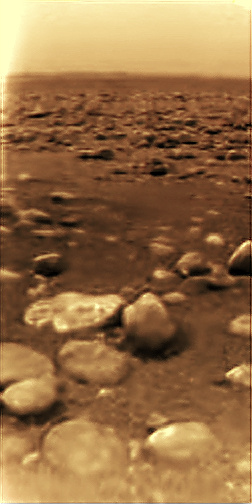
Wikimedia Commons, see: here

On the other hand a grainy picture of Titan from one of the Voyager probes offered mystery and a challenge to be solved - what is under those clouds? - now we get picture of sand grains on Mars. Have we accidentally removed the mystery? Or, have we lost the big exciting picture to a mass audience? A third possibility is that science is either not understood, or just can't complete with a crass, exploitative talent show...
Space exploration in any form is exciting...just listing some of the current probes:
- Dawn is on its way to Ceres after a successful encounter with Vesta.
- Messenger has completed mapping all of Mercury's surface and turned up just one or two (or freaking lots!) of major mysteries
- Cassini is still going strong around Saturn
- Juno on its way to Jupiter
- Venus Express still examining Earth's "twin"
- Numerous orbiters around Mars and not forgetting two (yes TWO!) working rovers on the surface
- Rosetta is still on its journey to 67P/Churyumov–Gerasimenko.
- China's moon probe made a detour to visit a near-Earth asteroid
- Hayabusa returning samples from an asteroid
- New Horizons still speeds to its all too rapid fly-by of Pluto and its now five moons (incidentally traveling at approx 15km per second or 34000mph)
- etc etc...
- oh, not forgetting Voyager 1 and the rest...
Tuesday, 5 March 2013
Weighting Metrics
I'm reading Richard Feynman's book What Do You Care What Other People Think? [1] - a fascinating account of the things that Feynman did and believed in: the power of science and the experiment (there's even a xkcd cartoon about that).
Feynman worked on the Challenger Commission which investigated why the shuttle Challenger exploded and concluded with the discovery of the O-ring failure in one of the solid rocket boosters. One of the most memorable incidents was Feynman's live O-ring in ice water experiment.
However, after dealing with metrics on various issues recently, a paragraph in the book where Feynman discovers the results of a go or no-go decision on the state of the O-rings under cold conditions. There are four named experts and four answers: 2 x no, 1 x yes, 1 x don't know - which effectively splits the vote 50-50 (for some reason don't know = yes).
However Feynman points out that the foremost experts on the properties of the O-rings both stated no and one of the four experts was not present at the original meeting. Taking this into account we get the following: 2w x no, 1v x yes, 1u x don't know, where w > v > u. Simple mathematics returns not a 50-50 split but a split where the no vote would overwhelm (even by a microscopic margin) the yes/don't know combined vote.
Suffice to say here that weighting of the inputs into the calculation here was critical to getting the righ results. This is not to say that finding the weights is not hard, but as we see in the case above even simple ordering would have sufficed.
The metrics are simple, the relevance and weighting unfortunately are forgotten and it is these that really tell you what the metrics mean and how to analyse them.
References
[1] Feynman R. (1988) What Do You Care What Other People Think? Penguin Books. 978-0-141-03088-3
Feynman worked on the Challenger Commission which investigated why the shuttle Challenger exploded and concluded with the discovery of the O-ring failure in one of the solid rocket boosters. One of the most memorable incidents was Feynman's live O-ring in ice water experiment.
However, after dealing with metrics on various issues recently, a paragraph in the book where Feynman discovers the results of a go or no-go decision on the state of the O-rings under cold conditions. There are four named experts and four answers: 2 x no, 1 x yes, 1 x don't know - which effectively splits the vote 50-50 (for some reason don't know = yes).
However Feynman points out that the foremost experts on the properties of the O-rings both stated no and one of the four experts was not present at the original meeting. Taking this into account we get the following: 2w x no, 1v x yes, 1u x don't know, where w > v > u. Simple mathematics returns not a 50-50 split but a split where the no vote would overwhelm (even by a microscopic margin) the yes/don't know combined vote.
Suffice to say here that weighting of the inputs into the calculation here was critical to getting the righ results. This is not to say that finding the weights is not hard, but as we see in the case above even simple ordering would have sufficed.
The metrics are simple, the relevance and weighting unfortunately are forgotten and it is these that really tell you what the metrics mean and how to analyse them.
References
[1] Feynman R. (1988) What Do You Care What Other People Think? Penguin Books. 978-0-141-03088-3
Thursday, 22 November 2012
Information Privacy: Art or Science?
I was handed a powerpoint deck today containing notes for a training course on privacy. One thing that struck me was the statement on one of the slides, in fact it was the only statement on that slide:
This troubles me greatly and the interpretation of this probably goes a long way into explaining some things about the way information privacy is perceived and implemented.
What do we mean by art, and does this mean that privacy is not a science?
Hypothesis 1: Privacy is an art
If you've ever read great code it is artistic in nature. You can appreciate the amount of understanding and knowledge that has gone into writing that code. Not just at the act of writing, or the layout and indentation, but in the design of the algorithms, the separation of concerns, the holistic bigger picture of the architecture. Great code requires less debugging, performs well, stays in scope, and if it ever does require modification, it is easy to do. Great programmers are scientists - they understand the value to the code, they avoid technical debt, they understand the theory (maybe only implicitly) and the science and discipline behind their work and in that respect they are the true artists of their trade.
For example, Microsoft spent a lot of effort in improving the quality of its code with efforts such as those the still excellent book Code Complete by Steve McConnell. This book taught programmers great techniques to improve the quality of their code. McConnell obviously knew what works and what didn't from a highly technical perspective based on a sound, scientific understanding of how code works, how code is written, how design is made and so on.
I don't think information privacy is an art in the above sense.
Hypothesis 2: Privacy is an "art".
In the sense that you're doing privacy well in much the same was as a visitor to an art gallery knows "great art". Everyone has their own interpretation and religious wars spring forth over whether something is art or not.
Indeed here is the problem, and in this respect I do agree that privacy is art. Art can be anything from the formal underpinnings of ballet to the drunken swagger of a Friday night reveler - who is to say that the latter is not art? Compare ballet with forms of modern and contemporary dance: ballet is almost universally considered "art" while some forms of contemporary dance is not - see our drunken reveler at the local disco...this is dance, but is it art?
Indeed sometimes the way we practice privacy is very much like the drunken reveler but telling everyone at the same time that "this is art!"
What elevates ballet, or the great coder, to become art is that they both have formal, scientific underpinnings. Indeed I believe that great software engineering and ballet have many similarities and here we can also see the difference between a professional dancer and a drunken reveler on the dance floor: one has formal training in the principles and science of movement, one does not.
Indeed if we look at the sister to privacy: security, we can be very sure that we do not want to practice security of our information systems in an unstructured, informal, unscientific manner. We want purveyors of the art - artists - of security to look after our systems: those that know and intuitively feel what security is.
There are many efforts to better underpin information privacy, rarely do these come through in the software engineering process in any meaningful manner unless explicitly required or audited for. Even then we are far from a formal, methodical process by which privacy becomes an inherent property of the systems we are building. When we achieve this as a matter of the daily course of our work then, and only then, privacy will become an art practiced by artists.
PRIVACY IS AN ART
This troubles me greatly and the interpretation of this probably goes a long way into explaining some things about the way information privacy is perceived and implemented.
What do we mean by art, and does this mean that privacy is not a science?
Hypothesis 1: Privacy is an art
If you've ever read great code it is artistic in nature. You can appreciate the amount of understanding and knowledge that has gone into writing that code. Not just at the act of writing, or the layout and indentation, but in the design of the algorithms, the separation of concerns, the holistic bigger picture of the architecture. Great code requires less debugging, performs well, stays in scope, and if it ever does require modification, it is easy to do. Great programmers are scientists - they understand the value to the code, they avoid technical debt, they understand the theory (maybe only implicitly) and the science and discipline behind their work and in that respect they are the true artists of their trade.
For example, Microsoft spent a lot of effort in improving the quality of its code with efforts such as those the still excellent book Code Complete by Steve McConnell. This book taught programmers great techniques to improve the quality of their code. McConnell obviously knew what works and what didn't from a highly technical perspective based on a sound, scientific understanding of how code works, how code is written, how design is made and so on.
I don't think information privacy is an art in the above sense.
Hypothesis 2: Privacy is an "art".
In the sense that you're doing privacy well in much the same was as a visitor to an art gallery knows "great art". Everyone has their own interpretation and religious wars spring forth over whether something is art or not.
Indeed here is the problem, and in this respect I do agree that privacy is art. Art can be anything from the formal underpinnings of ballet to the drunken swagger of a Friday night reveler - who is to say that the latter is not art? Compare ballet with forms of modern and contemporary dance: ballet is almost universally considered "art" while some forms of contemporary dance is not - see our drunken reveler at the local disco...this is dance, but is it art?
Indeed sometimes the way we practice privacy is very much like the drunken reveler but telling everyone at the same time that "this is art!"
What elevates ballet, or the great coder, to become art is that they both have formal, scientific underpinnings. Indeed I believe that great software engineering and ballet have many similarities and here we can also see the difference between a professional dancer and a drunken reveler on the dance floor: one has formal training in the principles and science of movement, one does not.
Indeed if we look at the sister to privacy: security, we can be very sure that we do not want to practice security of our information systems in an unstructured, informal, unscientific manner. We want purveyors of the art - artists - of security to look after our systems: those that know and intuitively feel what security is.
There are many efforts to better underpin information privacy, rarely do these come through in the software engineering process in any meaningful manner unless explicitly required or audited for. Even then we are far from a formal, methodical process by which privacy becomes an inherent property of the systems we are building. When we achieve this as a matter of the daily course of our work then, and only then, privacy will become an art practiced by artists.
Thursday, 18 October 2012
Two things: Mars and Mathematics
An interlude to my hiatus of posting...trying to write a paper based on the earlier DNT article...
There are couple very nice things I want to post here, mainly for future reference and because, well just because :-)
The first is a panorama of Mars taken by Curiosity found via the Bad Astronomy blog (regular and compulsory reading): what would it look like if you could stand (where Curiosity is) on Mars...

As explained by Phil Plait, these pictures were stitched together by Denny Bauer from a series of pictures from Curiosity's MastCam - amazing work-
This I rate in the same category as the Titan surface picture taken by Huygens, and talking of Huygens I found (via BadAstronomy) a link to a posting about the surface of Titan being somewhat like wet sand which then led to an article about Huygen's landing and then to an ESA page which details the landing with a video reconstruction. I know that Curiosity's landing was pretty spectacular and we have videos, but Huygens did it much, much further from home after a longer journey onto a moon that was a complete mystery - isn't science amazing!
Then there is a posting on n-Category Cafe about set theory and order theory and the dependence of one on the other: The Curious Dependence of Set Theory on Order Theory (Tom Leinster). The posting the question:
and offers two answers: yes and no ....
Rather than go into the mathematics, the discussion of the point is fascinating from two angles: firstly, that isn't it amazing how results in one area of mathematics appear to be inextricably linked with results in seemingly unrelated areas. I guess elliptic curves and modular forms via the Taniyama-Shimura conjecture is a good example. Secondly the discussions open up quite a debate on the philosophy of mathematics and ends up discussing computer programming, data structures and the Axiom of Choice.
Then there's Einstein's letter on religion which is being auctioned on eBay in which he detailed his views and more importantly his understanding of religion; this is a quote from a 1930's essay by Einstein:

:-)
There are couple very nice things I want to post here, mainly for future reference and because, well just because :-)
The first is a panorama of Mars taken by Curiosity found via the Bad Astronomy blog (regular and compulsory reading): what would it look like if you could stand (where Curiosity is) on Mars...

As explained by Phil Plait, these pictures were stitched together by Denny Bauer from a series of pictures from Curiosity's MastCam - amazing work-
This I rate in the same category as the Titan surface picture taken by Huygens, and talking of Huygens I found (via BadAstronomy) a link to a posting about the surface of Titan being somewhat like wet sand which then led to an article about Huygen's landing and then to an ESA page which details the landing with a video reconstruction. I know that Curiosity's landing was pretty spectacular and we have videos, but Huygens did it much, much further from home after a longer journey onto a moon that was a complete mystery - isn't science amazing!
Then there is a posting on n-Category Cafe about set theory and order theory and the dependence of one on the other: The Curious Dependence of Set Theory on Order Theory (Tom Leinster). The posting the question:
Is it strange that results about sets should depend on results about order?
and offers two answers: yes and no ....
Rather than go into the mathematics, the discussion of the point is fascinating from two angles: firstly, that isn't it amazing how results in one area of mathematics appear to be inextricably linked with results in seemingly unrelated areas. I guess elliptic curves and modular forms via the Taniyama-Shimura conjecture is a good example. Secondly the discussions open up quite a debate on the philosophy of mathematics and ends up discussing computer programming, data structures and the Axiom of Choice.
Then there's Einstein's letter on religion which is being auctioned on eBay in which he detailed his views and more importantly his understanding of religion; this is a quote from a 1930's essay by Einstein:
"To sense that behind anything that can be experienced there is something that our minds cannot grasp, whose beauty and sublimity reaches us only indirectly: this is religiousness. In this sense, and in this sense only, I am a devoutly religious man."Quite profound and I'll finish with an xkcd cartoon:
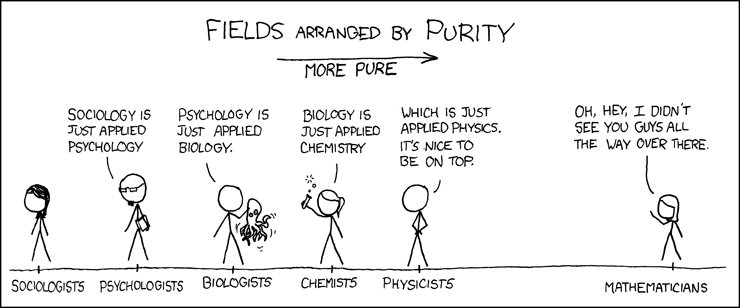
:-)
Saturday, 29 September 2012
Solar Flare Video
Found this via Phil Plait's amazing Bad Astronomy blog*:
On August 31st the Sun produce an immense solar flare: click here for a picture from Nasa with the Earth to scale or better still just go straight to the 1900x1200 version. I've made a crop of the picture below just to give a teaser:**

Now Nasa and the Goddard Space Flight Center have released a video of the event:
Make it full-screen and switch to 1080p, sit back and be impressed....
* You really should read this blog every day
** Using NASA Imagery and Linking to NASA Web Sites
On August 31st the Sun produce an immense solar flare: click here for a picture from Nasa with the Earth to scale or better still just go straight to the 1900x1200 version. I've made a crop of the picture below just to give a teaser:**

Now Nasa and the Goddard Space Flight Center have released a video of the event:
Make it full-screen and switch to 1080p, sit back and be impressed....
* You really should read this blog every day
** Using NASA Imagery and Linking to NASA Web Sites
Thursday, 27 September 2012
Teaching Privacy
It often surprises me that many of the people advocating privacy don't actually understand the things that they're trying to keep private, specifically information. Indeed the terms data and information are used interchangeably and there is often little understanding of the actual nature and semantics of said, data and information.
I've run courses on data modelling, formal methods, systems design, semantics and now privacy - the latter however always seems to be "a taster or privacy" or "brief introduction to privacy" and there rarely is the chance to get into specifics about what information is.
This of course has some serious implications and one of the best I can find is when we talk about anonymisation. I've seen horrors such as statements "if you hash this identifier, then it is anonymous" or "if we randomise this data then we can't track" or lately, "if we set this flag to '1' then no-one will track you anymore". In the first case I refer people back to the AOL Data Leak and the dangers of fingerprinting, semantic analysis and simple cross-referencing.
I made a study a while back based on the leak of 16,000 names from various Finnish education organisations (plus maybe other places). It was very interesting to see that even with the released list that contained dates of birth and last names how many were already unique, and even in the cases where there existed common Finnish names how easy it was to trace these back to a unique person. Actually going to the next step and verifying this with that person would I guess have been somewhat illegal or if not, unethical to say the least. Social engineering would have been very easy in many of these cases I'm sure.
So given cases like these and the current dearth of educational material I though it would be nice to try to put together a more comprehensive and deeper set of material. Some universities are already doing this and there also exist industrial qualifications such as those by the IAPP, however at this stage all ideas are welcome.
Now I want to specifically address a technical audience: software engineers, computer scientists - the people who end up building these systems because that's where I feel much breaks down - for many reasons but I won't appoint blame here - that's not really constructive in the current context.
First of all I want to break things down into 3 logical segments, actually there are 4 but I'll discuss that one later:
Legal is relatively straightforward in that an understanding of principles of privacy, how various jurisdictions view data, information, anonymisation, cross-referencing, children and minors, cross-border data transfer, retention and data collection and a discussion of certain practices, eg: EU, US, China, India etc. This discussion doesn't have to be heavy but an understanding of what the law states and how it interprets things is critical. Also from here we should get an understanding of how the law affects the engineering side of things: common terminology as a good example.
Consumer advocacy is really the overview material in my opinion - what are the principles of privacy, for example Cavoukian's Privacy by Design as an example (even if I'm not happy with the implementation of these), how to consumers view privacy, what is the reality (say vs do) and also various case studies such as how consumers view Google, Apple, Nokia, Facebook, various Governments, technologies such as NFC, mobile devices, 'Smart Televisions', direct marketing and advertising, store cards etc. Out of this comes an understanding of how privacy is viewed and even an appreciation of why we don't get privacy: anti-privacy if you like.
The technical aspect takes in many technologies, rather than describe, I'll list them (and this will be non-exhaustive and in no particular order)
Now that we have outlined the three areas we can look at the fourth which binds these together and which I tentatively call "Theory of Privacy".
Obviously something binds these areas together and there does exist a huge body of work on the nature of information and its classifications. I particularly like the approach by Barwise and Seligman in the 1997 book Information Flow: The Logic of Distributed Systems*. I believe we can quite easily get into all sorts of interesting ontology, semantics and even semiotic discussions. Shannon's Information Theory and notions of entropy (eg: Volkstein's book: Entropy and Information) are fundamental to many things. I think this really is an area that needs to be opened up and addressed seriously and anything that binds together and provides a common language to unify consumer advocacy, the law and software engineering is critical.
Finally, no outline of a course would be complete with some preliminary requirements and a book list. For the former an understanding of computer systems and basic computer security is a must (there is no privacy without security), a grounding in software engineering techniques and a dose of computer science similarly. For the books, my first draft list would include:
*somebody should make a movie of this.
I've run courses on data modelling, formal methods, systems design, semantics and now privacy - the latter however always seems to be "a taster or privacy" or "brief introduction to privacy" and there rarely is the chance to get into specifics about what information is.
This of course has some serious implications and one of the best I can find is when we talk about anonymisation. I've seen horrors such as statements "if you hash this identifier, then it is anonymous" or "if we randomise this data then we can't track" or lately, "if we set this flag to '1' then no-one will track you anymore". In the first case I refer people back to the AOL Data Leak and the dangers of fingerprinting, semantic analysis and simple cross-referencing.
I made a study a while back based on the leak of 16,000 names from various Finnish education organisations (plus maybe other places). It was very interesting to see that even with the released list that contained dates of birth and last names how many were already unique, and even in the cases where there existed common Finnish names how easy it was to trace these back to a unique person. Actually going to the next step and verifying this with that person would I guess have been somewhat illegal or if not, unethical to say the least. Social engineering would have been very easy in many of these cases I'm sure.
So given cases like these and the current dearth of educational material I though it would be nice to try to put together a more comprehensive and deeper set of material. Some universities are already doing this and there also exist industrial qualifications such as those by the IAPP, however at this stage all ideas are welcome.
Now I want to specifically address a technical audience: software engineers, computer scientists - the people who end up building these systems because that's where I feel much breaks down - for many reasons but I won't appoint blame here - that's not really constructive in the current context.
First of all I want to break things down into 3 logical segments, actually there are 4 but I'll discuss that one later:
- Legal
- Consumer Advocacy
- Technical
Legal is relatively straightforward in that an understanding of principles of privacy, how various jurisdictions view data, information, anonymisation, cross-referencing, children and minors, cross-border data transfer, retention and data collection and a discussion of certain practices, eg: EU, US, China, India etc. This discussion doesn't have to be heavy but an understanding of what the law states and how it interprets things is critical. Also from here we should get an understanding of how the law affects the engineering side of things: common terminology as a good example.
Consumer advocacy is really the overview material in my opinion - what are the principles of privacy, for example Cavoukian's Privacy by Design as an example (even if I'm not happy with the implementation of these), how to consumers view privacy, what is the reality (say vs do) and also various case studies such as how consumers view Google, Apple, Nokia, Facebook, various Governments, technologies such as NFC, mobile devices, 'Smart Televisions', direct marketing and advertising, store cards etc. Out of this comes an understanding of how privacy is viewed and even an appreciation of why we don't get privacy: anti-privacy if you like.
The technical aspect takes in many technologies, rather than describe, I'll list them (and this will be non-exhaustive and in no particular order)
- Basic Security - Web, Encryption, Hashing, Hacking (XSS etc), authentication (OpenID, OAuth etc), differences/commonalities between privacy and security, mapping privacy problems into security problems as a solution
- Databases - technologies, design, schema development (eg: relational theory), "schema-less" databases, cross-referencing, semantic isolation
- Semantics - ontologies, classifications, aspect, Semantic Web
- Data-flow
- Distributed Systems - networking and infrastructure
- API design - browsers, apps, web-interfaces, REST
- Data Collection - primary vs secondary vs infrastructure, logging
- Policy - policy languages, logic, rules, data filtering
- Anonymisation - data cleansing
- Identifiers - tracking, "Do Not Track"
- User-Interface
- Metrics for privacy - entropy
- Information Types and Classification - location, personally identifiable information, identifiers, PCI, health/medical data
Now that we have outlined the three areas we can look at the fourth which binds these together and which I tentatively call "Theory of Privacy".
Obviously something binds these areas together and there does exist a huge body of work on the nature of information and its classifications. I particularly like the approach by Barwise and Seligman in the 1997 book Information Flow: The Logic of Distributed Systems*. I believe we can quite easily get into all sorts of interesting ontology, semantics and even semiotic discussions. Shannon's Information Theory and notions of entropy (eg: Volkstein's book: Entropy and Information) are fundamental to many things. I think this really is an area that needs to be opened up and addressed seriously and anything that binds together and provides a common language to unify consumer advocacy, the law and software engineering is critical.
Finally, no outline of a course would be complete with some preliminary requirements and a book list. For the former an understanding of computer systems and basic computer security is a must (there is no privacy without security), a grounding in software engineering techniques and a dose of computer science similarly. For the books, my first draft list would include:
- Barwise, Seligman. Information Flow
- O'Hara, Shadbolt. The Spy in the Coffee Machine: The End of Privacy as We Know It
- Solove. Understanding Privacy
- Nissenbaum. Privacy in Content: Technology, Policy, and the Integrity of Social Life
- Solove: The Future of Reputation: Gossip, Rumour, and Privacy on the Internet
*somebody should make a movie of this.
Subscribe to:
Posts (Atom)