After a few "side-bar" stories, I finally got one on the Newsbiscuit front page!
Go here for the full story...
..Trouble is, given the state of Brexit, I'm not sure this is humour or irony anymore...next step: The Onion - a place for more reliable news.
Showing posts with label Politics. Show all posts
Tuesday, 4 October 2016
Thursday, 23 June 2016
So, the UK's referendum on whether it should leave the EU or not is today.
Now the caveats:
Given the caveats, this probably isn't the best environment for any UK-EU negotiations and would actually take up time from repealing the various UK Laws on EU membership and the 2 years negotiation time.
Then just a final remark on the arguments of sovereignty and democracy.
Apparently Britain has a 1000 years of history...apart from the 3000 years or so of Celtic/Briton history before that.
If we stay in the EU we lose our "Britishness" - whatever that is? Personally I notice the Finns are just as Finnish, the French, Germans, etc similarly. Anyway the UK is made of four different countries each with their own identities anyway.
Sovereignty of Parliament lies with Parliament anyway. At any point in time the UK Parliament could repeat the laws relating the EU membership; though no-one really knows what this means anyway.
The EU Parliament is an elected body by the universal suffrage - you do know who your MEP is don't you?
EU Laws/Directives/Recommendations must be ratified not only by the democratically elected EU Parliament, but also by each country's parliament after going through a process in which each country separately decides how to implement each law/directive/recommendation.
This latter point is important: EACH COUNTRY INDEPENDENTLY DECIDES HOW TO IMPLEMENT EU LAWS/DIRECTIVES/RECOMMENDATIONS. This means that a country (Finland - looking at you here) can implement huge restrictions on things and then "blame" EU Law - whereas often it was just a directive stating some basic ideals.
Finally immigration: which immigrants are we talking about?
- If more than 50% of the electorate who cast a vote for remaining then it is fairly obvious what happens next with a small caveat (see below).
- If more then 50% of the electorate who case a vote for leaving then the theoretical process is that the UK has 2 years to negotiate its leaving of the EU - trade agreements, human rights, workers rights, environmental rights etc. Whatever is left over after the 2 years is "free game" and the UK would be a complete outsider with regards to its bargaining position.
Now the caveats:
- Under UK Referendum Law, referenda are not legally binding which means that the result could be annulled, ignored or reversed.
- A majority of MPs in the UK Parliament could band together and cause the result to be annulled, reversed or ignored. This is actually likely as there would have to be a vote on the clauses in UK Law relating to EU membership. What happens if a majority of MPs vote to ignore/annul/reverse the referendum result?
- Given the level of division in the UK's Conservative Party, if the result is to remain then what happens to those MPs in the Conservative Party who campaigned against the PM?
- If the UK votes to leave, then the PM will more then likely be challenged by the remain faction of the Conservative Party: a) the PM will likely resign in this case, b) would a general election be called
- If a general election is called: a) what happens if the country votes in a government that is pro-EU but the referendum delivers a leave result? b) vice versa of (a) or c) what happens if the UK gets a hung parliament with a mix of pro and anti-EU factions?
Given the caveats, this probably isn't the best environment for any UK-EU negotiations and would actually take up time from repealing the various UK Laws on EU membership and the 2 years negotiation time.
Then just a final remark on the arguments of sovereignty and democracy.
Apparently Britain has a 1000 years of history...apart from the 3000 years or so of Celtic/Briton history before that.
If we stay in the EU we lose our "Britishness" - whatever that is? Personally I notice the Finns are just as Finnish, the French, Germans, etc similarly. Anyway the UK is made of four different countries each with their own identities anyway.
Sovereignty of Parliament lies with Parliament anyway. At any point in time the UK Parliament could repeat the laws relating the EU membership; though no-one really knows what this means anyway.
The EU Parliament is an elected body by the universal suffrage - you do know who your MEP is don't you?
EU Laws/Directives/Recommendations must be ratified not only by the democratically elected EU Parliament, but also by each country's parliament after going through a process in which each country separately decides how to implement each law/directive/recommendation.
This latter point is important: EACH COUNTRY INDEPENDENTLY DECIDES HOW TO IMPLEMENT EU LAWS/DIRECTIVES/RECOMMENDATIONS. This means that a country (Finland - looking at you here) can implement huge restrictions on things and then "blame" EU Law - whereas often it was just a directive stating some basic ideals.
Finally immigration: which immigrants are we talking about?
- EU migrants - the EU upholds a basic right that any EU citizen can work and live in any EU country according to a basic set of minimal rights. Some countries impose additional restrictions but the basic right of free movement is EU Law.
- Non-EU migrants - decided broadly by national parliaments and the EU.
- Refugees - there are strict criteria set by the EU, UN and national parliaments on who can be a refugee. The EU has set out a basic set of rights and a mechanism by which countries in the EU "share" refugees.
Whatever happens today the result will be either a very bad mess for the Conservatives or an extremely bad mess for the whole UK. But therein lies the problem, that the vote is no longer about the EU but about the future of the UK Conservative and Unionist Party and the power brokerage of various players within this.
It is just extremely sad that there has been no intelligent discourse on the subject - primarily due to the lack of knowledge and education of not just how the EU works but how the UK's whole system of government works. I fear this is quite deliberate.
The whole debate has been riddled with fear and hate which unfortunately has also led to the death of an MP. For all the debate about sovereignty and democracy, is this what it the whole EU debate is about?
Finally I don't care whether you are pro or anti-EU, I would like some idea of what will happen in the case of either a remain or leave result. So far, there has been even less discussion of what happens next than there has been of what the EU and UK mean to each other.
Thursday, 22 October 2015
Tryweryn and Welsh Devolution
It has been fifty years since the flooding of the Tryweryn valley in Wales in order to create a reservoir for the city of Liverpool. This week also saw the publication of the planned reserved powers for the Welsh Assembly.
The planned reserved powers when coupled with the planned English Laws plan introduces an scenario where it becomes possible for English MPs to veto a Welsh Law in cases where there might be a perceived affect upon England. The reverse situation can not happen however.
This then raises all sorts of strange constitutional questions; such as does this invalidate the results of the 2011 referendum of law making powers for Wales?
Another point then in the definition of what sovereignty means.
If we place the above into the EU-UK then this becomes the heart of the debate about whether the UK should in in or out of the EU.
To give a more concrete example of the convoluted ideas of sovereignty and national responsibility there's the point made by John Elfed Jones, former chairman of Welsh Water that Wales should be allowed to sell its water to England. The analogy drawn between food and crops from eastern England and 'Scottish' oil should spawn a very interesting debate.
To finalise, we have confusion in the UK about what sovereignty and responsibility means. At one political-economic level we demand responsibility and sovereignty, but at others not at all. So where does the boundary exist between these concepts?
Discuss.
The planned reserved powers when coupled with the planned English Laws plan introduces an scenario where it becomes possible for English MPs to veto a Welsh Law in cases where there might be a perceived affect upon England. The reverse situation can not happen however.
This then raises all sorts of strange constitutional questions; such as does this invalidate the results of the 2011 referendum of law making powers for Wales?
Another point then in the definition of what sovereignty means.
If we place the above into the EU-UK then this becomes the heart of the debate about whether the UK should in in or out of the EU.
To give a more concrete example of the convoluted ideas of sovereignty and national responsibility there's the point made by John Elfed Jones, former chairman of Welsh Water that Wales should be allowed to sell its water to England. The analogy drawn between food and crops from eastern England and 'Scottish' oil should spawn a very interesting debate.
To finalise, we have confusion in the UK about what sovereignty and responsibility means. At one political-economic level we demand responsibility and sovereignty, but at others not at all. So where does the boundary exist between these concepts?
Discuss.
Saturday, 4 April 2015
2015 UK Election Leader TV Debate
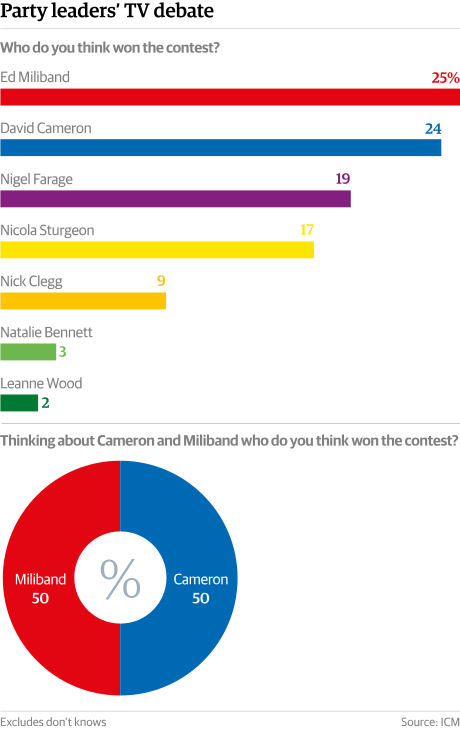
Whether leadership debates are a good thing or not is itself a debate, however ITV's UK Leadership Debate with seven party leaders was held with the result that Miliband (Lab) "beat" Cameron (Con) by a small margin. YouGov made a survey of who do you think won the debate with the results as shown below (source: Guardian)
One thing however is not explained, and that is who was asked. Obviously if you'd polled in Ceredigion or Gwynedd then Wood (PC) would have won, if in Brighton then Bennet (Greens) and so on. However I assume that we could say that this was a representative sample from across the UK, but still it is going to be heavily weighted in favour of the national parties and then especially the two leading parties.
This got me thinking, as you can tell whatever you want with statistics - think of it as accountancy with more leeway - could the above figures be weighted according to the uk electorate, especially as two of the parties involved do not campaign outside of Wales or Scotland.
The electorate figures for England, Scotland and Wales for 2013 according to the Electoral Commission are 40,100,00, 4,100,00 and 2,300,00 (to nearest 100,000). Given this I think it is obvious that the above results are going to be skewed towards the established parties.
Furthermore the SNP are fairly well known and have a more 'national' or UK-wide agenda than Plaid Cymru who are much more focussed on Wales. Leanne Wood (PC) for example is standing as a member of the Welsh Parliament rather than Westminster. Welsh politics rarely feature outside of Wales, except for a strange incident back in 1997 (one, certainly for the conspiracy theorists). Ironically given the current constitutional issues since the Scottish independence vote, it has been Rhodri Morgan, leader of the Welsh Government who has been proposing ideas (even at EU level) of how the UK and Northern Ireland should be governed.
That given, the above figures on who "won" really should be taken much more in context of the audiences to which they are most relevant. The above is so much biased towards an English view - not that there's a problem with that - it does give a false impression to voters in Wales and Scotland. Furthermore, given the size of England and its electorate even the above figure does not truly represent England - how would it look in the context of Thanet versus Toxteth?
So getting back to how the leaders actually did in the debate, it would be best to take each individually, especially as each has very different leadership goals. Probably the best overview of each of the party leaders' performances was given by the Telegraph. Or as another put it, four out of touch public school boys taken to task by three women :-)
One thing however is not explained, and that is who was asked. Obviously if you'd polled in Ceredigion or Gwynedd then Wood (PC) would have won, if in Brighton then Bennet (Greens) and so on. However I assume that we could say that this was a representative sample from across the UK, but still it is going to be heavily weighted in favour of the national parties and then especially the two leading parties.
This got me thinking, as you can tell whatever you want with statistics - think of it as accountancy with more leeway - could the above figures be weighted according to the uk electorate, especially as two of the parties involved do not campaign outside of Wales or Scotland.
The electorate figures for England, Scotland and Wales for 2013 according to the Electoral Commission are 40,100,00, 4,100,00 and 2,300,00 (to nearest 100,000). Given this I think it is obvious that the above results are going to be skewed towards the established parties.
Furthermore the SNP are fairly well known and have a more 'national' or UK-wide agenda than Plaid Cymru who are much more focussed on Wales. Leanne Wood (PC) for example is standing as a member of the Welsh Parliament rather than Westminster. Welsh politics rarely feature outside of Wales, except for a strange incident back in 1997 (one, certainly for the conspiracy theorists). Ironically given the current constitutional issues since the Scottish independence vote, it has been Rhodri Morgan, leader of the Welsh Government who has been proposing ideas (even at EU level) of how the UK and Northern Ireland should be governed.
That given, the above figures on who "won" really should be taken much more in context of the audiences to which they are most relevant. The above is so much biased towards an English view - not that there's a problem with that - it does give a false impression to voters in Wales and Scotland. Furthermore, given the size of England and its electorate even the above figure does not truly represent England - how would it look in the context of Thanet versus Toxteth?
So getting back to how the leaders actually did in the debate, it would be best to take each individually, especially as each has very different leadership goals. Probably the best overview of each of the party leaders' performances was given by the Telegraph. Or as another put it, four out of touch public school boys taken to task by three women :-)
Monday, 13 October 2014
Whiskeygate
No one is really sure who said what and the air is full of denials and the Nuremberg Defense, but it seems like Finland is trying to suppress the word "wisky", or more specifically the Finnish "viski" just in case it corrupt, well, everyone....just think of the children...or maybe it is for my safety and security...but even if it saves just one person...
Yes, this is true:
Anyway Finnish taxes being put to work by our elected and unelected officials...good thing there's nothing else to worry about such as the economy, jobs, overly high taxation, food prices, energy prices, energy dependence, flying squirrels, child benefit reductions hirvikarpaset and a government that wants to avoid all hard decisions at all costs.
After all, banning words, moving kunta boundaries and pay rises of 6000 euros per month are far more important than the people of Finland.
Can anyone say Streisand Effect?
Whisky, Whiskey, Viski, Whisky, Whiskey, Viski,Whisky, Whiskey, Viski,Whisky, Whiskey, Viski,Whisky, Whiskey, Viski,Whisky, Whiskey, Viski,Whisky, Whiskey, Viski,Whisky, Whiskey, Viski,Whisky, Whiskey, Viski,Whisky, Whiskey, Viski,Whisky, Whiskey, Viski,Whisky, Whiskey, Viski,Whisky, Whiskey, Viski,Whisky, Whiskey, Viski,Whisky, Whiskey, Viski,Whisky, Whiskey, Viski,Whisky, Whiskey, Viski,Whisky, Whiskey, Viski,Whisky, Whiskey, Viski,Whisky, Whiskey, Viski,Whisky, Whiskey, Viski,Whisky, Whiskey, Viski,Whisky, Whiskey, Viski,Whisky, Whiskey, Viski,Whisky, Whiskey, Viski,Whisky, Whiskey, Viski,Whisky, Whiskey, Viski,Whisky, Whiskey, Viski,Whisky, Whiskey, Viski,Whisky, Whiskey, Viski,Whisky, Whiskey, Viski,Whisky, Whiskey, Viski,Whisky, Whiskey, Viski,Whisky, Whiskey, Viski,Whisky, Whiskey, Viski,Whisky, Whiskey, Viski,Whisky, Whiskey, Viski,Whisky, Whiskey, Viski,Whisky, Whiskey, Viski,Whisky, Whiskey, Viski,Whisky, Whiskey, Viski,Whisky, Whiskey, Viski,Whisky, Whiskey, Viski,Whisky, Whiskey, Viski,Whisky, Whiskey, Viski,Whisky, Whiskey, Viski,Whisky, Whiskey, Viski,Whisky, Whiskey, Viski,Whisky, Whiskey, Viski,Whisky, Whiskey, Viski,Whisky, Whiskey, Viski,Whisky, Whiskey, Viski,Whisky, Whiskey, Viski,Whisky, Whiskey, Viski,Whisky, Whiskey, Viski,Whisky, Whiskey, Viski,Whisky, Whiskey, Viski,Whisky, Whiskey, Viski,Whisky, Whiskey, Viski,Whisky, Whiskey, Viski,Whisky, Whiskey, Viski,Whisky, Whiskey, Viski,Whisky, Whiskey, Viski,Whisky, Whiskey, Viski,Whisky, Whiskey, Viski,Whisky, Whiskey, Viski,Whisky, Whiskey, Viski,Whisky, Whiskey, Viski,Whisky, Whiskey, Viski,Whisky, Whiskey, Viski,Whisky, Whiskey, Viski,Whisky, Whiskey, Viski,Whisky, Whiskey, Viski,Whisky, Whiskey, Viski,Whisky, Whiskey, Viski,Whisky, Whiskey, Viski,Whisky, Whiskey, Viski,Whisky, Whiskey, Viski,Whisky, Whiskey, Viski,Whisky, Whiskey, Viski,Whisky, Whiskey, Viski,Whisky, Whiskey, Viski,Whisky, Whiskey, Viski,Whisky, Whiskey, Viski,Whisky, Whiskey, Viski,Whisky, Whiskey, Viski,Whisky, Whiskey, Viski ....
Yes, this is true:
News |
HS: Finnish officials ban the word "whisky" on private blog
Organisers of a beer and whisky fair in Helsinki have been granted a license on condition that search engines do not link to the event’s website when users search for “whisky”, according to a report in Helsingin Sanomat. The officials have also asked the beer and whisky fair to remove the word “whisky” from their logo and the event’s official name.
Anyway Finnish taxes being put to work by our elected and unelected officials...good thing there's nothing else to worry about such as the economy, jobs, overly high taxation, food prices, energy prices, energy dependence, flying squirrels, child benefit reductions hirvikarpaset and a government that wants to avoid all hard decisions at all costs.
After all, banning words, moving kunta boundaries and pay rises of 6000 euros per month are far more important than the people of Finland.
Can anyone say Streisand Effect?
Whisky, Whiskey, Viski, Whisky, Whiskey, Viski,Whisky, Whiskey, Viski,Whisky, Whiskey, Viski,Whisky, Whiskey, Viski,Whisky, Whiskey, Viski,Whisky, Whiskey, Viski,Whisky, Whiskey, Viski,Whisky, Whiskey, Viski,Whisky, Whiskey, Viski,Whisky, Whiskey, Viski,Whisky, Whiskey, Viski,Whisky, Whiskey, Viski,Whisky, Whiskey, Viski,Whisky, Whiskey, Viski,Whisky, Whiskey, Viski,Whisky, Whiskey, Viski,Whisky, Whiskey, Viski,Whisky, Whiskey, Viski,Whisky, Whiskey, Viski,Whisky, Whiskey, Viski,Whisky, Whiskey, Viski,Whisky, Whiskey, Viski,Whisky, Whiskey, Viski,Whisky, Whiskey, Viski,Whisky, Whiskey, Viski,Whisky, Whiskey, Viski,Whisky, Whiskey, Viski,Whisky, Whiskey, Viski,Whisky, Whiskey, Viski,Whisky, Whiskey, Viski,Whisky, Whiskey, Viski,Whisky, Whiskey, Viski,Whisky, Whiskey, Viski,Whisky, Whiskey, Viski,Whisky, Whiskey, Viski,Whisky, Whiskey, Viski,Whisky, Whiskey, Viski,Whisky, Whiskey, Viski,Whisky, Whiskey, Viski,Whisky, Whiskey, Viski,Whisky, Whiskey, Viski,Whisky, Whiskey, Viski,Whisky, Whiskey, Viski,Whisky, Whiskey, Viski,Whisky, Whiskey, Viski,Whisky, Whiskey, Viski,Whisky, Whiskey, Viski,Whisky, Whiskey, Viski,Whisky, Whiskey, Viski,Whisky, Whiskey, Viski,Whisky, Whiskey, Viski,Whisky, Whiskey, Viski,Whisky, Whiskey, Viski,Whisky, Whiskey, Viski,Whisky, Whiskey, Viski,Whisky, Whiskey, Viski,Whisky, Whiskey, Viski,Whisky, Whiskey, Viski,Whisky, Whiskey, Viski,Whisky, Whiskey, Viski,Whisky, Whiskey, Viski,Whisky, Whiskey, Viski,Whisky, Whiskey, Viski,Whisky, Whiskey, Viski,Whisky, Whiskey, Viski,Whisky, Whiskey, Viski,Whisky, Whiskey, Viski,Whisky, Whiskey, Viski,Whisky, Whiskey, Viski,Whisky, Whiskey, Viski,Whisky, Whiskey, Viski,Whisky, Whiskey, Viski,Whisky, Whiskey, Viski,Whisky, Whiskey, Viski,Whisky, Whiskey, Viski,Whisky, Whiskey, Viski,Whisky, Whiskey, Viski,Whisky, Whiskey, Viski,Whisky, Whiskey, Viski,Whisky, Whiskey, Viski,Whisky, Whiskey, Viski,Whisky, Whiskey, Viski,Whisky, Whiskey, Viski,Whisky, Whiskey, Viski,Whisky, Whiskey, Viski,Whisky, Whiskey, Viski ....
Thursday, 18 September 2014
Scotland, Independence, Wales, the UK etc...
Well, what ever happens today in Scotland, I think that Salmond has won: the concessions that have been offered Scotland by the leaders of the main parties in the UK are generous to say the least. In effect a no vote will trigger practically everything but independence and full financial autonomy, while a yes vote will lead to much protracted negotiations and to be honest I'm not sure either side in this has a good idea of how these will turn out.
The questions of economy, currency union and EU membership are academic to a point. Firstly Scotland's economy will probably do quite well, though the independence vote is not specifically about the economy but rather the right of a people to decide their own future - democratically. Currency union might well become a moot point - if Scotland enters a currency union with the UK pound then there isn't really much the UK could do about it; there are alternatives such as pegging a Scottish currency against the EU in much the same way as Montenegro has done. Even if Scotland's currency did devalue then this could be a good thing for inward investment.
EU membership is interesting, especially as Spain and quite probably Belgium has vested interests in quelling their own internal independence movements - even then the pressure from their local voters and even smaller EU nations which might feel threatened by over dominance by larger members might sway this. EU membership also solves the currency issue.
Border controls and the like? Well Scotland couldn't become a Schengen country unless the UK joined too and I strongly doubt that we'd see passport checks at any time in the future other than in the more fanciful predictions.
My main issue however is - regardless of yes or no - is what happens to Wales and to a smaller extend to Northern Ireland and England. Certainly some Welsh politicians seem blissfully unaware or even naive of the implications. Even the Conservative Party in Wales has come out much more in favour of devolution of powers to Wales than Labour.
Politicians always has vested interests anyway: the Conservatives know that their only chance of any power in Wales is through the Senedd while Labour can always sit back and count on votes from their heartlands both in Wales and England. If Scotland leave, or even in Westminster is reorganised to solve the West Lothian Question this might change as Welsh MPs would have little influence even if they did vote on English specific legislations. There's an interesting discussion about this on the TrueWales web site in an article written by Rachel Banner (24 Jan 2012): The West Lothian Question.
Ironically it has been Welsh MPs who have probably made some of the most important decisions regarding England the UK: Nye Bevan and the NHS, Lloyd George and Home Rule (which unfortunately didn't come to pass due to World War 1) and even back to the Welsh advisors to Queen Elizabeth the First who promoted the idea of naval supremacy.
If we come back to what has been offered Scotland now and since the 1998 devolution votes one must seriously ask the question of why Scotland gets so much at the expense of the rest of the nations of the UK. I'm still unsure why every change to devolution in Wales requires a referendum such as that back in 2011 which granted Wales the power to make laws specific to the needs of the nation. Are politicians so weak and afraid of their decisions? Surely the populace voted those MPs into power to make such decisions for the good of the people and so they should take the responsibility themselves rather than pass it off to often under informed voters?
So on Friday, will Wales be offered DevoMax? I doubt it - no politician is that brave.
Friday, 22 November 2013
Semiotic Analysis of a Privacy Policy
Pretty much every service has a privacy policy attached to it; these policies state the data collection, usage, purpose and expectations that the customer has to agree with before using that said service. But at another level they also attempt to signify (that's going to be a key word) that the consumer can trust the company providing the service at some level. Ok, so there's been huge amounts of press about certain social media and search service provides "abusing" this trust and so on, but we still use the services provided by those companies.
Found this paper while researching for this: Philippe Codognet's THE SEMIOTICS OF THE WEB, it starts with a quote:
So this gets me thinking, when a privacy policy is written, could we analyse that text to understand better the motives and expectations from both the customer and the service provider perspective? Effectively can we make a semiotic analysis of a privacy policy.
What would we gain by this? It is imperative that any texts of this nature portray the right image to the consumer, thus this can be used in the drafting of such a text to ensure that this this right image is correctly portrayed. For example, the oft seen statement:
"Your privacy is important to us"
is a sign in the semiotic sense, and in this case probably an 'icon' in its near universal usage. Signs are a relationship between the 'object' and 'interpretant', respectively the subject matter at hand and the clarified meaning respectively.
![]() |
| Pierce's Semiotic Trangle |
The object may be that we (the writer of the statement) are trying to state a matter of fact about how trust worthy we are, or at least we want to emphasise that we can be trusted.
The interpretant of this, if we are the customer, can of course vary from total trust to utter cynicism. I guess of late the latter interpretation tends to be true. Understanding the variation in interpretants is a clear method for understanding what is being conveyed by the policy itself and whether the right impression is being given to the consumer.
At a very granular level the whole policy itself is a sign and the very existance of that policy and its structure, is it long and full of legalese or short and simple? Then there's the content (as described above) which may or may not depend upon the size of the policy....as in the World's Worst Privacy Policy.
References:
Aside:
I am not sure that the web weaved by Persephone in this Orphic tale, cited in exergue of Michel Serres’ La communication , is what we are currently used to call the World Wide Web. Our computer web on the internet is nevertheless akin Persephone’s in its aims : representing and covering the entire universe. Our learned ignorance is conceiving an infinite virtual world whose center is everywhere and circumference nowhere ...Must admit, I find that very, very nice. Best I've got is getting quotes about existential crises and cosmological structures in a paper about the Semantic Web with Ora Lassila.
Friday, 25 January 2013
On The Naivety of Privacy
Recent events regarding privacy and the internet have left me wondering if we are being somewhat naïve. We are starting to see a slew of new laws, strategies and technologies for protecting our privacy in what is effectively a public space. The end-user however is not, as far as I can tell, really getting the benefit of this - indeed if anyone is it is the emerging privacy-industrial complex [1] as some have written.
It is utterly naïve to believe that laws, strategies, intentions, grand speeches, certifications, automatic filtering, classification iconography and so on make for better end-user privacy. The more we do this the more confused we become, and simultaneously we lose sight of what we're really trying to achieve. Spare a thought for the poor end-users.
There is a great deal that is misunderstood or not known by privacy advocates about how the internet, computers and information systems work - I fear in a lot of cases either some don't want to understand because it takes them outside of their comfort zone, or the semantic gap between the engineers and the legal/advocacy side is too great and that bridging this gap is extraordinarily difficult for both parties.
I worry about our lack of formality and discipline, possibly in equal quantities. We – the privacy community – lack these aspects to really understand and accept the fundamentals of our area and how to apply this to the information systems we are trying to protect. In some cases we are actively fighting against the need to scientifically ground our chosen area.
We must take a moment to think and understand what problem we are really trying to solve. The more philosophical works by Solove and Nissenbaum address the overall concept of privacy. I'm not sure that the implications of these are really understood. Part of the problem is that general theories of information [2] are very abstract and obtuse when compared with the legal views of the above authors, and we've done very little to tie these areas together to produce the necessary scientific formalisation of privacy we need.
As an example, the Privacy by Design (PbD) manifesto is being waived by many to be the commandments of privacy and following these magically solves everything. This only leads to “technical debt” and greater problems in the future. Often we find the engineers, R&D teams and the scientists excluded from, and outside of, this discussion.
I think we're missing the point what privacy really is and certainly we have little idea at this time how to effectively build information systems with inherent privacy [3] as a property of those systems. I have one initial conclusion:
We have no common definitions, common language, common semantics nor mappings between our individual worlds: legal, advocacy and engineering. Worse, in each of these worlds terminology and semantics are not always so well internally defined.
When an [software] engineer says “data collection”, "log" or "architecture", these do not mean the same to a lawyer or a consumer advocate. Indeed I don't think these terms semantically map even remotely cleanly – if at all - between these groups.
A set of PowerPoint slides with a strategy, a vision, a manifesto, good intentions, project plan or a classifications scheme mean very little and without some form of semantics are wasted, token efforts that only add to the complexity and confusion of a rapidly changing field.
We desperately need to address the problem that we must create a way of communicating amongst ourselves through which all of the internal factions within the privacy community can effectively understand each other's point of view. Only then might we even have a chance of realistically and effectively addressing the moving target of privacy issues facing end- users and businesses that rely so much on the interchange and analysis of information.
The problem with formally (or rigorously) defining anything is that it has the nasty tendency to expose holes and weaknesses in our thinking. Said holes and weaknesses are not entirely appreciated, especially when it challenges an established school of thought or a political or dogmatic balance [4].
The privacy community is constantly developing new laws and legal arguments, new sets of guidelines, manifestos and doom scenarios while the engineers are trying to address these often inconsistent and complex ideas through technical means. From the engineering perspective not only we are internally exposing flaws in database design, information system architecture and user experience but also the mismatch between engineering, legal, the world of the consumer advocate and ultimately a company's information strategy.
An information strategy needs to address everything from how the engineers develop software to how you want your company to be perceived by the consumer. How many information strategies actually address the role that information plays in a modern, global consumer ecosystem where the central concept is the collection and processing of user information? Of those, how many address the engineering and scientific levels of information?
We must take a serious retrenchment [5] step and look back at what we have created. Then we need ruthlessly carve away anything that does not either solve the communication issue within the privacy community or does not immediately serve the end-user. Reemphasizing the latter point, this explicitly means the end-user values, not what we as a privacy community might perceive to be valued by the end-user.
We must fully appreciate the close link between privacy and information, and that privacy is one of the most crosscutting of disciplines. Privacy is going to expose every single flaw in the way we collect, manage, process and use information from the user experience, as well as the application and services eco-system, and even the manner in which we conduct our system and software engineering processes and information governance. The need to get privacy right is critical not just for the existence of privacy as a technical discipline in its own right (alongside security, architecture, etc) but also for the consumer and the business.
The emphasis must be placed on the deep technical knowledge of experts in information systems – these must be the drivers and unifiers between the engineers, the lawyers, the advocates and ultimately the users. Without this deep, holistic, scientific and mathematical foundation we will not be able to sufficiently nor consistency address or govern any issues that arise in the construction of our information systems at any level of abstraction.
If the work we do in privacy does not have a scientific, consistent and formal underpinning [6] that brings together the engineers, lawyers and advocates then privacy is waste of time at best and deeply destructive to the information systems at worst.
Without this we are a disjointed community caring for ourselves and not the business or consumer and privacy becomes just a bureaucratic exercise to fulfill the notions of performing a process and metrics rendered as meaningful as random numbers.
PostScript:
Via Twitter I came across a talk given by Jean Bezivin entitled "Should we Resurrect Software Engineering?" presented at the Choose Forum in December 2012. Many of the things he presented are analogous to what is happening in privacy. He makes the point a number of times that we have never addressed the missing underlying theory of software engineering and how to really unify the various communities, fields and techniques in this area. Two points I particularly liked was that we concentrated on the solution (MDE) but never thought about the problem; the other point is the use Albert Camus' quote
Notes
[1] #pii2012: The Emergent Privacy-Industrial Complex
[2] Jerry Seligmann, Jon Barwise (1997) Information Flow. Cambridge University Press.
[3] I like the idea of privacy being an inherent construct in system design in much the same way that inherent safety emerged from chemical/industrial plant design
[4] A blog article discussing “mathematical catastrophes” – two that come to mind are Russel and Frege and also Russel and Gödel. Both related but the latter’s challenge to the mathematical school of thought was dramatic to say the least.
[5] A formal retrenchment step in that we not just start again but actively record what we’re backtracking on. Poppleton et.al. constructed a theory of retrenchment for software design using formal methods; the same principles apply here.
[6] If you’re still in doubt just remember that whatever decisions are made with respect to privacy, there’s a programmer writing formal, mathematical statements encoding this. Lessig’s Code is Law principle.
It is utterly naïve to believe that laws, strategies, intentions, grand speeches, certifications, automatic filtering, classification iconography and so on make for better end-user privacy. The more we do this the more confused we become, and simultaneously we lose sight of what we're really trying to achieve. Spare a thought for the poor end-users.
There is a great deal that is misunderstood or not known by privacy advocates about how the internet, computers and information systems work - I fear in a lot of cases either some don't want to understand because it takes them outside of their comfort zone, or the semantic gap between the engineers and the legal/advocacy side is too great and that bridging this gap is extraordinarily difficult for both parties.
I worry about our lack of formality and discipline, possibly in equal quantities. We – the privacy community – lack these aspects to really understand and accept the fundamentals of our area and how to apply this to the information systems we are trying to protect. In some cases we are actively fighting against the need to scientifically ground our chosen area.
We must take a moment to think and understand what problem we are really trying to solve. The more philosophical works by Solove and Nissenbaum address the overall concept of privacy. I'm not sure that the implications of these are really understood. Part of the problem is that general theories of information [2] are very abstract and obtuse when compared with the legal views of the above authors, and we've done very little to tie these areas together to produce the necessary scientific formalisation of privacy we need.
As an example, the Privacy by Design (PbD) manifesto is being waived by many to be the commandments of privacy and following these magically solves everything. This only leads to “technical debt” and greater problems in the future. Often we find the engineers, R&D teams and the scientists excluded from, and outside of, this discussion.
I think we're missing the point what privacy really is and certainly we have little idea at this time how to effectively build information systems with inherent privacy [3] as a property of those systems. I have one initial conclusion:
WE HAVE NO UNDERLYING THEORY OF PRIVACY
We have no common definitions, common language, common semantics nor mappings between our individual worlds: legal, advocacy and engineering. Worse, in each of these worlds terminology and semantics are not always so well internally defined.
When an [software] engineer says “data collection”, "log" or "architecture", these do not mean the same to a lawyer or a consumer advocate. Indeed I don't think these terms semantically map even remotely cleanly – if at all - between these groups.
A set of PowerPoint slides with a strategy, a vision, a manifesto, good intentions, project plan or a classifications scheme mean very little and without some form of semantics are wasted, token efforts that only add to the complexity and confusion of a rapidly changing field.
We desperately need to address the problem that we must create a way of communicating amongst ourselves through which all of the internal factions within the privacy community can effectively understand each other's point of view. Only then might we even have a chance of realistically and effectively addressing the moving target of privacy issues facing end- users and businesses that rely so much on the interchange and analysis of information.
The problem with formally (or rigorously) defining anything is that it has the nasty tendency to expose holes and weaknesses in our thinking. Said holes and weaknesses are not entirely appreciated, especially when it challenges an established school of thought or a political or dogmatic balance [4].
The privacy community is constantly developing new laws and legal arguments, new sets of guidelines, manifestos and doom scenarios while the engineers are trying to address these often inconsistent and complex ideas through technical means. From the engineering perspective not only we are internally exposing flaws in database design, information system architecture and user experience but also the mismatch between engineering, legal, the world of the consumer advocate and ultimately a company's information strategy.
An information strategy needs to address everything from how the engineers develop software to how you want your company to be perceived by the consumer. How many information strategies actually address the role that information plays in a modern, global consumer ecosystem where the central concept is the collection and processing of user information? Of those, how many address the engineering and scientific levels of information?
We must take a serious retrenchment [5] step and look back at what we have created. Then we need ruthlessly carve away anything that does not either solve the communication issue within the privacy community or does not immediately serve the end-user. Reemphasizing the latter point, this explicitly means the end-user values, not what we as a privacy community might perceive to be valued by the end-user.
We must fully appreciate the close link between privacy and information, and that privacy is one of the most crosscutting of disciplines. Privacy is going to expose every single flaw in the way we collect, manage, process and use information from the user experience, as well as the application and services eco-system, and even the manner in which we conduct our system and software engineering processes and information governance. The need to get privacy right is critical not just for the existence of privacy as a technical discipline in its own right (alongside security, architecture, etc) but also for the consumer and the business.
The emphasis must be placed on the deep technical knowledge of experts in information systems – these must be the drivers and unifiers between the engineers, the lawyers, the advocates and ultimately the users. Without this deep, holistic, scientific and mathematical foundation we will not be able to sufficiently nor consistency address or govern any issues that arise in the construction of our information systems at any level of abstraction.
If the work we do in privacy does not have a scientific, consistent and formal underpinning [6] that brings together the engineers, lawyers and advocates then privacy is waste of time at best and deeply destructive to the information systems at worst.
Without this we are a disjointed community caring for ourselves and not the business or consumer and privacy becomes just a bureaucratic exercise to fulfill the notions of performing a process and metrics rendered as meaningful as random numbers.
* * *
PostScript:
Via Twitter I came across a talk given by Jean Bezivin entitled "Should we Resurrect Software Engineering?" presented at the Choose Forum in December 2012. Many of the things he presented are analogous to what is happening in privacy. He makes the point a number of times that we have never addressed the missing underlying theory of software engineering and how to really unify the various communities, fields and techniques in this area. Two points I particularly liked was that we concentrated on the solution (MDE) but never thought about the problem; the other point is the use Albert Camus' quote
<< Mal nommer les choses, c'est ajouterau malheur du monde >>
[To misname things is to add misery to the world]A subtle hint to getting the fundamentals right: terminology and semantics!
Notes
[1] #pii2012: The Emergent Privacy-Industrial Complex
[2] Jerry Seligmann, Jon Barwise (1997) Information Flow. Cambridge University Press.
[3] I like the idea of privacy being an inherent construct in system design in much the same way that inherent safety emerged from chemical/industrial plant design
[4] A blog article discussing “mathematical catastrophes” – two that come to mind are Russel and Frege and also Russel and Gödel. Both related but the latter’s challenge to the mathematical school of thought was dramatic to say the least.
[5] A formal retrenchment step in that we not just start again but actively record what we’re backtracking on. Poppleton et.al. constructed a theory of retrenchment for software design using formal methods; the same principles apply here.
[6] If you’re still in doubt just remember that whatever decisions are made with respect to privacy, there’s a programmer writing formal, mathematical statements encoding this. Lessig’s Code is Law principle.
Friday, 12 October 2012
DNT Story Update
Just a quick post relating to the previous entry about a possible dystopian DNT-compliant future...the inspiration for the short story was Stephen Baxter's Glass Earth Inc., itself a short story which appeared in the Nokia sponsored collection Future Histories edited by Stephen McClelland.
I have no idea if this book is still available but there do appear to be copies on Amazon and I'm sure Nokia employees from the time probably have a few copies around somewhere. It makes very interesting reading especially given the developments over the past 15 years since its publication.
Stephen McCelland (1997) Future Histories. Horizon House (in conjunction with Nokia). ISBN: 0-9530648-0-8
I have no idea if this book is still available but there do appear to be copies on Amazon and I'm sure Nokia employees from the time probably have a few copies around somewhere. It makes very interesting reading especially given the developments over the past 15 years since its publication.
Stephen McCelland (1997) Future Histories. Horizon House (in conjunction with Nokia). ISBN: 0-9530648-0-8
Sunday, 7 October 2012
A Post-"Do No Track" Dystopia?
I remember reading a short story published in a collection of futures that become possible or enabled by the rise of mobile technology. The collection was entitled "Future Histories" edited by Stephen McClelland (link to Amazon) and was produced in part by Nokia.
UPDATE 12 October 2012: The short story is called Glass Earth Inc., by Stephen Baxter appearing in the above collection. See new posting.
NOTE: I have the book, but not to hand - probably in my archive (or in work) so please forgive the missing reference to the particular story in the book - I will correct this as soon as I lay my hands on it.
The story went something like this: in the future advertisers became some omni-powerful that everyone had a quota of advertisements they each had to read or view every day. Interestingly the story had a side plot where McDonalds build a giant Golden-M across the River Thames, presumably next to the then less famous Tower Bridge - something that everyone vehemently protested against until it was agreed that its presence would reduce everyone's daily advertisement quota by a certain amount. I guess that's what you'd call a value proposition...
"Do Not Track" [1] is a proposed W3C standard for adding a header to the ubiquitous HTTP protocol that would instruct servers (specifically first and third parties in the DNT Combined Proposal [2]). While there are many arguments for and against, DNT represents an interesting foray into providing the user with more control over how they are tracked when interacting with internet based services.
Let's for a moment imagine that DNT becomes a standard and browsers and other software implement the functionality and let's also say that compliance becomes enforced by law what unintended consequences could entail?
References
[1] Tracking Preference Expression (DNT). W3C Working Draft 2 October 2012, Eds: Roy Fielding, David Singer
[2] Do Not Track - Combined Proposal, Eds: Aleecia McDonald, 12 June 2012
UPDATE 12 October 2012: The short story is called Glass Earth Inc., by Stephen Baxter appearing in the above collection. See new posting.
The story went something like this: in the future advertisers became some omni-powerful that everyone had a quota of advertisements they each had to read or view every day. Interestingly the story had a side plot where McDonalds build a giant Golden-M across the River Thames, presumably next to the then less famous Tower Bridge - something that everyone vehemently protested against until it was agreed that its presence would reduce everyone's daily advertisement quota by a certain amount. I guess that's what you'd call a value proposition...
"Do Not Track" [1] is a proposed W3C standard for adding a header to the ubiquitous HTTP protocol that would instruct servers (specifically first and third parties in the DNT Combined Proposal [2]). While there are many arguments for and against, DNT represents an interesting foray into providing the user with more control over how they are tracked when interacting with internet based services.
Let's for a moment imagine that DNT becomes a standard and browsers and other software implement the functionality and let's also say that compliance becomes enforced by law what unintended consequences could entail?
Since the World Privacy Laws of 2013 all browsing was anonymised, even to the point that details semantic analysis to reveal the user was no-longer possible. Indeed this had triggered some of the deepest research and insights into semiotics, semantics and information theory and its application into everyday life as revolutionary as the original World Wide Web. From the perspective of advertising, today's web was quite unlike the spam filled, intrusive and unstructured advertising mess that so amply characterised the first fifteen or so years of the 2000s.
Initially there was a backlash amongst the advertisers and near war between them, the privacy evangelists and the technology providers. The outcry and resultant, hastily passed laws - initially starting in the EU and Canada and (surprisingly) rapidly spreading to the USA enforced anti-tracking compliance. By mid 2014 most advertisers had given up and the once mighty Google and Facebook struggling with a need to find a new business model.
This new anonymity for users proved to something of a new freedom for users but left much of the commercial side of the internet stagnating. Out of this emerged a compromise: a centralised advertising proxy run by a newly formed company with much experience in this area - GoogleBook - who would guarantee anonymity from the producers and advertisers at the expense of each individual being required not just to view a certain amount of advertisements but to interact with them to ensure that the advertisement had actually been read. A person's quota would become the new currency of the internet and be based upon your social network, your willingness to promote products and ultimately to purchases.
Because of the necessity for personal anonymity, the specific details of the mechanisms of how this worked were somewhat confidential. That didn't seem to overly concern users, nor the privacy advocates, nor the advertisers - everyone got their share - for privacy's sake...
* * *
As John sat down at his office computer that morning. London was never easy in the mornings, but a 45 minute trip on the tube gained him 45 advertisement credits - a bargain.
With 200 advertisement credits left for the day, including the deduction for the London-McDonalds Bonus. The arch across the Thames was hideous, but 100 credits deducted from the normal daily tally was worth it. Some even said that next year's proposed Coca-Cola's branding of Tower Bridge might even bring another 100 credits deduction!
It varied, but 200 credits usually meant an hour or so of viewing and interacting with advertisements. Hell, he might just have to make that purchase of a computing device from AppleAmazon Corp: a great offer this month tempted him with its bundled 2000 advertisement credits that would buy him almost a whole day without having to go through this daily routine. Funny how one remembers the days when people complained about Amazon's tablets with targeting advertising on the screen saver...oh those halcyon days of 2012...
It was an inevitable part of the deal..an anonymous internet for forced advertisement consumption via some centralised proxy, or whatever they were - part search engine, part advertiser, part social network.
That always bothered him to a point - most didn't really care - but they always seemed to know what advertisements to show him...a little too good given that the rest of the internet was anonymous; then again they were the only provider of advertisements now. Maybe that's why here was here, despite his job seemingly almost futile now.
The computer played the advertisements and almost subconsciously he clicked each strategically to demonstrate that he had sufficiently read the contents - it took him a while to acquire the skill to do that well enough to fool the system but once gained it freed him to perform some degree of multitasking.
A new breed of advertisements were coming - multiply, cross-referenced adverts that demanded your understanding too.
He used a pen and paper, his little eccentricity...he toyed with writing the line: "in a hole in the ground lived...", instead he penned the title:
Globally Targeted Advertisement Tracking Preference Expression (DNT)
W3C Working Draft 07 October 2018
References
[1] Tracking Preference Expression (DNT). W3C Working Draft 2 October 2012, Eds: Roy Fielding, David Singer
[2] Do Not Track - Combined Proposal, Eds: Aleecia McDonald, 12 June 2012
Monday, 11 June 2012
Information engineers wanted
Continuing on the theme of semantic isolation and data siloing* somewhat, I was listening to the Diane Rhem Show on US talk radio station NPR via Finland's YLE Mondo. Today's programme "New Voter ID Laws and the 2012 Elections" was about the USA's law regarding voter eligability and the problems of keeping track of who is and who isn't allowed to vote in certain elections (2012 presidential election being of particular concern).
One part of the programme concentrated on the difficulty of cross-referencing between voting lists in states, counties and various government bodies such as the driver and vehicle licensing (DMV). One of the major problems is that actually identifying and subsequently cross-refenencing people by ID numbers (plural!), by name (due to misspellings, usually involving punctuation) or by address and location. Making this even more interesting is the temporal aspect that over time people move and records in differing data-sets end up overlapping or being temporally disjoint.
One of the current solutions is to use what was termed "election geeks" - people with highly detailed knowledge of voter lists and how to match records in different formats from different states and agencies together. That is a group of people who are highly skilled in performing the manual task of deisolating the semantics of each data set (of voters) and matching these together.
One of the presenters remarked that while a technological solution was necessary we need more so called election geeks. Putting it another way, we need more highly skilled engineers specialising in information, information theory, semantics and ultimlately semiotics. What a great idea!
*this links to part 1, parts: 2 and 2 and a half.
One part of the programme concentrated on the difficulty of cross-referencing between voting lists in states, counties and various government bodies such as the driver and vehicle licensing (DMV). One of the major problems is that actually identifying and subsequently cross-refenencing people by ID numbers (plural!), by name (due to misspellings, usually involving punctuation) or by address and location. Making this even more interesting is the temporal aspect that over time people move and records in differing data-sets end up overlapping or being temporally disjoint.
One of the current solutions is to use what was termed "election geeks" - people with highly detailed knowledge of voter lists and how to match records in different formats from different states and agencies together. That is a group of people who are highly skilled in performing the manual task of deisolating the semantics of each data set (of voters) and matching these together.
One of the presenters remarked that while a technological solution was necessary we need more so called election geeks. Putting it another way, we need more highly skilled engineers specialising in information, information theory, semantics and ultimlately semiotics. What a great idea!
*this links to part 1, parts: 2 and 2 and a half.
Thursday, 2 February 2012
Welsh Independence
The Guardian today has an excellent, well-written, balanced article on the issue of Welsh independence in light of the moves by the Scottish Government.
Could Wales leave the United Kingdom?
Talk of independence is growing – and the referendum in Scotland in 2014 is eagerly awaited. But could Wales really break free from England – and stand on its own?John Harris
guardian.co.uk, Wednesday 1 February 2012 20.00 GMT
Quite interestingly, this article (and comments) are devoid of the usual rabit, anti-devolutionist talk but rather focus on some interesting issues. Now if looking at a post-independent Scotland UK, what would this mean for Northern Ireland and Wales. Certainly in this situation we'd have an extremely powerful English central parliement with two very small additions. Does this imply we'd automatically get a federal UK (whatever the UK means at this point) - Spanish or German style federation? More importantly, at least from the English perspective, is what happens to England; especially what happens to the bulk of England that isn't London or the South-East?
Anyway, I digress, most of the talk about the Welsh Government is along the lines of a certain scene in Monty Python's Life of Brian .... "what have the Romans ever done for us?"
Could Wales leave the United Kingdom?
Talk of independence is growing – and the referendum in Scotland in 2014 is eagerly awaited. But could Wales really break free from England – and stand on its own?John Harris
guardian.co.uk, Wednesday 1 February 2012 20.00 GMT
Leanne Wood is rather different from most of the UK's politicians. Forty years old and a mother of one, she still lives in the same street in the Rhondda Valley where she was born and brought up. She thinks the crash of 2008 should have "resulted in the rejection of capitalism and many of its basic economic and political assumptions", and that the UK's coalition amounts to a "hyper-competitive, imperial/militaristic, climate-change-ignoring and privatising government". She is also a proud republican, who refuses to attend the kind of official events at which the Queen turns up, and was once thrown out of the Welsh Assembly for referring to the reigning monarch as "Mrs Windsor". If any of this chimes with your general view of what's wrong with the world, it's fair to say that you'd like her.
Quite interestingly, this article (and comments) are devoid of the usual rabit, anti-devolutionist talk but rather focus on some interesting issues. Now if looking at a post-independent Scotland UK, what would this mean for Northern Ireland and Wales. Certainly in this situation we'd have an extremely powerful English central parliement with two very small additions. Does this imply we'd automatically get a federal UK (whatever the UK means at this point) - Spanish or German style federation? More importantly, at least from the English perspective, is what happens to England; especially what happens to the bulk of England that isn't London or the South-East?
Anyway, I digress, most of the talk about the Welsh Government is along the lines of a certain scene in Monty Python's Life of Brian .... "what have the Romans ever done for us?"
Monday, 20 June 2011
Syria and American Politics
Interesting article by Adam Curtis of the BBC about the recent (1947-) history of Syria and the involvement of the Americans and others..
read on...
THE BABY AND THE BAATH WATER
Adam Curtis | 18:00 UK time, Thursday, 16 June 2011
What is happening in Syria feels like one of the last gasps of the age of the military dictators. An old way of running the world is still desperately trying to cling to power, but the underlying feeling in the west is that somehow Assad's archaic and cruel military rule will inevitably collapse and Syrians will move forward into a democratic age.
That may, or may not, happen, but what is extraordinary is that we have been here before. Between 1947 and 1949 an odd group of idealists and hard realists in the American government set out to intervene in Syria. Their aim was to liberate the Syrian people from a corrupt autocratic elite - and allow true democracy to flourish. They did this because they were convinced that "the Syrian people are naturally democratic" and that all that was neccessary was to get rid of the elites - and a new world of "peace and progress" would inevitably emerge.
read on...
Subscribe to:
Posts (Atom)