Showing posts with label Mercury. Show all posts

Friday, 1 May 2015

Goodbye Messenger

One of the first posts here was about NASA's Messenger probe to Mercury, and today its mission ended. Here's Messenger's final image and tip of the hat, or a beer or two to NASA's engineers!


Now it is just waiting for ESA's BepiColombo probe to arrive - it departs in January 2017, makes 2 fly-bys of Venus, 5 of Mercury before entering orbit in January 2024.

Thursday, 19 March 2015

Messenger at Mercury .. the "end game"

A long time ago, and probably one of the reasons I started writing this blog, Messenger arrived, or more correctly made a fly-by of Mercury. Now after many years NASA plan some audacious manoeuvres before they finally crash Messenger into Mercury.

Sad to see Messenger's mission end, but the results have been amazing. You can read about the planned hovering and low passes at Science Daily.


Sunday, 3 August 2014

Messenger 10 year Anniversary

One of the first posts I made on this blog was about the Messenger probe to Mercury - at the time it had just made the 3rd fly-by before orbit insertion about 18 months later. On 1st August it celebrated 10 years since its launch.

So a large beer to all involved!

So now we have Messenger at Mercury, Venus Express performing dangerous aerobraking manoeuvres in Venus' atmosphere, a fleet robots trundling over Mars - not forgetting a small fleet of satellites around the planet, Juno on its way to Jupiter and venerable Cassini still going strong around Saturn.

Then there are the three that I'm most anticipating:

and then in just a few days, Rosetta finally arrives at 67P/Churyumov-Gerasimenk after 10 years. At this moment she's 3 days away with about 500 km to go! She's caring a lander called Philae which'll deeply later this year. ESA have a good track record of this kind of landings in exotic places with Huygens.

Can't wait!

In the meantime:

Thursday, 21 March 2013

Has space exploration become boring?

At the expense of evoking Betteridge's Law of Headlines - obviously space exploration isn't boring - and with Voyager 1 maybe leaving the Solar System, I was wondering what happened to the romance of space exploration.

Does anyone anymore sit up until the early hours of the morning as I did when Giotto encountered Halley, being amazed at Uranus' bizarre collection of moons, fascinated with the existence of nitrogen geysers on Triton, volcanoes on Io; does anyone (other than scientists working at NASA, ESA, JAXA etc) get overly excited these days at pictures from Mercury, Vesta etc?

Does anyone dream of what the Ice Giants explorer might have found at Uranus, or what creatures might live under the icy crust of Europa's ocean?

I remember (pre internet days) desperately waiting for pictures of Neptune, Triton, Miranda, Titan etc to appear in newspapers, books, news broadcasts. Even back in 1992 the joy of connecting to NASA ftp servers to download Voyager and Pioneer pictures of Saturn and it enigmatic, orange cloud enveloped moon Titan on the only Sun workstation with a colour display the university had, over a slow internet link. Watching in fascination as line-by-line the picture was displayed and possibly imagining oneself at JPL watching those raw pictures being received at Earth.

The Register has an article from yesterday on Voyager 1 (yes, still going since its launch in 1977!) which has the paragraph (emphasis mine):

Probably the most-loved survivor of 1970s space optimism, Voyager, has sent back signals indicating that it's left the heliosphere.

Maybe this is it, in the 1970s we were optimistic - there were many missions planned: Pioneers 10 and 11, followed by Voyagers 1 and 2 to complete the Grand Tour of the Solar System; later with the first missions to comets, landers on Venus and Mars.

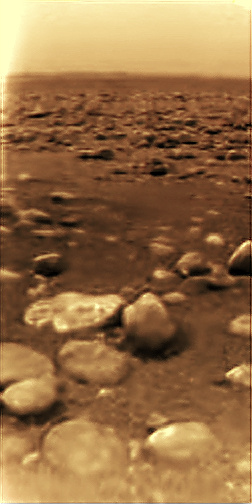
Maybe science just took center stage for a brief moment only to be replaced with the need for fame and appearing on X-Factor? Maybe a picture of the creme brulee surface of Titan from a small lander piggybacked on a probe that made a multi-billion mile tour via Venus, Earth, the Moon, an asteroid or two, Jupiter and finally to Saturn, just don't complete against today's media offerings?

How can you not be amazed by pictures like this - think about what you're looking at and what it took to get those pictures for a moment!


Wikimedia Commons, see: here

On the other hand a grainy picture of Titan from one of the Voyager probes offered mystery and a challenge to be solved - what is under those clouds? - now we get picture of sand grains on Mars. Have we accidentally removed the mystery? Or, have we lost the big exciting picture to a mass audience? A third possibility is that science is either not understood, or just can't complete with a crass, exploitative talent show...

Space exploration in any form is exciting...just listing some of the current probes:
  • Dawn is on its way to Ceres after a successful encounter with Vesta.
  • Messenger has completed mapping all of Mercury's surface and turned up just one or two (or freaking lots!) of major mysteries
  • Cassini is still going strong around Saturn
  • Juno on its way to Jupiter
  • Venus Express still examining Earth's "twin"
  • Numerous orbiters around Mars and not forgetting two (yes TWO!) working rovers on the surface
  • Rosetta is still on its journey to 67P/Churyumov–Gerasimenko.
  • China's moon probe made a detour to visit a near-Earth asteroid
  • Hayabusa returning samples from an asteroid
  • New Horizons still speeds to its all too rapid fly-by of Pluto and its now five moons (incidentally traveling at approx 15km per second or 34000mph)
  • etc etc...
  • oh, not forgetting Voyager 1 and the rest...
Now tell my what that isn't exciting? Maybe our media needs to reacquire its love affair with exploration and science and stop feeding minds with talentless shows...

Thursday, 16 June 2011

Mercury - NASA Press Release

NASA'S MESSENGER REVEALS GLOBAL VIEWS FROM MERCURY ORBIT

Date: June 16, 2011, at 1 p.m. EDT

Introduction

NASA's MErcury Surface, Space ENvironment, GEochemistry, and Ranging (MESSENGER) spacecraft entered orbit around Mercury on March 18, becoming the first spacecraft ever to do so. MESSENGER’s instruments are performing the first complete reconnaissance of the planet’s geochemistry, geophysics, geologic history, atmosphere, magnetosphere, and plasma environment. After nearly three months in orbit, the payload is providing a wealth of new information about Mercury, as well as a few surprises.

Panelists

- Brett W. Denevi, Staff Scientist, The Johns Hopkins University Applied Physics Laboratory, Laurel, Md.
- Larry R. Nittler, Staff Scientist, Department of Terrestrial Magnetism, Carnegie Institution of Washington, Washington, D.C.
- Sean C. Solomon, MESSENGER Principal Investigator, Carnegie Institution of Washington, Washington, D.C.
- Ralph L. McNutt, Jr., MESSENGER Project Scientist, The Johns Hopkins University Applied Physics Laboratory, Laurel, Md.

Friday, 18 March 2011

Messenger in orbit around Mercury

Finally! Seems a long time since launch and one of the first postings here about Messenger, but finally she's in orbit as of last night... From the Messenger site a NASA:

MESSENGER Begins Historic Orbit Around Mercury
MESSENGER MOI

NASA’s MESSENGER spacecraft successfully achieved orbit around Mercury at approximately 9 p.m. EDT Thursday. This marks the first time a spacecraft has accomplished this engineering and scientific milestone at our solar system's innermost planet.

For the next several weeks, APL engineers will be focused on ensuring the spacecraft’s systems are all working well in Mercury’s harsh thermal environment. Starting on March 23, the instruments will be turned on and checked out, and on April 4 the mission's primary science phase will begin.

Wednesday, 30 September 2009

Messenger at Mercury

3rd fly-by before orbit insertion in 2011 occured yesterday 29th Sept 09:

http://messenger.jhuapl.edu/news_room/telecon6.html

Currently there seems only to be a single image from the fly-in on the 29th available at this time:

http://messenger.jhuapl.edu/gallery/sciencePhotos/image.php?gallery_id=2&image_id=330