Showing posts with label Space. Show all posts

Sunday, 5 March 2017

Kerbal...

Kerbal Space Programme: What a fantastic way to:
  1. Indulge in running your own space programme
  2. Learning about orbital mechanics and vector calculus (yay!)
  3. Using countless hours in learning how points 1 and 2 above work
  4. Building space stations that make Mir look thought out :-)


Now you'll have to forgive me, I've been testing landers for an Eve mission all day and I've a launch window coming up...

Thursday, 24 September 2015

Pluto in colour

Just released colour image of Pluto...and you thought last week's image was incredible...


http://www.nasa.gov/sites/default/files/thumbnails/image/crop_p_color2_enhanced_release_small.png


Tuesday, 14 July 2015

Pluto

Finally :-)  Not a lot to say about this one except this fantastic picture from NASA:

Pluto (C)2015 NASA


Wednesday, 1 July 2015

Pluto

On the 14th of July a small and very fast space probe will fly-by Pluto and its menagerie of moons. In the space of a few hours we'll learn more about Pluto and its companions than we have since its discovery on the 18th of February 1930.

In fact we've learnt huge amounts so far even at the huge distances New Horizons is away from the planet (yes PLANET!).

At the moment, we've four exciting missions on-going and actively producing data: five if you include Cassini which just seems to keep going and going to the point where one could even be quite blase about its constant stream of images. OK, there *are* others but for us that particular like planetary exploration...I'll come back to Mars and Jupiter in a moment....

Of the four I'll pick out Rosetta and Philae circling and sitting on a comet nucleus respectively - I think Philae should be renamed Phoenix after its return from the dead. Then there's Dawn orbiting Ceres tantalising us with better and better resolution of a world that was probably considered no more than a lump of rock to one that is possibly even active. Finally New Horizons itself.

We've also lost two probes this year: Messenger and Venus Express as their missions came to an end. Juno is still on its way and hopefully the mission planners will get us a better look at Europa along the way, and of course a flotilla at and on Mars.

I've probably missed a few from the above list - it is getting difficult to keep track especially when even the Chinese surprise us with things such as a quick visit to a passing asteroid!

But despite all of this excitement, New Horizons brings a little sadness: we'll have completed initial exploration of the nine planets. As a child I watched, sometimes in the middle of the night the Voyager probes, especially when Voyager 2 reached Uranus and Neptune. In both cases returning not just surprises but shocks - the cliffs of Miranda, nitrogen geysers on Triton anyone!

Pluto was left alone, unvisited and somewhat unloved.

Now we get a few weeks of excitement and a day or so of wondrous revelations and New Horizons departs giving us our first and last view for a long time of this mysterious place.

And that will be all nine and it comes to an end the first major milestone of the exploration of our Solar System.

There are silver linings to this cloud: the stream of data from all the probes and years of research of New Horizons' data will hopefully provide more impetus to space exploration. We can't stay rooted to our Blue Marble forever and we must pave the way forward, not just in exploring new worlds but also in understand how the Universe operates and what is out there. These space probes furthermore push technology to unexplored boundaries will many unexpected innovations to even our daily lives.

Finally, New Horizons will look back and Pluto, probably go into hibernation and continue to a possible second target. A world that even until the 1980s and 1990s was purely hypothetical. Considering that until 1989 we expected Neptune's moons to be inert and barren rocks and found something completely different, and now expecting the same - at least in terms of surprises - at Pluto, we should have learnt by now, after the exploration of the first nine planets, that whatever comes next is going to be truly wondrous.


Friday, 1 May 2015

Goodbye Messenger

One of the first posts here was about NASA's Messenger probe to Mercury, and today its mission ended. Here's Messenger's final image and tip of the hat, or a beer or two to NASA's engineers!


Now it is just waiting for ESA's BepiColombo probe to arrive - it departs in January 2017, makes 2 fly-bys of Venus, 5 of Mercury before entering orbit in January 2024.

Thursday, 19 March 2015

Messenger at Mercury .. the "end game"

A long time ago, and probably one of the reasons I started writing this blog, Messenger arrived, or more correctly made a fly-by of Mercury. Now after many years NASA plan some audacious manoeuvres before they finally crash Messenger into Mercury.

Sad to see Messenger's mission end, but the results have been amazing. You can read about the planned hovering and low passes at Science Daily.


Sunday, 3 August 2014

Messenger 10 year Anniversary

One of the first posts I made on this blog was about the Messenger probe to Mercury - at the time it had just made the 3rd fly-by before orbit insertion about 18 months later. On 1st August it celebrated 10 years since its launch.

So a large beer to all involved!

So now we have Messenger at Mercury, Venus Express performing dangerous aerobraking manoeuvres in Venus' atmosphere, a fleet robots trundling over Mars - not forgetting a small fleet of satellites around the planet, Juno on its way to Jupiter and venerable Cassini still going strong around Saturn.

Then there are the three that I'm most anticipating:

and then in just a few days, Rosetta finally arrives at 67P/Churyumov-Gerasimenk after 10 years. At this moment she's 3 days away with about 500 km to go! She's caring a lander called Philae which'll deeply later this year. ESA have a good track record of this kind of landings in exotic places with Huygens.

Can't wait!

In the meantime:

Wednesday, 11 December 2013

Earth and Moon from Juno

Somewhat stunning (understatment!) video made from Juno's low resolution camera during its Earth fly-by back in October:


Thanks to Phil Plait of Bad Astronomy once again...and just to think that every human that has ever lived existed in and no human has even travelled beyond the frames in that video...

Saturday, 27 July 2013

2001 again...

James Maynard Gelinas' blogpost on "Underground Research Initiative" entitled
2001: A Space Odyssey - Discerning Themes through Score and Imagery is a 22,000 word essay about the film 2001 and one certainly as worth reading as watching Kubrik's masterpiece.

In the 50 years since its release, while special effects have improved, the sheer grandeur of the film from many angles, especially that of science, has not diminished.

I can't say anything more other than what is already written in Gelinas' article, maybe than we got Facebook and Twitter instead, which given the effect of the Monolith in later books in Clarke's series might have been a good thing (though it seems that while 3001 told us how to destroy a Monolith, another movie used the idea - and a Macintosh - aliens (and humans too), beware of iPods).

OK, if I do add something, in 2001 you're probably going to see the best portrayal of a computer in any film (including ones using Macintoshes).

Maybe I should lobby Finnkino to show it on their number one screen in Helsinki....

Tuesday, 9 July 2013

Facebook and Twitter....instead....

It was one of those funnily serendipitous things that connect everything together...first of all it started "playing" with XPlane 10....a damned good (understatement!) simulator and I suppose the next best thing to actually owning your own aircraft or holding a pilots license...anyway, flying around with some VOR or VOR navigation I ended up in Shannon --- and yes, I did land the plane.

Then I started wondering what flies out of Shannon now - the Shannon Stop-Over has been gone a very long time - and so I ended up looking for the Shannon departures board. Noticing the BA001 and 003 flights there - London City to JFK via Shannon on the outbound leg on an Airbus A318, I was wondering what that service was like.

Read a few passenger reports and noticed a comment about it being like the Pan Am Lunar Shuttle inside - certainly the photos of the all business-class seating look like it.

Which brings me to a clip of the said Lunar Shuttle from Kubrik's 2001:


Which then got me thinking:

  1. The Blue Danube or more correctly An der schönen blauen Donau is a beautiful piece of music perfectly suited to a space docking
  2. Kubrik was a genius
  3. A.C. Clarke's 2001 is also a piece of genius
  4. We had vision in the 1960's of a future where space travel and space-stations might be common place
  5. We got Twitter and Facebook instead....
 ....which allows me to write about what we could have had instead of having it....

Thursday, 21 March 2013

Has space exploration become boring?

At the expense of evoking Betteridge's Law of Headlines - obviously space exploration isn't boring - and with Voyager 1 maybe leaving the Solar System, I was wondering what happened to the romance of space exploration.

Does anyone anymore sit up until the early hours of the morning as I did when Giotto encountered Halley, being amazed at Uranus' bizarre collection of moons, fascinated with the existence of nitrogen geysers on Triton, volcanoes on Io; does anyone (other than scientists working at NASA, ESA, JAXA etc) get overly excited these days at pictures from Mercury, Vesta etc?

Does anyone dream of what the Ice Giants explorer might have found at Uranus, or what creatures might live under the icy crust of Europa's ocean?

I remember (pre internet days) desperately waiting for pictures of Neptune, Triton, Miranda, Titan etc to appear in newspapers, books, news broadcasts. Even back in 1992 the joy of connecting to NASA ftp servers to download Voyager and Pioneer pictures of Saturn and it enigmatic, orange cloud enveloped moon Titan on the only Sun workstation with a colour display the university had, over a slow internet link. Watching in fascination as line-by-line the picture was displayed and possibly imagining oneself at JPL watching those raw pictures being received at Earth.

The Register has an article from yesterday on Voyager 1 (yes, still going since its launch in 1977!) which has the paragraph (emphasis mine):

Probably the most-loved survivor of 1970s space optimism, Voyager, has sent back signals indicating that it's left the heliosphere.

Maybe this is it, in the 1970s we were optimistic - there were many missions planned: Pioneers 10 and 11, followed by Voyagers 1 and 2 to complete the Grand Tour of the Solar System; later with the first missions to comets, landers on Venus and Mars.

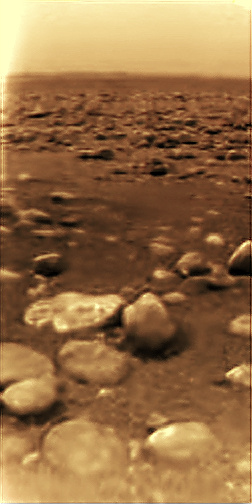
Maybe science just took center stage for a brief moment only to be replaced with the need for fame and appearing on X-Factor? Maybe a picture of the creme brulee surface of Titan from a small lander piggybacked on a probe that made a multi-billion mile tour via Venus, Earth, the Moon, an asteroid or two, Jupiter and finally to Saturn, just don't complete against today's media offerings?

How can you not be amazed by pictures like this - think about what you're looking at and what it took to get those pictures for a moment!


Wikimedia Commons, see: here

On the other hand a grainy picture of Titan from one of the Voyager probes offered mystery and a challenge to be solved - what is under those clouds? - now we get picture of sand grains on Mars. Have we accidentally removed the mystery? Or, have we lost the big exciting picture to a mass audience? A third possibility is that science is either not understood, or just can't complete with a crass, exploitative talent show...

Space exploration in any form is exciting...just listing some of the current probes:
  • Dawn is on its way to Ceres after a successful encounter with Vesta.
  • Messenger has completed mapping all of Mercury's surface and turned up just one or two (or freaking lots!) of major mysteries
  • Cassini is still going strong around Saturn
  • Juno on its way to Jupiter
  • Venus Express still examining Earth's "twin"
  • Numerous orbiters around Mars and not forgetting two (yes TWO!) working rovers on the surface
  • Rosetta is still on its journey to 67P/Churyumov–Gerasimenko.
  • China's moon probe made a detour to visit a near-Earth asteroid
  • Hayabusa returning samples from an asteroid
  • New Horizons still speeds to its all too rapid fly-by of Pluto and its now five moons (incidentally traveling at approx 15km per second or 34000mph)
  • etc etc...
  • oh, not forgetting Voyager 1 and the rest...
Now tell my what that isn't exciting? Maybe our media needs to reacquire its love affair with exploration and science and stop feeding minds with talentless shows...

Saturday, 29 September 2012

Solar Flare Video

Found this via Phil Plait's amazing Bad Astronomy blog*:

On August 31st the Sun produce an immense solar flare:  click here for a picture from Nasa with the Earth to scale or better still just go straight to the 1900x1200 version. I've made a crop of the picture below just to give a teaser:**


Now Nasa and the Goddard Space Flight Center have released a video of the event:


Make it full-screen and switch to 1080p, sit back and be impressed....


* You really should read this blog every day
** Using NASA Imagery and Linking to NASA Web Sites

Monday, 13 August 2012

Perseid meteor or ....

This is in the right place and at the right time (the bright star just right of center is Deneb) so might just be a Perseid meteor:
From Astronomy
Clear sky the light pollution even out here in the countryside didn't make for optimal viewing conditions and neither did the camera settings in this instance. You can however just make out a very faint trace of the Milky Way. The other option for the streak in the picture are satellites, but according to my searches the only things in the vicinity were 3 GPS satellites (14,22,24) and passing through that area though moving orthogonally to the steak was Saudisat 1A (SO-41). NOAA-13 was too far to the right of Deneb to be a candidate.

Wednesday, 7 March 2012

Sunday, 11 December 2011

Mission to Europa

Space.com have an article about NASA sending a lander to Europa, or at least a proposal thereof:


Jupiter's Moon Europa Is Target for Possible NASA Lander
by Mike Wall, SPACE.com Senior Writer
Date: 09 December 2011 Time: 03:22 PM ET


SAN FRANCISCO — NASA is considering dropping two robotic landers on the surface of Jupiter's moon Europa, a body that many scientists regard as the solar system's best bet for harboring life beyond Earth.

Researchers at NASA's Jet Propulsion Laboratory (JPL) in Pasadena, Calif., are developing a concept mission that could launch in 2020 and deliver the landers to Europa about six years later. The chief goal would be to investigate whether life could ever have existed on the huge moon, which likely hosts an ocean of liquid water beneath its icy shell.

This I think should be a priority, and should have been the mission flown rather than the relatively boring Juno probe. Europa is extremely interesting from the point of view that it probably, or even more than likely, has life due to its icy surface and liquid water ocean underneath. The only other places that have these possibilities (as we understand at present) are Enceladus and Titan - the latter having been visited by the truely amazing Huygen's lander by ESA.

So this gets me thinking, space probes are extraordinarily expensive as they tend to be one off constructions. However building on mass production techniques would it be possible (almost certainly economically better) to mass produce probes. Make them light-weight with a small RTG, standardised components: visible light cameras, IR cameras, magnetometer, various particle detectors etc.

Make two batches, one orbiter and one lander and take advantage of systems such as SpaceX which provide low cost launching facilities. There needs to be done work on getting the launchers to provide the capabilities to get the things out of Earth orbit.

Now if you built, say, ten or even twenty (NASA's Surveyor programme made seven landers of a standardised design)  you could quite easily send two or more to whatever target, or maybe just one to the "easy" targets and two to the "harder" ones.

So my list:
Just a thought....but might be an interesting method of fiscial stimulus and jobs for tech workers, not to mention the increase in interest for science and exploration this might provoke.


Tuesday, 15 November 2011

Voyager 2 and LHC

Been a bit slow this month with things to write - actually plenty to write but little time to actually write here. Anyway, two from that bastion of tech literature, El Reg...

 The first is about the current results from the LHC and also an exercise in how to write a science article for the layman:


LHC results may solve riddle of how universe can exist

Antimatter bombshell set to explode physics applecart

Top boffins at the Large Hadron Collider – mightiest particle-punisher and largest machine of any kind ever assembled by humanity – say that they may have uncovered a vital clue explaining one of the greatest mysteries of physics: namely, how is it that matter itself can exist?

Good to see the Standard Model getting a bit of a run for its money...one paragraph spurred a superb retort in the comments:


One of the things the Hadron Collider can do by means of blasting protons into one another head-on at just a gnat's chuff less than light speed is create all sorts of very rare and exotic particles – and the antimatter versions of themselves. Almost anything you might want in the way of crazy particles will appear in the shattered sub-subatomic wreckage spraying out of the proton pileups on the Collider's 27km underground orbital motorway.
and the retort from "a non e mouse":
"Almost anything you might want in the way of crazy particles will appear..."
Except, maybe, the Higgs Boson

However it does look like we might have a lightweight Higgs....maybe....

and then over to the still running Voyager probes and in this case the efforts by NASA to keep Voyager 2 running for another 10 years...(El Reg writes space articles in a similar innuendo filled style as LHC articles...)

Voyager 2 finally agrees to a long hard thrust

Probe takes light-ages to return boffins' calls

Voyager 2 has finally gotten back to NASA to let engineers know that its switch to back-up thrusters was successful.
The space agency sent the signal last week to advise the old explorer to switch to back-up thrusters in order to conserve energy so it can continue its voyage for another decade.
 
Not bad when you consider Voyager 2 was launched in August 1977 and a touch over 9 billion (9,000,000,000) miles away...
 

Tuesday, 18 October 2011

Jupiter

A little experiment with the Canon 55-250mm kit lens:  Jupiter with (left to right) three of the Galilean moons: Io, Europa and Ganymede:


Not the greatest photograph but it demonstrates that it is just about possible...the disk of Jupiter is completely saturated while the moons are out of focus blurs. Impossible to focus correctly and it was windy - not a great lens for this sort of work either...

Monday, 19 September 2011

Neptune (in infrared)

Skymania has an article on Neptune taken with the Keck 10m telescope in infrared. Given the distance to Neptune the quality of the pictures is incredible especially if compared with the Voyager 2 pictures from 1989.

Stunning snaps of Neptune and Triton

Posted by on September 18th, 2011
Infrared image of Neptune
Infrared image of Neptune (Credit: Mike Brown/CalTech)
Here are a couple of views of Neptune as you have probably never seen the planet before. They were captured earlier today by astronomer Mike Brown using a 10-meter (33 ft) telescope at the W. M. Keck observatory on Hawaii.

This also appeared on the Bad Astronomy blog: Neptune is *really* far away...which also explains something about the distance to Neptune and the difficulties of taking pictures...


Sunday, 18 September 2011