Showing posts with label Wales. Show all posts

Thursday, 23 June 2016

So, the UK's referendum on whether it should leave the EU or not is today.

  • If more than 50% of the electorate who cast a vote for remaining then it is fairly obvious what happens next with a small caveat (see below).
  • If more then 50% of the electorate who case a vote for leaving then the theoretical process is that the UK has 2 years to negotiate its leaving of the EU - trade agreements, human rights, workers rights, environmental rights etc. Whatever is left over after the 2 years is "free game" and the UK would be a complete outsider with regards to its bargaining position.


Now the caveats:


  1. Under UK Referendum Law, referenda are not legally binding which means that the result could be annulled, ignored or reversed.
  2.  A majority of MPs in the UK Parliament could band together and cause the result to be annulled, reversed or ignored. This is actually likely as there would have to be a vote on the clauses in UK Law relating to EU membership. What happens if a majority of MPs vote to ignore/annul/reverse the referendum result?
  3. Given the level of division in the UK's Conservative Party, if the result is to remain then what happens to those MPs in the Conservative Party who campaigned against the PM?
  4. If the UK votes to leave, then the PM will more then likely be challenged by the remain faction of the Conservative Party: a) the PM will likely resign in this case, b) would a general election be called
  5. If a general election is called: a) what happens if the country votes in a government that is pro-EU but the referendum delivers a leave result? b) vice versa of (a) or c) what happens if the UK gets a hung parliament with a mix of pro and anti-EU factions?


Given the caveats, this probably isn't the best environment for any UK-EU negotiations and would actually take up time from repealing the various UK Laws on EU membership and the 2 years negotiation time.

Then just a final remark on the arguments of sovereignty and democracy.
Apparently Britain has a 1000 years of history...apart from the 3000 years or so of Celtic/Briton history before that.

If we stay in the EU we lose our "Britishness" - whatever that is? Personally I notice the Finns are just as Finnish, the French, Germans, etc similarly. Anyway the UK is made of four different countries each with their own identities anyway.

Sovereignty of Parliament lies with Parliament anyway. At any point in time the UK Parliament could repeat the laws relating the EU membership; though no-one really knows what this means anyway.

The EU Parliament is an elected body by the universal suffrage - you do know who your MEP is don't you?

EU Laws/Directives/Recommendations must be ratified not only by the democratically elected EU Parliament, but also by each country's parliament after going through a process in which each country separately decides how to implement each law/directive/recommendation.

This latter point is important: EACH COUNTRY INDEPENDENTLY DECIDES HOW TO IMPLEMENT EU LAWS/DIRECTIVES/RECOMMENDATIONS. This means that a country (Finland - looking at you here) can implement huge restrictions on things and then "blame" EU Law - whereas often it was just a directive stating some basic ideals.

Finally immigration: which immigrants are we talking about?

  1. EU migrants - the EU upholds a basic right that any EU citizen can work and live in any EU country according to a basic set of minimal rights. Some countries impose additional restrictions but the basic right of free movement is EU Law.
  2. Non-EU migrants - decided broadly by national parliaments and the EU.
  3. Refugees - there are strict criteria set by the EU, UN and national parliaments on who can be a refugee. The EU has set out a basic set of rights and a mechanism by which countries in the EU "share" refugees. 
Whatever happens today the result will be either a very bad mess for the Conservatives or an extremely bad mess for the whole UK. But therein lies the problem, that the vote is no longer about the EU but about the future of the UK Conservative and Unionist Party and the power brokerage of various players within this.

It is just extremely sad that there has been no intelligent discourse on the subject - primarily due to the lack of knowledge and education of not just how the EU works but how the UK's whole system of government works. I fear this is quite deliberate.

The whole debate has been riddled with fear and hate which unfortunately has also led to the death of an MP. For all the debate about sovereignty and democracy, is this what it the whole EU debate is about?

Finally I don't care whether you are pro or anti-EU, I would like some idea of what will happen in the case of either a remain or leave result. So far, there has been even less discussion of what happens next than there has been of what the EU and UK mean to each other.

Thursday, 22 October 2015

Tryweryn and Welsh Devolution

It has been fifty years since the flooding of the Tryweryn valley in Wales in order to create a reservoir for the city of Liverpool. This week also saw the publication of the planned reserved powers for the Welsh Assembly.

The planned reserved powers when coupled with the planned English Laws plan introduces an scenario where it becomes possible for English MPs to veto a Welsh Law in cases where there might be a perceived affect upon England. The reverse situation can not happen however.

This then raises all sorts of strange constitutional questions; such as does this invalidate the results of the 2011 referendum of law making powers for Wales?

Another point then in the definition of what sovereignty means.

If we place the above into the EU-UK then this becomes the heart of the debate about whether the UK should in in or out of the EU.

To give a more concrete example of the convoluted ideas of sovereignty and national responsibility there's the point made by John Elfed Jones, former chairman of Welsh Water that Wales should be allowed to sell its water to England. The analogy drawn between food and crops from eastern England and 'Scottish' oil should spawn a very interesting debate.

To finalise, we have confusion in the UK about what sovereignty and responsibility means. At one political-economic level we demand responsibility and sovereignty, but at others not at all. So where does the boundary exist between these concepts?

Discuss.

Saturday, 4 April 2015

2015 UK Election Leader TV Debate

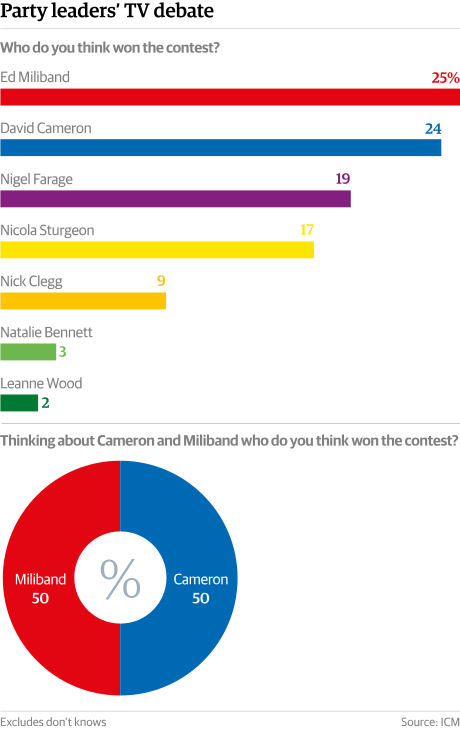
Whether leadership debates are a good thing or not is itself a debate, however ITV's UK Leadership Debate with seven party leaders was held with the result that Miliband (Lab) "beat" Cameron (Con) by a small margin. YouGov made a survey of who do you think won the debate with the results as shown below (source: Guardian)

One thing however is not explained, and that is who was asked. Obviously if you'd polled in Ceredigion or Gwynedd then Wood (PC) would have won, if in Brighton then Bennet (Greens) and so on. However I assume that we could say that this was a representative sample from across the UK, but still it is going to be heavily weighted in favour of the national parties and then especially the two leading parties.

This got me thinking, as you can tell whatever you want with statistics - think of it as accountancy with more leeway - could the above figures be weighted according to the uk electorate, especially as two of the parties involved do not campaign outside of Wales or Scotland.

The electorate figures for England, Scotland and Wales for 2013 according to the Electoral Commission are 40,100,00, 4,100,00 and 2,300,00 (to nearest 100,000). Given this I think it is obvious that the above results are going to be skewed towards the established parties.

Furthermore the SNP are fairly well known and have a more 'national' or UK-wide agenda than Plaid Cymru who are much more focussed on Wales. Leanne Wood (PC) for example is standing as a member of the Welsh Parliament rather than Westminster. Welsh politics rarely feature outside of Wales, except for a strange incident back in 1997 (one, certainly for the conspiracy theorists). Ironically given the current constitutional issues since the Scottish independence vote, it has been Rhodri Morgan, leader of the Welsh Government who has been proposing ideas (even at EU level) of how the UK and Northern Ireland should be governed.

That given, the above figures on who "won" really should be taken much more in context of the audiences to which they are most relevant. The above is so much biased towards an English view - not that there's a problem with that - it does give a false impression to voters in Wales and Scotland. Furthermore, given the size of England and its electorate even the above figure does not truly represent England - how would it look in the context of Thanet versus Toxteth?

So getting back to how the leaders actually did in the debate, it would be best to take each individually, especially as each has very different leadership goals. Probably the best overview of each of the party leaders' performances was given by the Telegraph. Or as another put it, four out of touch public school boys taken to task by three women :-)


Thursday, 18 September 2014

Scotland, Independence, Wales, the UK etc...


Well, what ever happens today in Scotland, I think that Salmond has won: the concessions that have been offered Scotland by the leaders of the main parties in the UK are generous to say the least. In effect a no vote will trigger practically everything but independence and full financial autonomy, while a yes vote will lead to much protracted negotiations and to be honest I'm not sure either side in this has a good idea of how these will turn out.

The questions of economy, currency union and EU membership are academic to a point. Firstly Scotland's economy will probably do quite well, though the independence vote is not specifically about the economy but rather the right of a people to decide their own future - democratically. Currency union might well become a moot point - if Scotland enters a currency union with the UK pound then there isn't really much the UK could do about it; there are alternatives such as pegging a Scottish currency against the EU in much the same way as Montenegro has done. Even if Scotland's currency did devalue then this could be a good thing for inward investment.

EU membership is interesting, especially as Spain and quite probably Belgium has vested interests in quelling their own internal independence movements - even then the pressure from their local voters and even smaller EU nations which might feel threatened by over dominance by larger members might sway this. EU membership also solves the currency issue.

Border controls and the like? Well Scotland couldn't become a Schengen country unless the UK joined too and I strongly doubt that we'd see passport checks at any time in the future other than in the more fanciful predictions.

My main issue however is - regardless of yes or no - is what happens to Wales and to a smaller extend to Northern Ireland and England. Certainly some Welsh politicians seem blissfully unaware or even naive of the implications. Even the Conservative Party in Wales has come out much more in favour of devolution of powers to Wales than Labour.

Politicians always has vested interests anyway: the Conservatives know that their only chance of any power in Wales is through the Senedd while Labour can always sit back and count on votes from their heartlands both in Wales and England. If Scotland leave, or even in Westminster is reorganised to solve the West Lothian Question this might change as Welsh MPs would have little influence even if they did vote on English specific legislations. There's an interesting discussion about this on the TrueWales web site in an article written by Rachel Banner (24 Jan 2012): The West Lothian Question.

Ironically it has been Welsh MPs who have probably made some of the most important decisions regarding England the UK: Nye Bevan and the NHS, Lloyd George and Home Rule (which unfortunately didn't come to pass due to World War 1) and even back to the Welsh advisors to Queen Elizabeth the First who promoted the idea of naval supremacy.

If we come back to what has been offered Scotland now and since the 1998 devolution votes one must seriously ask the question of why Scotland gets so much at the expense of the rest of the nations of the UK. I'm still unsure why every change to devolution in Wales requires a referendum such as that back in 2011 which granted Wales the power to make laws specific to the needs of the nation. Are politicians so weak and afraid of their decisions? Surely the populace voted those MPs into power to make such decisions for the good of the people and so they should take the responsibility themselves rather than pass it off to often under informed voters?

So on Friday, will Wales be offered DevoMax? I doubt it - no politician is that brave.

Thursday, 2 February 2012

Welsh Independence

The Guardian today has an excellent, well-written, balanced article on the issue of Welsh independence in light of the moves by the Scottish Government.

Could Wales leave the United Kingdom?
Talk of independence is growing – and the referendum in Scotland in 2014 is eagerly awaited. But could Wales really break free from England – and stand on its own?John Harris
guardian.co.uk, Wednesday 1 February 2012 20.00 GMT
 
Leanne Wood is rather different from most of the UK's politicians. Forty years old and a mother of one, she still lives in the same street in the Rhondda Valley where she was born and brought up. She thinks the crash of 2008 should have "resulted in the rejection of capitalism and many of its basic economic and political assumptions", and that the UK's coalition amounts to a "hyper-competitive, imperial/militaristic, climate-change-ignoring and privatising government". She is also a proud republican, who refuses to attend the kind of official events at which the Queen turns up, and was once thrown out of the Welsh Assembly for referring to the reigning monarch as "Mrs Windsor". If any of this chimes with your general view of what's wrong with the world, it's fair to say that you'd like her.

 
Quite interestingly, this article (and comments) are devoid of the usual rabit, anti-devolutionist talk but rather focus on some interesting issues. Now if looking at a post-independent Scotland UK, what would this mean for Northern Ireland and Wales. Certainly in this situation we'd have an extremely powerful English central parliement with two very small additions. Does this imply we'd automatically get a federal UK (whatever the UK means at this point) - Spanish or German style federation? More importantly, at least from the English perspective, is what happens to England; especially what happens to the bulk of England that isn't London or the South-East?

Anyway, I digress, most of the talk about the Welsh Government is along the lines of a certain scene in Monty Python's Life of Brian .... "what have the Romans ever done for us?"


Sunday, 15 January 2012

Election Boundary Changes in Wales

Just some raw figures from The Guardian's description of the proposed boundary changes for the next UK general election:


Boundary changes: the first map of the UK's new constituencies
Simon Rogers and James Ball
guardian.co.uk, Wednesday 11 January 2012 07.30 GMT
How would the UK have looked if the 2010 election had been fought with the new constituencies? Would your MP still have a seat? Boundary Commissions for England, Scotland, Northern Ireland and now Wales have published their recommendations - and we've collated them to show the country as a whole. A crude analysis of the 2010 results creates the following map.

Party Seats 2010 %age seats 2010 Seats New Boundaries %age seats (new) Difference %age points
Conservative 8 20% 5 16% -4
Labour 26 65% 22 73% +8
Liberal Democrat 3 7.5% 2 6.6% -1
Plaid Cymru 3 7.5% 1 3.3% -4
NB: These results and predicitions are based on the 2010 results following the methodology used by The Guardian. These results refer to the Welsh MPs as elected to the Westminster parliaments and not to the Welsh Devolved Government which is elected by a separate system.

Given that these changes are being made by the Boundary Commission which should be independent of any serving government, it is interesting the rise in power of Labour in Wales at the expense, especially of the nationalist party Plaid Cymru. This raises an interesting point, especially with the current debate and discussion about Scottish independence and the position of the major national parties within the UK. Scotland's nationalist party's - SNP - seats under this new model wouldn't change, in Northern Ireland, Sinn Fein, loses its stronghold to a highly variable mix of other parties, and in Wales, as we can see, Plaid Cymru loses 66% of its seats.

Caveat: these results are based upon the 2010 result and extrapolated over the proposed changes - things could and probably will change in a real election, especially given current economic and political circumstances.

Now there has been discussion on the fairness of these changes and one reason for the rise in Labour and the reduction in smaller parties and the Conservatives might be to address the balance of power in a future Westminster Parliament given that England overall has a large Conservative majority. The other reason could be that this is an attempt to weaken nationalist or smaller parties in Westminster. The latter is also interesting given the move in Wales of the major parties: Labour, Conservatives and Liberal Democrats to distance themselves away from Westminster and even in the case of the Conservatives to even consider changing their name in Wales.

And in here lies some interesting aspects of devolution in the UK, for example in Wales, the Conservatives who were highly sceptical and anti-devolution have come to support this as the only mechanism by which they can have some power in Wales (and Scotland too) and ironically for Labour, a pro-devolution party, became at a national level a kind of anti-devolutionist party given the extremely awkward set of rules and processes placed upon the Welsh Government to actively prevent use of that body's powers. Now after the last referendum in Wales which finally gave primary law making powers in the 20 or so devolved areas of government after some 800 years, we still have the possibility of anther referendum to given Wales tax-varying and borrowing powers in line with Scotland, though not control over certain fiscal issues such as the ability to print its own currency.

However one of the good things is that this does reduce the number of MPs in the UK overall but does somewhat distance the national MP away from their constituents, especially in England where no intermediate form of government exists. At least in Wales, Scotland and Northern Ireland, the respective devolved governments are closer to the local people with more interest in local issues.

Tuesday, 18 October 2011

Llantrisant and Taff Vale on Facebook?

Someone (or something) has copied the Wikipedia articles that I mainly authored on the Llantriant and Taff Vale Junction Railway and made Facebook pages out of them...not quite sure why unless they're trying to get a following for the line and individual stations - not really sure how social networking really helps a disused railway with no chance of reopening (pity!)....

Some links to the Facebook pages:
I don't really mind, it is in the spirit of Wikiedia and the articles are according the creative commons licensing; nice to be sort of famous....anyway the Wikipedia articles are the authorative source along with Chapman's book on the line:
Chapman, C (1996) The Llantrisant Branches of the Taff Vale Railway. The Oakwood Press. ISBN 0 85361 4814
Here's the original blog article from here linking to the Wikipedia articles...

Friday, 21 January 2011

Llantrisant and Taff Vale Junction Railway

Interesting article on Wikipedia (quite a lot of which I'm responsible for...especially the map) about the railway line between Pontypridd and Llantrisant as well as the "Barry Railway" branch:

Llantrisant and Taff Vale Junction Railway

Additionally some fantastic pictures of Tonteg Halt and Junction. This was the post 1930 Tonteg Halt station after track rationalisation between Tonteg and Treforest High Level and Llantwit Road, the former Tonteg Halt was further down Maes Mawr road.

Saturday, 19 December 2009

Organ Donation Law Proposal in Wales

Given Wales' limited autonomy, the ability to make decisions such as this are only good for the country; it also means that Wales' policies and (secondary) laws are different from the rest of the UK and provide a differentiation which is to the advantage of the people of Wales. This particular piece of proposed primary legislation is particularly important and really should be the default - in the meantime go here (UK NHS):

This from the BBC:

Wales seeks organ opt-out powers
Wales could become the first part of the UK introduce an opt-out system of organ donation under plans by the assembly government. It would mean that Welsh residents would be presumed to be organ donors unless they have joined an opt out register or immediate relatives object.
Long may it continue, however future primary law making powers are still to be crippled by Westminster...

As an aside, many countries in Europe use the presumed consent idea - Finland does not (link to English translation of Finnish law) though it has been proposed to be changed in the next year.

Tuesday, 1 December 2009

Welsh Devolution

It all seems so simple: Wales (similarly to what Scotland has) will get primary law making powers if the country votes yes in a referendum to be held sometime in the future.

Betsan's Blog on the BBC website contains daily udates on the Welsh political scene and of course much discussion on devolution.

While there's is much debate from the usual suspects (generally from people who are rabidly against devolution but have no idea why) about the Welsh Assembly and whether Wales should take responsibility for its own affairs instead of it being dictated by someone in Westminster (what was it, over 1000 quangos under previous administrations and none of them accountable to the Welsh electorate?), there is absolutely no discussion about why Westminster put all these restrictions on Welsh self-determination.

For example, the current discussion about what would happen after a referendum and in what areas Wales would take full responsibility reveals that the piecemeal approach by Westminster shows a bizarre degree of arrogance to Wales - but not Scotland nor Northern Ireland? Ironically it is England that actually suffers from a lack of transparency and democracy in this case.

So some questions:

  • Why didn't Wales get primary law and tax varying powers?
  • Why can't Wales get primary law and tax varying powers?

One answer is "history" and that the current system is "working" . Let's tackle the latter point first in terms of "working" ... should we go back to the situation where the decisions directly affecting the Welsh electorate are not made in Wales but by a group of politicians sitting in London, the vast majority of which do not have any interest in Wales at all?  This is effectively the West Lothian Question by applied to Wales. Secondly where in history do you wish to base your defintion of the "correct" time ... pre 1066?, 1535-1542? 1979? 1997? Why not use the Laws of of Hywel Dda?

But also as answers to the two above questions, the amount of tax payers money (in the UK as a whole) now being spent on managing a bizzarely, complicated LCO process for allowing Wales to even manage things such as the Welsh language is obscene (a link to this particular LCO is here). This of course produces another question as to why Wales didn't get responsibility for the laws relating to a language spoken inside her borders in the first place?  Why the utter arbitaryness of the whole process in the first place?

To answer the question of whether Wales needs these powers is quite simple, the smaller and more focussed government is the more relevant it is for the people. If Wales shouldn't have more devolution then why should Scotland or Northern Ireland, or even England? But this brings up another bogey term - federalism - which is banded around the UK press and uttered with the same contempt as the EU - but seems to work in Germany, Spain, Switzerland etc...not too dissimilar countries from the UK?