Showing posts with label Elections. Show all posts

Saturday, 4 April 2015

2015 UK Election Leader TV Debate

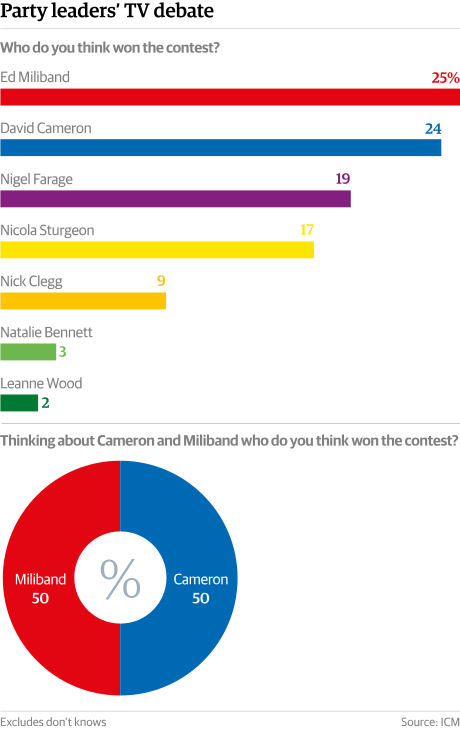
Whether leadership debates are a good thing or not is itself a debate, however ITV's UK Leadership Debate with seven party leaders was held with the result that Miliband (Lab) "beat" Cameron (Con) by a small margin. YouGov made a survey of who do you think won the debate with the results as shown below (source: Guardian)

One thing however is not explained, and that is who was asked. Obviously if you'd polled in Ceredigion or Gwynedd then Wood (PC) would have won, if in Brighton then Bennet (Greens) and so on. However I assume that we could say that this was a representative sample from across the UK, but still it is going to be heavily weighted in favour of the national parties and then especially the two leading parties.

This got me thinking, as you can tell whatever you want with statistics - think of it as accountancy with more leeway - could the above figures be weighted according to the uk electorate, especially as two of the parties involved do not campaign outside of Wales or Scotland.

The electorate figures for England, Scotland and Wales for 2013 according to the Electoral Commission are 40,100,00, 4,100,00 and 2,300,00 (to nearest 100,000). Given this I think it is obvious that the above results are going to be skewed towards the established parties.

Furthermore the SNP are fairly well known and have a more 'national' or UK-wide agenda than Plaid Cymru who are much more focussed on Wales. Leanne Wood (PC) for example is standing as a member of the Welsh Parliament rather than Westminster. Welsh politics rarely feature outside of Wales, except for a strange incident back in 1997 (one, certainly for the conspiracy theorists). Ironically given the current constitutional issues since the Scottish independence vote, it has been Rhodri Morgan, leader of the Welsh Government who has been proposing ideas (even at EU level) of how the UK and Northern Ireland should be governed.

That given, the above figures on who "won" really should be taken much more in context of the audiences to which they are most relevant. The above is so much biased towards an English view - not that there's a problem with that - it does give a false impression to voters in Wales and Scotland. Furthermore, given the size of England and its electorate even the above figure does not truly represent England - how would it look in the context of Thanet versus Toxteth?

So getting back to how the leaders actually did in the debate, it would be best to take each individually, especially as each has very different leadership goals. Probably the best overview of each of the party leaders' performances was given by the Telegraph. Or as another put it, four out of touch public school boys taken to task by three women :-)


Monday, 11 June 2012

Information engineers wanted

Continuing on the theme of semantic isolation and data siloing* somewhat, I was listening to the Diane Rhem Show on US talk radio station NPR via Finland's YLE Mondo. Today's programme "New Voter ID Laws and the 2012 Elections" was about the USA's law regarding voter eligability and the problems of keeping track of who is and who isn't allowed to vote in certain elections (2012 presidential election being of particular concern).

One part of the programme concentrated on the difficulty of cross-referencing between voting lists in states, counties and various government bodies such as the driver and vehicle licensing (DMV). One of the major problems is that actually identifying and subsequently cross-refenencing people by ID numbers (plural!), by name (due to misspellings, usually involving punctuation) or by address and location. Making this even more interesting is the temporal aspect that over time people move and records in differing data-sets end up overlapping or being temporally disjoint.

One of the current solutions is to use what was termed "election geeks" - people with highly detailed knowledge of voter lists and how to match records in different formats from different states and agencies together. That is a group of people who are highly skilled in performing the manual task of deisolating the semantics of each data set (of voters) and matching these together.

One of the presenters remarked that while a technological solution was necessary we need more so called election geeks. Putting it another way, we need more highly skilled engineers specialising in information, information theory, semantics and ultimlately semiotics. What a great idea!

*this links to part 1, parts: 2 and 2 and a half.

Wednesday, 28 April 2010

Monday, 19 April 2010

UK Election 2010

Now it gets interesting: Election 2010: Lib Dem policies targeted by rivals

with the Liberal Democrats actually showing around 30% of the popular vote and in some polls even in first place. However, in the UK's electoral system neither the head of state nor the upper house are voted for. Then there's the lower house which works on a first past the post system which produces a very skewed result - primarily because the the vote is for a constituency rather than a party; and the winning party then rearranges the constituency boundaries to its favour.

So, what happens if the Liberal Democrats win 30% of the vote, Conservatives 30% and Labour 30% with 10% going to Plaid Cymru, SNP and the other parties? According to the BBC's vote calculator the UK gets this:

Party, Popular Vote, Seats in Government, %age of seats
Labour 30% 315 seats (~48.5% of seats)
Conservative 29.9% 206 seats (~31.5% of seats)
LibDem 30% 100 seats (~15% of seats)
Other 10% 29 seats (~4% of seats)

*NB: figures are +/- 0.5%

Tuesday, 1 December 2009

Welsh Devolution

It all seems so simple: Wales (similarly to what Scotland has) will get primary law making powers if the country votes yes in a referendum to be held sometime in the future.

Betsan's Blog on the BBC website contains daily udates on the Welsh political scene and of course much discussion on devolution.

While there's is much debate from the usual suspects (generally from people who are rabidly against devolution but have no idea why) about the Welsh Assembly and whether Wales should take responsibility for its own affairs instead of it being dictated by someone in Westminster (what was it, over 1000 quangos under previous administrations and none of them accountable to the Welsh electorate?), there is absolutely no discussion about why Westminster put all these restrictions on Welsh self-determination.

For example, the current discussion about what would happen after a referendum and in what areas Wales would take full responsibility reveals that the piecemeal approach by Westminster shows a bizarre degree of arrogance to Wales - but not Scotland nor Northern Ireland? Ironically it is England that actually suffers from a lack of transparency and democracy in this case.

So some questions:

  • Why didn't Wales get primary law and tax varying powers?
  • Why can't Wales get primary law and tax varying powers?

One answer is "history" and that the current system is "working" . Let's tackle the latter point first in terms of "working" ... should we go back to the situation where the decisions directly affecting the Welsh electorate are not made in Wales but by a group of politicians sitting in London, the vast majority of which do not have any interest in Wales at all?  This is effectively the West Lothian Question by applied to Wales. Secondly where in history do you wish to base your defintion of the "correct" time ... pre 1066?, 1535-1542? 1979? 1997? Why not use the Laws of of Hywel Dda?

But also as answers to the two above questions, the amount of tax payers money (in the UK as a whole) now being spent on managing a bizzarely, complicated LCO process for allowing Wales to even manage things such as the Welsh language is obscene (a link to this particular LCO is here). This of course produces another question as to why Wales didn't get responsibility for the laws relating to a language spoken inside her borders in the first place?  Why the utter arbitaryness of the whole process in the first place?

To answer the question of whether Wales needs these powers is quite simple, the smaller and more focussed government is the more relevant it is for the people. If Wales shouldn't have more devolution then why should Scotland or Northern Ireland, or even England? But this brings up another bogey term - federalism - which is banded around the UK press and uttered with the same contempt as the EU - but seems to work in Germany, Spain, Switzerland etc...not too dissimilar countries from the UK?

Tuesday, 27 October 2009

Yr etholiad nesaf yng Nghymru

Ffeindiais fi rhyweth diddorol o blog yma gân Gymro. Diddorol iawn ydy'r y post yn ei flog Saesneg e (mae blog arall yn Gymraeg gyda fe) am y YouGov Poll ar yr etholiad ym Mhriadain nesaf yng Ngymru: "Poll predicts Labour trouncing at next election".

Yn yr blog (yn Saesneg) ydy'r dyfynbris:
"...a word of caution: Apparently The figures have been weighted and are representative of all GB adults (aged 18+). This has been one of the reasons why most previous Welsh polls have proved disastrously inaccurate. Wales is not a mini GB. In Wales the C2s Ds and Es are a much more important factor in elections than the C1s who swing middle England for one party or an other."
mae'r rhifau o'r YouGov Poll ydy (Hydref 2009)
  • Plaid Llafur 34% (-8.7%)
  • Plaid Geidwadol 31% (+9.6%)
  • Democratiaid Rhyddfrydol 12% (-6.4%)
  • Plaid Cymru 15% (+2.4%)
Newyddion drwg i Blaid Llafur a Phlaid Cymru hefyd - ydyn nhw'n wrthbleid wir i'r Ceidwadol? Sain gwybod, ond rydw i'n siwr pan bydd yn dod swpreis mawr yng Nghymru yn yr etholiad, ond i pwy?

Wednesday, 21 October 2009

Sequoia's code, pt.2

More discussion here to keep track of...

http://www.codersrevolution.com/index.cfm/2009/10/21/Sequoia-Voting-System-Witch-Hunt-err-Study-Project

Comment on e-Voting system standards:

http://www.sos.ca.gov/elections/voting_systems/ttbr/sequoia-source-public-jul26.pdf

State of California's report on Sequoia's voting systems:

http://www.sos.ca.gov/elections/voting_systems/ttbr/sequoia-source-public-jul26.pdf

Sequioia Voting Systems' Code

http://studysequoia.wikispaces.com/