Friday, 17 July 2015

Privacy Engineering Book, 1 Year since publication

On the 18th of July, 2014 I published my first book: Privacy Engineering, a dataflow and ontological approach.

So, happy birthday to my book and the story of its writing can be found on this blog (here!). :-)


Since then I've been privileged to have invited talks at the IAPP's DP Intensive, IWPE 2015, various university lectures, an EIT SIG on Privacy, a semi-regular column on the IAPP's Privacy Tech blog and many other unexpected places - all to talk about the ideas in this book. Next up is a tutorial session at TrustCom 2015 in Helsinki in August with the authors of my "rival" book, The Privacy Engineer's Manifesto: Michelle Dennedy and Jonathan Fox of McAfee/Intel.

And it does feel good to call oneself "an author" ...gives one an air of gravitas...maybe I should start drinking absinthe and discuss philosophy while smoking a pipe?

So what's next? Well, a second book concentrating more on the modelling analysis should appear later this year - tentatively in December. Here's a preview of the cover:


Privacy Engineering is available on Amazon UKAmazon US (as well as where ever else Amazon has sites), Barnes and Noble, CDON (Finland) and CreateSpace itself

* * *

Privacy Engineering: A Data Flow and Ontological Approach by Ian Oliver, 18 July 2014 (CreateSpace Independent Publishing). ISBN-13: 978-1497569713 ISBN-10: 1497569710 264 Pages, B/W on White Paper

Tuesday, 14 July 2015

Pluto

Finally :-)  Not a lot to say about this one except this fantastic picture from NASA:

Pluto (C)2015 NASA


How not to collect data

Would you give your personal details to someone without knowing what they're going to be used for? How about if I said, "give me your name, email address and post code" and I'll make you a member of our exclusive most-favoured customer club? But, I'm not going to tell you what the terms and conditions are, how I'll use the data or even who I am except by vague implication in the latter case?

How about if I wrote the above on a piece of paper and left it on an official looking stand in a shop...yes?

Seen in a shop in Finland:

The text says:

Join now as a favoured customer and you'll hear always as the first about our fantastic offers and wonderful happenings. 
If you want to join as our favoured customer just fill this form with the needed information and hand it to the staff and we will take care of the rest. 
Name:_____________________________________________________
Email:
_____________________________________________________
Postcode:
___________________________________________________

I tried asking the store staff but they say it is a different company's problem and they have no idea of how the forms will be used. So far I've had no luck in contacting the company to which the forms probably belong...

Wednesday, 8 July 2015

Tufte-LaTeX

Edward Tufte is well known for his work on textual and graphic presentations. His books, starting with The Visual Display of Quantitative Information are written with a very specific style, particularly in the way the pages are organised. Tufte uses wide margins which enforce the writing of side nodes.
For users of LaTeX there is a very good package called tufte-latex for emulating this style. I used this for the writing of the Privacy Engineering book [1], as an example page below shows:
Extract from book: Privacy Engineering -
showing the Tufte style of page layout

There is a Google group for the discussion of the tufte-latex package, but I'll reproduce here my experiences of using this package so maybe a wider audience gets to know about this and how they might too use this excellent LaTeX package.

Originally written 20 July 2014, tufte-latex Google Group

Just a few experiences on self-publishing and the Tufte-LaTeX style - I noticed a few questions and after going through this process successfully (yay!) I'll offer some thoughts here.

Firstly, I looked at a number of self-publishers, Lulu, CreateSpace etc. Of these CreateSpace gives the best options from book styles (colour, B/W, sizes), ISBN options, marketing etc. YMMV of course.

In the end I chose a 7x9 inch format for an academic text book, B/W printing on white paper. CreateSpace assigned the ISBN and deal with the purchasing and printing, plus the sales channels which are fairly extensive. The main problem is that you don't get an editor nor deadlines :-)   So spelling checking is going to be your responsibility. You also don't get an advance from the publisher either, so no Ferrari while you complete your masterpiece....

My set up is as follows:
  • Sublime and vi editors
  • Bibtex
  • Pdflatex
  • Microsoft Visio Professional
running on Windows, MacOSX, Linux as necessary. Whether you like Visio or not, it is the best diagramming tool. You might also need Gimp for cropping pictures.

Actually, running LaTeX with the Tufte style is no more difficult than anything else in LaTeX but there are a few considerations:

  1. Tufte gives ample room for side notes - great for references and additional comments, marginalia etc

  2. You can no longer say things like "as demonstrated in [34]" because the reference number appears as a superscript. This changes the style of sentence in that you must explain what you're talking about instead of relying on the reader referring to the reference.

  3. Diagrams:  be very careful with figure* and figure.  Most of the time  figure  is fine and try to keep the diagram within the margins of the main body of text. Sometimes it is necessary to use the full width, but sparingly IMHO

  4. Tables: I used the full width unless the table was particularly simple.  So  table*  for most.

  5. Labels: Didn't use as \ref{label name} doesn't give the section number. I suppose you could reference back to page, but (see #2) you can change your style of writing to make everything stand-alone. Actually I did refer back to figures and tables as necessary.

  6. Margins... I actually hacked tufts-common.def (see below)

  7. Tables again: see below for the Latex formatting not to use vertical lines - works well.

  8. Diagrams again: 300dpi minimum. I actually used 600dpi PNG files for inclusion in the text. If you export from PowerPoint this is going to be a big problem, but there are instructions to force PPT to export at 300dpi by adding things to the registry (fun!)

  9. Justified text for the body and sans serif sidenotes looks great!

I should have used \geometry but this was my method. I added between the A4paper and B5paper sections to tufte-common.def:

%%%%%%%%%%%%%%%%% IAN 7.44 by 9.69 inches
\newboolean{@tufte@ianpaper}
\DeclareOptionX[tufte]{ianpaper}{\setboolean{@tufte@ianpaper}{true}}

Then later in the file (Search for a4paper and put it after there):

%%%%%%%%%%%%%%%%%%%%IANPAPER DEFINITION
%%%% 7.44in x 9.69in  == 18.898cm x 24.613 cm
%Another modification for 300 page manuscript on CreateSpace
\ifthenelse{\boolean{@tufte@ianpaper}}
  {\geometry{paperwidth=7.44in,paperheight=9.69in,left=0.75in,top=20mm,bottom=20mm,headsep=2\baselineskip,textwidth=3.86in,marginparsep=0.28in,marginparwidth=1.8in,textheight=190\baselineskip,headheight=\baselineskip}}
  {}

You'll need to play with the margins to get CreateSpace's previewer to stop reporting errors regarding the sizes and gutter etc. But you HAVE to do this anyway to get the book published regardless of whether you using Word, LaTeX etc. Now you can use the above as a document style, ie:

\documentclass[10pt,ianpaper,sfsidenotes,twoside,justified]{tufte-book}

When working with margins the showframe package is very, very helpful:

\usepackage{showframe}


Tables

 You need to work with the p{size} options quite a bit to get these perfect...lots of LaTeX recompiling sorry. For example, the following extract gives an idea:

\begin{table*}
\small
    \begin{tabular}{  p{2.2cm}  p{2.2cm}  p{4.2cm}  p{1.5cm}  p{2.9cm} }
    \hline
 & \textbf{Adult} &  \textbf{Child} &  \textbf{System} &  \textbf{External} \\ \hline\hline
Collection & Allowed, with consent & As per COPPA, but generally not allowed & Allowed & As per agreements \\ \hline
    \end{tabular}
   \caption[][0.5cm]{Example Policy Level Provenance Classification Requirements}
\end{table*}

I found that a double line after the title and single horizontal lines elsewhere looks good IMHO

Citations, Sidenotes, Captions and Marginalia:

This is going to be the biggest headache!!!

Don't fiddle with the layout of these until you've reached your final, final draft. I noticed that various PDF views won't show text outside the margins so things seem to disappear only to reappear in CreateSpace's previewer which tells you about these things. Once the text is finalised then work with moving these elements up and down to make the fit within the vertical margins of the page. Much trial and error. Note that captions take 3 parameters, sidenotes just 2 ... this caught me a few times!

Also, sometimes text in \url{} or unsplittable text exceeds the horizontal margins...YMMV and you'll have to find a work around. Again for these aspects the showframe package is very helpful.

TOC, Indexes:

ToC depth should be 1 otherwise the ToC becomes too long, even though I used subsections, these don't appear in the ToC. The list of tables and figures doesn't follow the ToC style, but given the length of the latter in my case I'm pretty happy about this! This could be moved to the back matter if you want, depending upon what you're writing of course.

makeindex for some reason did not work - I could not get indexes to work at all... :-(   No idea why but in the end writing was more important than typesetting and indexes at that stage.

Font size:

I used \small with all the tables but didn't see a huge difference in font size. \tiny works, but that way too small. Otherwise things like \Huge etc work fine. Don't forget \normalsize after you've changed the font size temporarily :-)

So, overall Tufte-LaTeX is fairly easy to use with CreateSpace...thanks to all who gave help and worked on this style: it really does look fantastic in print! If you want to see the book you can go here: www.privacyengineeringbook.net   and navigate to Amazon - I think there might be a preview available. However the conversion to Kindle is always a little problematical from what I've heard but then again not a lot you can do about that. Kindle doesn't like tables and sometimes the sidenotes get mixed in the text.

My preamble looks something like this:

Note I have two documentclass lines so I can swap between A4 for printing on rather obstinate HP laser printer and the 7x9 for the real version. Showframe is commented out here. A few other things I found on these groups such as the paragraph indentations etc. I changed the parskip here.
TOC depth I set to 1 otherwise the ToC becomes too long.

\documentclass[10pt,ianpaper,sfsidenotes,twoside,justified]{tufte-book}
%\documentclass[10pt,a4paper,sfsidenotes,twoside]{tufte-book}

\usepackage{graphicx}
\usepackage{amsmath}
\usepackage{microtype}

%\usepackage{showframe}

\DeclareGraphicsExtensions{.pdf,.png,.jpg,.PNG}

%package to get copyright symbol
\usepackage{textcomp}

\makeatletter
% Paragraph indentation and separation for normal text
\renewcommand{\@tufte@reset@par}{%
  \setlength{\RaggedRightParindent}{1.0pc}%
  \setlength{\JustifyingParindent}{1.0pc}%
  \setlength{\parindent}{0pt}%
  \setlength{\parskip}{14pt}%
}
\@tufte@reset@par

% Paragraph indentation and separation for marginal text
\renewcommand{\@tufte@margin@par}{%
  \setlength{\RaggedRightParindent}{0.5pc}%
  \setlength{\JustifyingParindent}{0.5pc}%
  \setlength{\parindent}{0pt}%
  \setlength{\parskip}{6pt}%
}

\makeatother

\setcounter{tocdepth}{1}

\renewcommand{\baselinestretch}{0.925}

%----------------------------------------------------------------------------------------
% BOOK META-INFORMATION
%----------------------------------------------------------------------------------------

\title{Privacy Engineering} % Title of the book
\author[I. Oliver]{Ian Oliver} % Author

%----------------------------------------------------------------------------------------
\begin{document}
%----------------------------------------------------------------------------------------
\frontmatter

\input{./FrontMatter/title}
\input{./FrontMatter/copyright}
\input{./FrontMatter/dedication}

\tableofcontents \thispagestyle{empty}
\listoffigures \thispagestyle{empty}
\listoftables \thispagestyle{empty}


%----------------------------------------------------------------------------------------
\mainmatter
\input{./introduction/introduction}
\input{./CaseStudy/casestudy}
\input{./privacyEngineeringProcess/privacyengineeringprocess}
\input{./DataFlowModelling/dataflowmodelling}

%lots of skipped chapters!!

\backmatter
\bibliography{privacyrefs}
\bibliographystyle{plainnat}
\input{./BackMatter/bio}
\end{document}


* * *

References

[1] Ian Oliver. Privacy Engineering: a data flow and ontological approach. CreateSpace Independent Publishing.

Wednesday, 1 July 2015

Pluto

On the 14th of July a small and very fast space probe will fly-by Pluto and its menagerie of moons. In the space of a few hours we'll learn more about Pluto and its companions than we have since its discovery on the 18th of February 1930.

In fact we've learnt huge amounts so far even at the huge distances New Horizons is away from the planet (yes PLANET!).

At the moment, we've four exciting missions on-going and actively producing data: five if you include Cassini which just seems to keep going and going to the point where one could even be quite blase about its constant stream of images. OK, there *are* others but for us that particular like planetary exploration...I'll come back to Mars and Jupiter in a moment....

Of the four I'll pick out Rosetta and Philae circling and sitting on a comet nucleus respectively - I think Philae should be renamed Phoenix after its return from the dead. Then there's Dawn orbiting Ceres tantalising us with better and better resolution of a world that was probably considered no more than a lump of rock to one that is possibly even active. Finally New Horizons itself.

We've also lost two probes this year: Messenger and Venus Express as their missions came to an end. Juno is still on its way and hopefully the mission planners will get us a better look at Europa along the way, and of course a flotilla at and on Mars.

I've probably missed a few from the above list - it is getting difficult to keep track especially when even the Chinese surprise us with things such as a quick visit to a passing asteroid!

But despite all of this excitement, New Horizons brings a little sadness: we'll have completed initial exploration of the nine planets. As a child I watched, sometimes in the middle of the night the Voyager probes, especially when Voyager 2 reached Uranus and Neptune. In both cases returning not just surprises but shocks - the cliffs of Miranda, nitrogen geysers on Triton anyone!

Pluto was left alone, unvisited and somewhat unloved.

Now we get a few weeks of excitement and a day or so of wondrous revelations and New Horizons departs giving us our first and last view for a long time of this mysterious place.

And that will be all nine and it comes to an end the first major milestone of the exploration of our Solar System.

There are silver linings to this cloud: the stream of data from all the probes and years of research of New Horizons' data will hopefully provide more impetus to space exploration. We can't stay rooted to our Blue Marble forever and we must pave the way forward, not just in exploring new worlds but also in understand how the Universe operates and what is out there. These space probes furthermore push technology to unexplored boundaries will many unexpected innovations to even our daily lives.

Finally, New Horizons will look back and Pluto, probably go into hibernation and continue to a possible second target. A world that even until the 1980s and 1990s was purely hypothetical. Considering that until 1989 we expected Neptune's moons to be inert and barren rocks and found something completely different, and now expecting the same - at least in terms of surprises - at Pluto, we should have learnt by now, after the exploration of the first nine planets, that whatever comes next is going to be truly wondrous.


Monday, 29 June 2015

UK Ontology Network 2015 Presentation

I really have been a bit lax here of late - not that I have little to write, but rather time (as always!) and the day job takes me away from privacy into new uncharted, more security research related areas - which I will admit is great fun!

Back in April I attending a fascinating little workshop run by the UK Ontology Network to talk about ontologies for privacy. What makes this workshop fun is the sheer amount of interaction between the participants: the distinction between presenter and audience is completely blurred. As a presenter you get a 5 minute slot then after a number of presenters on similar subjects, a 20 minute panel session where the audience really gets into the conversation.

I'm going to be unfair to all the presenters at UKON 2015 but I'm going to pick out a presentation by Adam Nogradi on Sparqlycode - a tool for semantically annotating source code and establishing compliance against, in this case, certain security guarantees. Of course, to move to a different area all you need is an ontology for your subject area, say, privacy, and you have a tool for privacy compliance...more on this later :-)

So here's my presentation based on the work in the book Privacy Engineering: A Dataflow and Ontological Approach.


And the book containing a much more detailed description can be bought from Amazon, Barnes and Nobles etc etc.

Amazon UK/EUAmazon UK/EU

Saturday, 27 June 2015

An article on The Semantics of PII


A while back I wrote a short article for the IAPP's Privacy Tech Blog. With permission I'll reproduce it here for additional reference. Also,a tip of the hat for the administrator of the blog: Jedidah Bracy of the IAPP for his spell checking, grammar checking and editorial skills!


The Semantics of PII
Privacy Tech | Feb 26, 2015


Last year, Profs. Peter Swire and Annie Antón wrote a compelling piece in Privacy Perspectives about the need for privacy engineers and lawyers to get along. Establishing a common language in which to communicate will be essential to appropriately connect policy with technology.

It’s probably safe to say that the most common terms used in privacy are personally identifiable information (PII) and personal data, depending upon whether you come from a U.S. or European background. I think these terms are more or less self-explanatory.

But what do they really mean?

Take PII, for example. It means a chunk of data that reveals some knowledge about a person that can be unambiguously identified. Sounds more or less about right, doesn’t it? Is a computer's IP address personally identifiable? What if that IP address belongs to a router for a large, multinational corporation? Is it PII then? And what if it belongs to a family using multiple computers, tablets, phones or other devices?

We will soon find ourselves delving into the minutiae of meaning—the what-does-personal-really-mean type questions. Plus, we must ask what isinformation, and what does identifiable denote?

There is a whole area of linguistics, philosophy and mathematics—take your pick—that deals with the meaning of things, otherwise known as semantics, or even semiotics if you want the overall field.

Mathematicians took years to fully understand the semantics of even simple statements such as 1+1=2, which looks obvious until you try to explain what 1 is, what 2 is, what + means, what = means and then what it means to say 1+1. The English philosophers Bertrand Russell and Albert Whitehead spent most of their careers writing Principia Mathematica to answer this question, and after four editions and 300 pages of dense mathematics, they had an answer. That was, until a young German by the name of Kurt Gödel came along and shook mathematics to its foundations with an equally "trivial" result.

So if it took 300 pages by two of the brightest minds in mathematics to give us a semantics for 1+1=2, how many pages—and years of work—will it take to give "PII" a semantics?

Now here's an interesting point: The definition of PII that is used in contemporary privacy is perfectly well defined in the privacy-legal context. I can go to various legal documents and read a formal definition of what PII or personal data means. But as we move between disciplines—in our case from privacy-legal to privacy-engineering disciplines—these definitions no longer hold, or at the very least, they don't work well.

If we move to the other end of the scale from legal to mathematics, we find concepts such as information entropy, which provides a clear, unambiguous and precise definition of what information is as well as the identifiability of a data set with respect to some population and so on. Information entropy, however, is not an easy concept with which to work. We can state now that the legal definition of PII can be defined in terms of the mathematical definition; it's just that this is obscenely difficult to do.

Somewhere between these two extremes lies software engineering, the discipline that actually implements privacy law into our systems, in ostensibly mathematical (programming language) terms.

Software engineers, much to the chagrin of privacy lawyers, do not understand legal terms. Well, ok, they do to a point, but you try coding a statement such as "reasonable privacy" into C++ or Java!

Plus, privacy lawyers don't understand all the subtle ramifications of virtual machines, machine language, object orientation, distributed computing, network protocols, XML, RDF—the list goes on!—again, much to the chagrin of software engineers.

Yet, as we stated earlier, there is a relationship between the terms and language that privacy lawyers use and the terms and language that software engineers use. That link provides the translation mechanism that allows both groups not just to talk but to properly communicate with each other.

We can spend as much time as we’d like writing manifestos and principles, designing processes, inventing new job titles such as privacy officer, privacy compliance tsar, grand chief-overseer-of-the-worshipful-court-of-privacy-dudes and so on, but without grounding semantics into terms such as PII and personal data—terms that will allow us to translate between legal-speak and engineer-speak—all of this work will be in vain.

Thursday, 25 June 2015

What is quality?

Everyone talks about quality, whether it be a quality customer experience, or quality product, or even a quality process...still not sure what that is...but ask the question of "what is quality?" and you won't get a good answer.

There are two good places to start:
  1. Robert Pirsig's Zen and the Art of Motorcycle Maintenance
  2. John Guaspari's "I know it when I see it"
Anyone working in "quality" should have not just read but completely internalised both books before uttering a further word on the subject.

Interestingly, quality doesn't necessary mean expensive or the best - though being called the "best" occurs when you have quality.

For example, SAS actually have a "quality" long-haul economy product. This doesn't mean it is great, but they do their best to keep passengers (on an 11 hour flight) well fed and watered. Now just because I had a good experience and perceived their economy product to be of a high quality doesn't necessarily mean that they shouldn't improve on it. Trust me, there are LOTS of things SAS could do to improve on their economy product.

Airlines are abound with examples of quality: for example, Finnair vs Norwegian - the former just feels to be an expensive Ryanair but without the friendliness while the latter gives you what you need plus free Wifi (slow Wifi, but Wifi still). To me, Norwegian provides me with a quality product. Another example is Lufthansa: while their long-haul economy offering is poor from a seating point of view, their food (SAS take note, I get beer and wine for free with my meal!) and superb crews, plus the added advantage of using the A380 means I choose to fly Lufthansa when I can.

But today I came across something interesting while stopping at a cafe to buy ice-cream for my children. There is no doubt this particular cafe has good service, smiling and ample staff, and excellent ice-cream, though a bit pricey! But even with, I counted 3 members of staff and a manager present they couldn't actually keep the 10 or so tables clean. It really isn't pleasant to have to sit at a table with someone else's food still left there, or having to clean it up yourself.

While everything about this cafe says "we provide a quality product" this is let down by a very simple action of not cleaning up.

This got me thinking, especially when referring back to Pirsig's observation that even though you might have the most expensive and best built motorcycle, it only takes a single screw to become threaded, or the head to become ground away to reduce that most expensive of machines to being totally unfit for purpose - in Pirsig's case, unrepairable because of a single flaw in the cheapest, most innocuous of components.

Funny how a simple act such as clearing up a table can ruin a cafe's reputation; or, how a faulty IFE screen can ruin a flight. Sometimes it is just attitude that ruins everything...when a much respected company fails to ever ask of, or even respect even a semi-regular customer then the quality of the whole is reduce to nothing.

Sunday, 3 May 2015

Privacy Engineering on Wikipedia

I noticed that an entry for privacy engineering was missing on Wikipedia, so in the true traditions of Wikipedia I created it:


It is a bit sparse at the moment, but here's hoping that the privacy community adds material and the Gods of Wikipedia look favourably on the entry...


Friday, 1 May 2015

Goodbye Messenger

One of the first posts here was about NASA's Messenger probe to Mercury, and today its mission ended. Here's Messenger's final image and tip of the hat, or a beer or two to NASA's engineers!


Now it is just waiting for ESA's BepiColombo probe to arrive - it departs in January 2017, makes 2 fly-bys of Venus, 5 of Mercury before entering orbit in January 2024.

Thursday, 30 April 2015

Automating Privacy Compliance

I was at the 2015 meeting of the UK Ontology Network in Leeds earlier this month where, amongst many, there was a presentation about a tool called Sparqlycode - which if you get the chance you must check out!

Anyway, Paul Worral of Interition Ltd wrote a very nice summary of my work:

Ian Oliver [Nokia Networks, Espoo, Finland] presented Ontologies for Privacy.  The whole idea behind Sparqlycode is to provide an information tier for software that enables it to be linked to knowledge about the business.  Ian's work is a perfect example of this. He demonstrates how high-level policies on Personally Identifiable Information should and can be directly related to the code responsible for adhering to them. Ian has authored a book on the subject, Privacy Engineering. I bought it and hope to have some examples of how it can be applied to Sparqlycode soon.

I look forward to seeing how this works out, but it certainly is in the direction of where I hoped. It'll be very interesting to see how this particular approach matches with a more data-flow based modelling approach.

At UKON2015 there was also an extremely interesting presentation about a tool called TawnyOWL for programmatically generating ontologies. Given that Clojure is my current language of choice this seems a perfect fit for the privacy ontologies themselves.

Tuesday, 28 April 2015

Modelling Privacy

Here's a teaser from the next book on privacy. ETA late 2015, December - just in time for Christmas - if I work really hard!


It will compliment the existing book Privacy Engineering and build upon more of the data flow modelling, use of taxonomies and techniques for analysing models such as those from safety critical engineering, eg: FMEA, RCA etc.

In the meantime, Privacy Engineering is available from Amazon.com, Amazon.co.uk, CreateSpace as well as Barnes and Noble and even book stores such as CDON.fi here in Finland.

Monday, 27 April 2015

Privacy Awareness Training (more thoughts)

I had the pleasure of presenting at the IAPP's DPIntensive workshop in London this month. After my session I got to talk with many about how to move privacy forward beyond an insular group discussion properly towards the engineers whose job it is to build the systems that implement these privacy rules.

One thing that came up was the need for training and that privacy awareness training hasn't had the effect hoped for. Given that awareness training is exactly that, is it no surprise that once the, usually, one hour presentation on how we should all care about privacy is made nothing happens?

Primarily this is because awareness training is by its very nature very abstract at best and irrelevant at worst. Awareness training is also rarely followed up by more context relevant training, for example, for the software architects or programmers or marketers and so on.

There are various reasons for this, mainly, that to continue training in such a manner takes a great deal of effort to set up and comes with an interesting catch-22 problem: the privacy department/group/... probably doesn't have any engineers; which makes generating relevant training for engineers remarkably difficult.

Worse is that because of the current nature of privacy - it is primarily a legal discipline, albeit one trying to break through to engineering - very few engineers move towards or even into privacy.

One member of the audience at the DPIntensive workshop remarked on this stating that this was one of their biggest problems, especially as they had so much to learn from engineering.

The other major difficulty is that the structures that need to be put in place in order to translate between a legal discipline and an engineering one are undoubtedly complex. Consider a linguist trying to create a translation into an as yet not understood language: first one must understand the script, the syntactic structure and then the semantic ones - not to mention the whole problem of the pragmatic structures and idioms that exist before a degree of fluency is reached that makes translation or even basic conversation possible.

So, the problem with privacy awareness training is that it becomes almost impossible to follow up and continue beyond anything more than a broad, common denominator.

Such training however are fantastic for metrics ... make the training compulsory and you'll get 99% of the company taking the training - which normally lasts an hour, can be delivered by webcast or similar. Working with metrics and a delivery mechanism like that makes it an amazing vehicle for improving 'management' metrics. Which in this case are exactly the wrong metrics, at least from the point of view of the good of the company.

So next time you create a privacy awareness training consider :


  • whether that training is aimed at a particular audience, or it is broad and generic
  • how that training is to be followed up
  • what effects do you expect to see
  • measurement of must be made on what effects of the training actually went into practice
We can go further and ask what cultural changes happened due to the training, from the point of view of:
  • the programmers
  • the engineers
  • the overall R&D
  • the management
  • the marketing department
  • the legal department
  • the privacy group

Unless all of the above can be answered then the privacy awareness training will have no overall or lasting effect.


Monday, 6 April 2015

Quote of the Day about Truth

Emile Zola:

 “If you shut up truth and bury it under the ground, it will but grow, and gather to itself such explosive power that the day it bursts through it will blow up everything in its way.”

Saturday, 4 April 2015

2015 UK Election Leader TV Debate

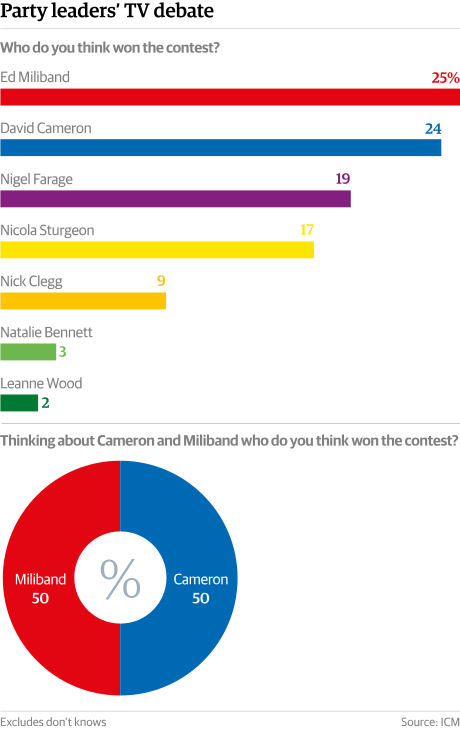
Whether leadership debates are a good thing or not is itself a debate, however ITV's UK Leadership Debate with seven party leaders was held with the result that Miliband (Lab) "beat" Cameron (Con) by a small margin. YouGov made a survey of who do you think won the debate with the results as shown below (source: Guardian)

One thing however is not explained, and that is who was asked. Obviously if you'd polled in Ceredigion or Gwynedd then Wood (PC) would have won, if in Brighton then Bennet (Greens) and so on. However I assume that we could say that this was a representative sample from across the UK, but still it is going to be heavily weighted in favour of the national parties and then especially the two leading parties.

This got me thinking, as you can tell whatever you want with statistics - think of it as accountancy with more leeway - could the above figures be weighted according to the uk electorate, especially as two of the parties involved do not campaign outside of Wales or Scotland.

The electorate figures for England, Scotland and Wales for 2013 according to the Electoral Commission are 40,100,00, 4,100,00 and 2,300,00 (to nearest 100,000). Given this I think it is obvious that the above results are going to be skewed towards the established parties.

Furthermore the SNP are fairly well known and have a more 'national' or UK-wide agenda than Plaid Cymru who are much more focussed on Wales. Leanne Wood (PC) for example is standing as a member of the Welsh Parliament rather than Westminster. Welsh politics rarely feature outside of Wales, except for a strange incident back in 1997 (one, certainly for the conspiracy theorists). Ironically given the current constitutional issues since the Scottish independence vote, it has been Rhodri Morgan, leader of the Welsh Government who has been proposing ideas (even at EU level) of how the UK and Northern Ireland should be governed.

That given, the above figures on who "won" really should be taken much more in context of the audiences to which they are most relevant. The above is so much biased towards an English view - not that there's a problem with that - it does give a false impression to voters in Wales and Scotland. Furthermore, given the size of England and its electorate even the above figure does not truly represent England - how would it look in the context of Thanet versus Toxteth?

So getting back to how the leaders actually did in the debate, it would be best to take each individually, especially as each has very different leadership goals. Probably the best overview of each of the party leaders' performances was given by the Telegraph. Or as another put it, four out of touch public school boys taken to task by three women :-)