Saturday, 27 July 2013

2001 again...

James Maynard Gelinas' blogpost on "Underground Research Initiative" entitled
2001: A Space Odyssey - Discerning Themes through Score and Imagery is a 22,000 word essay about the film 2001 and one certainly as worth reading as watching Kubrik's masterpiece.

In the 50 years since its release, while special effects have improved, the sheer grandeur of the film from many angles, especially that of science, has not diminished.

I can't say anything more other than what is already written in Gelinas' article, maybe than we got Facebook and Twitter instead, which given the effect of the Monolith in later books in Clarke's series might have been a good thing (though it seems that while 3001 told us how to destroy a Monolith, another movie used the idea - and a Macintosh - aliens (and humans too), beware of iPods).

OK, if I do add something, in 2001 you're probably going to see the best portrayal of a computer in any film (including ones using Macintoshes).

Maybe I should lobby Finnkino to show it on their number one screen in Helsinki....

Monday, 22 July 2013

Children of the Magenta

Children of the Magenta is a term used to describe pilots overly reliant on automation rather than trusting their own skills in flying an aircraft. This video from an American Airlines training session, where the term "children of the magenta" was coined - due to the colour of the flight director bug or icon - is essential viewing not just for pilots but for anyone involved in driving, managing or building systems of any kind:

In particular I want to present the bullet points from one slide and then address another aspect regarding levels of automation:

Automation Dependency
  • The pilot flying should remain as 'one' with the aircraft in any low altitude maneuvering environment with the autopilot engaged
  • To maintain situational awareness of both aircraft performance and flight path.
  • The autopilot and autothrottles have limitations which affect performance
  • Crews are returning to the autopilot in an attempt to resolve a deteriorating situation
  • Autopilot and Autothrottles, however good, cannot recover the aircraft from a critical flight attitude

If we consider what we do in software engineering, and especially in areas where there are strong privacy and security aspects such as any form of web and database development, do we end up relying upon our skills and technique or do we blindly follow process and procedure? Do we blindly follow waterfall or agile processes to their logical conclusion and attempt to beat that deadline and deliver something knowing that the quality of the delivered product is deteriorating. Do we allow our processes to become our overly trusted autopilots?

Finally three levels of automation were presented: low, medium, high. The lowest corresponds to hand flying, the medium to using the autopilot to guide the plane and the highest using the flight management computer to run everything.

I want to discuss these in a later post, but for now I'll leave it as an exercise to map these level to how we act in a given software engineer project.

Probably the biggest takeaway from this lesson in aviation when applied to any aspect of software engineering is:
If you are losing control of any aspect of project then the process won't correct it; only you as a software engineer will - if you take control.
And that applies to any aspect of the system: functionality, performance, security, privacy etc etc etc...


Sunday, 21 July 2013

Big Metadata

One of the issues I see with auditing systems for privacy compliance is actually understanding what data they are holding. Often it is the case that the project teams themselves don't understand their databases and log files sufficiently. Worse is that misinterpretation of the NoSQL and BigData approaches have left us in a situation where schemata can be forgotten - or at least defined implicitly at run-time. The dogma is that relational databases have failed and all this "non-agile", predefined, waterfall, defined schemata stuff is a major part of this.

Losing all this information about types and semantics is a huge problem because no longer can be fully sure of the consistency and integrity of the data and the relationships of that data to other objects and structures.

We are also then losing the opportunity to add additional information in the form of aspects to the data, for example, security classifications, broad usage classifications, and so on. This leads to embedding much of the information about the data statically into the algorithms that operation over that data; which in turn hides the meaning of the data away from the data itself.

I think this article entitled "Big Data success needs Big Metadata" by Simon James Gratton of CapGemini sums it quite quite well: forgetting about the meaning of data will seriously compromise our ability to understand, use and integrate the data in the first place!

To achieve this, good old fashioned data classification and cataloguing is required. Ironically this is exactly the stuff that database developers used to do before the onset of the trend to making everything schema-free.

Together with suitably defined aspects and ontologies that describe information (meta-information?) in much the same way as the OMG's MOF with additional structure and semantics we already have much, if not all, of the required infrastructure.

Then the process side of things needs to ensure that development of systems, services, analytics and applications integrates with this - in that whatever data they store (locally or in the cloud) gets recorded (and updated!). That's probably the hardest part!

See also:

Friday, 19 July 2013

Systems Safety - Defining Moments

As I've been concentrating on "safety improvements", or at least techniques for the improvement of system I've tended to concentrate on four areas:
  • Aviation
  • Industrial
  • Medical (specifically surgical)
  • Software Engineering (specifically information privacy)
The parallels between theses areas when it comes to what each define as "safety" and the techniques should be obvious. However the question remains what actually triggered each of these respective areas to take a more inherent safety approach and then what will trigger a similar approach with regards to information safety?

 
Above Diagram Key: Y-Axis: relative degree of safety embedded into that discipline, X-Axis, year of time since seminal incident.

Aviation safety's seminal moment was the 1935 crash of a Boeing Model 299 aircraft during a presentation flight. Instead of blaming the pilots, effort was made to understand the causes of the accident and develop techniques to help prevent similar accidents in the future.

For industrial safety the seminal moment was the 1974 Flixborough Disaster in the UK. This resulted in work on the design of industrial plants and the development of the notion of "inherent safety".

Surgical safety has quite a long tradition especially with the development of anaesthetic safety from the 1960s and the introduction of a proper systems approach. However anesthetists seem not to feature prominently as surgeons and doctors so the fame would probably go to Peter Pronovost et.al. for the Central Line checklist. This was probably one of the major contributors to the WHO Surgical Safety Checklist discussed in detail in Atul Gawande's book The Checklist Manifesto which brings together much of the above incidents. 

If you're still in doubt maybe Atul Gawande's article in the New Yorker magazine entitled The Checklist: If something so simple can transform intensive care, what else can it do? (Dec 10, 2007) might help.

Getting back to the crux of this article, what is the incident that will cause the wholesale change in attitudes and techniques to software engineering that instills such a sense of discipline that we can eradicate errors to such a degree that we could compare ourselves favourably with other disciplines?

The increasingly frequent hacking and information leaks? The NSA wiretapping and mass surveillance? Facebook and Google's privacy policies? None of these have had any lasting effect upon the very core of software engineering if any at all. Which either means that we place such low value on the safety of our information or that the economics of software are so badly formulated in society that the catastrophe would have to be so huge that it would have to cause societal change?

Interestingly, in software engineering and computer science we're certainly not short on techniques for improving the quality and reliability of the systems we're developing: formal methods (eg: Alloy, B, Z, VDM etc), proof, simulation, testing, modelling (in general). What we probably lack is the simplicity of a checklist to guide us through the morass of problems we encounter. In this last respect, this is why I think we're more like surgeons that modern day aviators; or, maybe some of us are like the investigators to the 1935 Boeing crash and other aviation heroes learning their trade?


Thursday, 18 July 2013

Asiana Flight 214 and Lessons for Software Engineering


Tony Kern's book Flight Discipline [1] discusses the notion of discipline related to flight safety through his experience flying, training and by example - almost invariably by way of a crash.

It is testament to the aviation industry overall how safe flying has become through the application of safety procedures and techniques, and also the very real need for pilots to be extremely disciplined in their work. The same concepts are also being applied in industrial and medical environments too as described earlier in this blog.

This week however has seen an accident at San Francisco airport involving Asiana Flight 214. The causes (note: plural!) are being investigated by the NTSB and I'm not in any position to appropriate blame, but I do think this will become quite a seminal accident in terms of what is found.

At the time of writing it is known that the aircraft was believe to be in a thrust managed mode which should have kept its speed and that the crew somehow allowed its speed to decay and mismanaged the final stage of landing. There are another set of possibly contributing factors such as CRM, crew fatigue, experience, the ILS being out of operation, a visual approach etc. This of course is compounded by the fact that hundreds of other aircraft have landed successfully at SFO in recent weeks under similar conditions.

Whether or not this is the fault of the pilots, a fault of the automatics on the aircraft or a combination of a host of those and other factors is to be ascertained. One thing that seems to be sure is that the pilots failed to monitor a critical aspect of the aircraft's situation. In Kern's terms the discipline of the pilots to maintain proper checks has failed. This will be an interesting case to follow, possible a seminal case with respect to discipline.

In terms of software engineering or specifically some aspects of developing with security in mind, I've been discussing with a colleague about SQL injection attacks and that these are remarkably easy to detect and defend against - though also remarkably easy to write. Given this, we still seem to be detecting vulnerable code remarkably often.

So this leads to the question why are we still writing code vulnerable to SQL injection if it is so easy to detect?

King puts forward four reasons for breakdown in discipline, which we can put into our context:

1.    Programmers don’t know the procedures for developing and testing code that is susceptible to SQL injection.
2.    Programmers don’t know the techniques to avoid writing code vunerable to SQL injection.
3.    Programmers forget either of points 1 and 2.
4.    Programmers willfully decide to ignore points 1 and 2.

Most programmers do know about the errors and pitfalls of particular implementation technologies, so the failure in discipline does not necessary lie mainly there. Even if it does, this is corrected simply by training.

Regrettably one of the excuses is always that the programmers are being “agile”: up against deadlines, constantly and inconsistently changing requirements, no or poor specifications, lack of emphasis on design and thought, and poor organisational communication. Errors can be fixed in a later sprint (if remembered and the if the fix is implemented). This then ends up with vulnerabilities such as SQL injection being forgotten by the programmers.

Willful ignorance of vulnerabilities follows from the previous point. As vulnerabilities are luckily not often exploited at run-time and if in place detection methods will probably catch these errors, then the programmers can often get away with vulnerable code. Furthermore, responsibility for the code nor the maintenance does not fall often with the original programmers or software engineering team.

Could it be that in software engineering we still have the hero mentality? Ironically it was many of the early 'hero' pilots who actively developed the procedures and techniques for safe flying.

Unlike software engineering the economics of bad flying proved to be a powerful incentive for actively pursuing good flying techniques and ultimately very sophisticated safety programmes. Maybe the only way of solving the discipline problem in software engineering is to radically alter the economic argument.

The economics of flying badly tends to end up with deaths and often the pilot’s own life (it is probably even worse if he/she survives) – the direct and collateral costs here are easily calculable. The economics of security errors in programming aren’t well understood nor calculated.

If a SQL injection releases one million records of personally identifiable information, why should the programmer care especially when there are little or no consequences for the programmer, the software engineering team, the managers and the business overall?

I don't suggest that we start killing programmers for errors, but maybe alter the way we prize teams for getting software into production. The fewer changes and bug fixes over the first year of a product's life = bigger bonus; inverting the bonus for bug fixing? Should we be more like hardware engineers and increase the costs of compilation of code such that a software engineering team gets only 1 chance per day to compile their code with penalties for compilation errors?

To finalise, maybe Tony Kern talking about discipline and what makes a great pilot - now apply this to software engineering, privacy, security etc etc:


References:

[1] Tony Kern (1998) Flight Discipline. McGraw Hill 0-07-034371-3


Tuesday, 9 July 2013

Facebook and Twitter....instead....

It was one of those funnily serendipitous things that connect everything together...first of all it started "playing" with XPlane 10....a damned good (understatement!) simulator and I suppose the next best thing to actually owning your own aircraft or holding a pilots license...anyway, flying around with some VOR or VOR navigation I ended up in Shannon --- and yes, I did land the plane.

Then I started wondering what flies out of Shannon now - the Shannon Stop-Over has been gone a very long time - and so I ended up looking for the Shannon departures board. Noticing the BA001 and 003 flights there - London City to JFK via Shannon on the outbound leg on an Airbus A318, I was wondering what that service was like.

Read a few passenger reports and noticed a comment about it being like the Pan Am Lunar Shuttle inside - certainly the photos of the all business-class seating look like it.

Which brings me to a clip of the said Lunar Shuttle from Kubrik's 2001:


Which then got me thinking:

  1. The Blue Danube or more correctly An der schönen blauen Donau is a beautiful piece of music perfectly suited to a space docking
  2. Kubrik was a genius
  3. A.C. Clarke's 2001 is also a piece of genius
  4. We had vision in the 1960's of a future where space travel and space-stations might be common place
  5. We got Twitter and Facebook instead....
 ....which allows me to write about what we could have had instead of having it....

Tuesday, 11 June 2013

Privacy, Data Collection and Surveillance


The privacy debate about the collection of data by the NSA continues with many asking questions about the moral and ethical issues surrounding this. The phrase "the death of privacy" is abound.
This is true I'm afraid, we lost our privacy, but not when the NSA starting collecting data but when we starting communicating using technologies that were readily and easily available - that probably dates back to the birth of written communication.

Data collection concerns me certainly, but here I want to focus on one of the maxims of privacy: "if you don'tuse it, don't collect it" and the fact that privacy is much more about the usage of data, not its collection (viz. the above maxim).

One can argue that merely using Google, Facebook and all the rest of the social media services one has already lost one's privacy, but interaction with these services is voluntary - no-one forced you to post those party pictures to the entire World and dog (complete with EXIF and location information). 

We admittedly do have a problem with other more hidden aspects of data collection and processing, for example with infrastructure and derived data.

In the above respects we have not lost privacy but moved the bounds of what personally and socially we call privacy – obviously people are not placing emphasis on the moral and ethical issues but rather on the economic benefit of using such data consuming services. In writing this blog I am losing my privacy, but with the economic gain of brand building and knowledge sharing.

Using this data consumers and users can be profiled and classified; typically for the serving of the perfect advertisement. However this is not unlike what an "old style shopkeeper" did through personally knowing his customers. The major difference is that today this is done automatically and impersonally by computer. We lost the link with that corner shop keeper who knew us and our families personally. Ever try contacting the customer service departments of practically any company these days?

This also touches on the point that users start or have started to feel that they are not in control of their data.

Most advertising and profiling companies are using classification structures that are fairly coarse grained but then further refined those with additional [coarse] grained data such as location and social network. This for the most part is nothing more than could be understood by reflecting on one's own life, place of abode and neighbourhood. For the most part this is just reasserting what is already derivable from a person’s postcode.

Much of the data collected by the NSA in the current revelations is somewhat innocuous; primarily this seems to be just telephone record meta-data like the kind you see on an itemized bill. But such innocuous data can easily be cross-referenced and fingerprinted.

The trouble here is that government authorities can have a more insidious effect upon a person's life than a supermarket or credit card provider can. Indeed there are safe guards and protections through the rule of law - though as we have seen these can be constructed so that under some circumstances the law can allow whatever is necessary to get a/the job done.

Before however we dismiss the above, consider two points:

  1. automatic guilt, or, guilty until proven innocent
  2. scope creep

The first derives from the fact that all your actions may be used against you in the future. If you think you have nothing to hide then consider all the crimes you committed today? Did you drive over the speed limit, run a red light, have you ever stolen something/anything etc?

The second derives from the first that once you have this information then it could be used for purposes well beyond its original intent. Worse are the twin possibilities of false positives and false negatives. Consider councils in the UK using CCTV cameras originally intended to catch terrorists and prevent crime (in general) for catching dog owners not cleaning up after their dogs.

From the above the moral and ethical arguments are easily fashioned, the economic arguments are much more difficult and vary depending upon the context and our view of what society should be:

  • Is personal freedom, privacy and liberty greater than that of society's?
  • Is mass surveillance better than letting one "terrorist" commit an act of atrocity?

These questions however go right to the heart of the definitions of freedom, liberty, privacy, security, society and our own control over our own data. I don't think any of us even remotely comprehend the repercussions and difficulties of even trying to address, let alone answer such questions. 

But until we start having this debate in an impartial, focused and formal manner with the terms and definitions clearly stated, judging and/or condemning any form of data collection and any form of processing and usage of data is not going to be possible in any meaningful, lasting manner.

In another way we're back to a question posted by a group of mathematicians regarding the esoteric nature of things as we move away from the fundamental building blocks, and losing sight of what those building blocks [of society and humanity] actually mean.

Whether the NSA and everyone else's collection of data is right or wrong I can't answer, but the debate about what privacy actually is and our relationship personally and as a society with the concepts of privacy, security and trust is going to be an extremely interesting debate with wide repercussions.

Monday, 10 June 2013

Privacy, Continuity and Performance...

Of the "big four" non-functional aspects of a system: security, privacy, continuity and performance, typically privacy and security are viewed together; there is no doubt about their relationship.

The relationship between privacy (more generally information management) and continuity and performance is much more subtle. Certain decisions in these areas have an effect upon the information management aspects. Consider a piece of middleware that for both continuity and performance reasons
  1. batches incoming data (for later processing or sending to some other system)
  2. caches authentication data (for "fast(er)" login)
Both require data to be held for a certain period of time and data to be removed. There are also implications for the storage of that data in terms of whether it is secured through some means (eg: encrypted file system, database, fields...) and the internal processing and communication mechanisms.

We are primarily concerned with minimising the amount of data held and avoiding a single point of failure which would allow access to all the data. We have three basic options:


The monolithic system has potentially greater performance characteristics, but less so with regards to continuity and privacy - these latter two having a single point of failure. The facade while providing a single API decreases the performance but potentially facilitates better continuity through decoupling internally the authentication and data-handling and the decoupled system places much more responsibility onto the client for handling the correct calling sequences but better deals with privacy by reducing the amount of available data via any one API and component.

However as we decouple the system we increase the amount of inter-component communication and introduce a different set of information management and continuity issues, such as securing these data-flows and the leaky abstraction of network/communication failures.

The point here is not to provide a definitive answer of whether one solution is better than another but to emphasise the subtle interaction between privacy, continuity and performance in differing architectural solutions.

Tuesday, 4 June 2013

Data Collection

Anyone who cares about privacy will tell you that data collection is bad...REALLY BAD, yet without data collection none of the services we use and need would work (there's an economic argument there). Indeed most of the issues around data collection seems to be very emotive in nature and usually end up in the "data collection is bad/must be minimsed panic".

First to understand data collection we must understand from where data is collected. First of all we need to understand the relationship between a client and a server via some infrastructure. This is described in an earlier article which talks about primary and secondary data.

Generally the case we mainly worry about in privacy is where the client is a human interacting with an app or browser via some device, eg: a mobile phone.

The end-user (customer or human) will provide some information required to fulfill the functions of the service required, eg: posting a photograph to Flickr with some description and their login details.

So far this seems reasonable - afterall, a user is posting a photograph to their account with a description. The service might then perform an number of other tasks
  • Set the current time and date of upload
  • Extract EXIF information from the photograph, including (but not limited to):
    • date and time of the shot
    • location information
    • camera information
    • free text strings, eg: copyright/ownership information
All of the above comes under the notion of data collection and all of the above is information provided by the user of the service. One can argue that the user didn't know about the EXIF contents of the photograph and surprisingly few people actually realise how much information is embedded into the picture.

Further operations can be performed such as facial recognition and linking this to persons who have been tagged in other photographs etc. For example, this is a service provided by Facebook.

Additionally the service maybe collecting secondary information about the usage of the service, for example, how much time was spent using a particular page, what the UI/UX flow was and so on.

Then there's the information collected from the infrastructure. This includes information provided by the browser or app, typically in the form of browser identification strings, application identifiers, device identifiers, and from the service infrastructure including such information as source IP address, contents of the API call, time and date of interaction, error codes etc.

When we talk about privacy we typically end up focussing on the primary and secondary information sets. The former set to decide whether that information is necessary for the service to function and provide the facilities the user requires and the second set to decide whether this information needs to be explicitly collected or not. Rarely do we even investigate the information collected by the infrastructure which can be used both to recreate primary and secondary data sets. Indeed one of the major targets for any hacker are the infrastructure logs themselves.

When we talk about data collection we must consider the following data sets:

Primary, secondary and infrastructure are described as above with the addition that we split primary into explicit and implicit where the former denotes that information which is explicitly understood by the end-user and implicit including that information that might be hidden, eg: EXIF. Combined together we produce the Total Information Set which when linked together by simple association becomes the Total Deduced Information Set.

Another way of looking at this is in a more Venn diagrammatic manner:

Where the labels are abbreviations of the corresponding labels in the first diagram and colours for emphasis.

It must be noted that some intersections might not properly exist, for example the union of EP and Sec, and others only in certain contexts, for example, whether IP is a proper superset of EP or not.

Now we have explicitly modelled data collection, we can now start tackling questions such as what does minimisation of data collection actually mean and then start looking at what the processing and extraction functions over that data might actually look like.

Friday, 31 May 2013

What is the economic component of privacy to the end-user?

Privacy is framed in terms of ethical, moral and economic arguments. Certainly most research supports that nearly everyone is worried about their on-line privacy, yet rarely if at all we've seen a company actually fail because of their attitude to privacy. Some companies have changed their ways admittedly, but the change has been minimal and after the initial fuss it is very much business as usual. Privacy seems not to be much of an ethical or moral issue to most people but rather an emotional one.

Given the above we don't see much of an economic argument either, at least not from the end-user side of things. The economic argument for using certain social networking services, sharing personal photographs, details etc seems to outweigh the potential disadvantages - which tend to be worries about to where data is being shared or sold, or who might be viewing that material.

Privacy is rarely framed in terms of an economic argument beyond the "data mart" idea but rather in emotional terms: nothing to hide, nothing to fear perhaps? Privacy is lost in the security and liberty arguments too being equated with concealment and freedom. Consider the argument put forward by US congressman Paul Rand [1] on privacy.

Laws are changing to emphasise the economic argument to the companies that provide internet services and there we do see a strong argument for a more robust privacy function. Whether we on the business side of things are addressing privacy in the right manner and in the same economic terms as our end-users is another matter altogether. For companies the economic argument for developing and adhering to an information safety (privacy) is very clear. We have a good economic argument for treating end-users' information with respect...whatever that is.

For the end-user the economic argument is unclear. Why should an end-user choose one service provider over another? What are the terms of this economic argument and have they even been defined at all?

References

[1]  Senator Rand Paul Talks Tech, Civil Liberties, and Keeping the Government Out of Your Email. By Spencer Ackerman 05.30.13 Wired

Wednesday, 29 May 2013

A Paper.li publication

Paper.li offer an interesting service collecting articles based on keywords (and probably some analytics too), here's mine concentrating on privacy:


Quite useful plus it acts as a collection point for Twitter users.

Sunday, 12 May 2013

A basic information privacy programme

Using the material discussed earlier as our starting point we can construct the outline of an information privacy programme (IPP). First however we must place any IPP into juxtaposition with the units it will affect:


Note that any "IPP" can not rule nor dictate over any of the affected parties, it does however provide a point of contact and expertise for those parties when working with information. The enforcement aspects come from a number of other places which we'll discuss in another article.

We structure the IPP into two parts: the programme elements and the knowledge base, both of which we will introduce here.

The Programme Elements are:

  • A Reporting System
  • An Information Distribution System
  • A Privacy Committee
  • An Inspection Programme
  • Education and Training
  • Accident Preparation and Investigation
The Reporting System is a mechanism by which people both inside and outside can bring to attention issues, problems, notification of data breaches and other privacy problems to attention. This mechanism must allow anonymous contributions and can be compared to the aviation related programmes CHIRP and CHIRP-MEMS.

The Information Distribution System is a mechanism by which privacy related topics can be communicated to interested parties outside of the IPP. Typically such information might be of the "interest" variety, eg: notification of new laws or relevant news articles, to the critical such as a notification of an information breach or threat which must be acted upon by any receiving parties.

The Privacy Committee is the one fraught with political difficulties, but a small (5-7 people) group from a cross-section of roles within the company. This is where many programmes fail because of placing management or non-technical staff here. The role of this group is not to manage the programme but to reivew incident/accident reports, review adequacy of corrective actions, hazard reviews, inspection reports, provide recommendations (based on information received via the reportins and information distribution systems) and to self-assess and improve the ways of working of the IPP as a whole. The committee is also the chance to bring onboard the expertise in the external parties from R&D, legal etc.

The Inspection Programme can cover many aspects, but is primarily concerned with auditing and providing mentoring/consultancy to external parties. Auditing usually takes place as part of the deployment cycle of a product for example. This area constitutes most likely the bulk of the work of the IPP.

Education and Training is always critical but often badly done (if at all). Developing relevant training for the external parties is critical to long-term success and accident avoidance.

Finally we get to Accident Preparation and Investigation. Hopefully data breach or similar incidents never happen, however having procedures to deal with these are critical to a good solution to any problem. Likewise, a good investigation procedure which not only traces down the causes but provides solutions is also critical.

This concludes the programme elements and now we move to the Knowledge Base which is where the tools, techniques, metrics and database for storing all of the required knowledge and wisdom for running the above element succesfully. We use the word "tool" in a loose sense - automation in any form might not be available, but things such as checklists or ontological structures/classifications are tools.

As a recommended minimum for databases: a database of relevant laws and implications (at an R&D level of detail), a database of reported risks and a database of investigation findings and so on.

All this is just an overview - specific companies, specific situations require customisation and we still have not discussed in any detail the content of the knowledge base nor programme elements let alone presented particular roles such as that of the privacy officer etc. What however should be clear is that a structuring is necessary and what have presented here summaries some of the best practices from an area that is already well versed with similar issues, that of aviation safety. [1]

References

[1] Wood R. (1997) Aviation Safety Programs. 2nd edn. Jeppesen.

Saturday, 11 May 2013

Topology, the periodic table and parasites

hree very interesting websites to amuse you. The first a homage to topology or as the author puts it:
"This is a toy for building complex 3D polyhedral shapes from simple ones by "recipes"
polyHédronisme allows you to construct various polyhedral shapes (only 3 dimensions though!) by composing rules over various bases, for example starting with a plain octahedron
and applying various rules we can get beauties such as this below using the rule "n18n18n9n9n9soxO" in the notation used on the site:


The second is the every popular Element of the Week via the The Guardian newspaper. A fun introduction of the basic building blocks of chemistry and each week a new element. This week, the famous and well known element: astatine .

I recommend you check out caesium, rubidium, potassium and sodium for the sheer fun of watching those being dropped into water and reacting violently. Such experiments are now banned from schools for safety reasons, along with many other aspects of science unfortunately...

Failing that there's the Royal Society of Chemistry's Visual Elements Period Table which is great fun.

And finally, for the squeamish of you stop reading now, for the less squeamish its probably best to avoid mealtimes, but this is great:

Parasite of the Day!

Introducing a new beast more or less regularly (if not every day). To understand this site you can read their introduction which helpfully has no pictures to put you off your food.

Friday, 10 May 2013

Privacy learning from aviation safety...

I've written before on my thoughts, or belief, that information should be treated as a dangerous chemical, or a patient undergoing surgery:

privacy is a safety critical concern

Developing ideas such as checklists from aviation, surgery etc, do improve the quality of work and actually implementing those has been a very interesting experience - if anyone wants to learn about this let me know, I'm very happy to talk about it.

Now while we have some parts of the "coalface work" working, ie: the real privacy engineering work with real software engineers, software architects, programmers and code, we can now turn to reassess how we're managing privacy and in turn managing risk and improving the safety of our code, products, business and ultimately our customers from a privacy perspective.

One area that has succeeded very well is aviation - our original starting point for much of this safety discussion. Indeed aviation safety precedes most other safety programmes by decades. I'd like then to quote from the book Aviation Safety Programs (Richard Wood, 2nd edn 1997, Jeppesen):

Safety is not a moral problem or an ethical problem or a pain and suffering problem. It is an economic problem. Safety, by itself, generates a lot of sympathy, but very little action. Only the economics of safety generate action. In the entire history of safety, nothing good happened unless it was either economically beneficial or mandated by government.

Now simply replace "safety" by "privacy":

Privacy is not a moral problem or an ethical problem or a pain and suffering problem. It is an economic problem. Privacy, by itself, generates a lot of sympathy, but very little action. Only the economics of privacy generate action. In the entire history of privacy, nothing good happened unless it was either economically beneficial or mandated by government.

Interesting don't you think?  Ah, yes, we know it is an economic problem and it certainly is being mandated by government. Adopting something like Privacy by Design today will not change the quality of your product or relationship with your customers. You'll get some sympathy but ultimately does anything change? There's an outcry every time Facebook changes it privacy policies but people still post private information there; similarly with Google and the rest. Privacy is talked about in moral and ethical terms: building trust with the customer.

Despite of everything, Facebook hasn't lost 50%, 90% or even 1% of its customer base because of its perceived "anti-privacy" stance, and neither has Google, nor any other company I can think of. Privacy must be framed as an economic argument: if company X abuses their consumer data privacy, then they lose all their customers and business.

We've a lot to learn from a successful safety program and that's something I'm going to write about more in the coming days and weeks. How do we put a privacy programme together such that it really does economically benefit a company and addresses all the cross-cutting issues from the top management through to the programmer actually writing the code that runs the business?

First things first though, when constructing such a programme, we need a group of people to lead the privacy culture within a company and that team needs day-to-day experience close to coalface, they need knowledge of not just the moral and ethical aspects but of real scientific and engineering experience. Starting with that we might just really see where the economics benefits are won and lost.

Thursday, 9 May 2013

Foundations of Applied Mathematics

Via the n-Category Cafe blog I noticed a real gem in the workshop on The Foundations of Applied Mathematics. Simplifying systems and trying to understand the foundations of things (information systems, software engineering, privacy) is of great interest to me.

For example, in my current area of information system privacy we have a huge problem in even contemplating what the foundation of the discipline looks like, let alone trying to formalise it (and it probably has a lot to do with entropy, semantics, measurement theory and information flow if you ask me - but before we get there we've a lot of other work to do).

The particular piece of work that interested me was by John Baez who has a history of work trying to unify various areas of mathematics ostensibly through category theory and his presentation entitled The Foundations of Applied Mathematics (slides) presents his work on applying these ideas to applied mathematics. This was also followed up by an interesting discussion on Google+.

The whole presentation and body of work starts to remind me of a few things
  • layered architecture
  • esoteric  models of understanding (- need a better way of explaining this!)
  • visualisation (= diagrams)
Baez presents a model of four (for oversimplicity's sake as he describes in his presentation) layers linking science and engineering with applied mathematics with pure mathematics and finally grounding that in the foundations of mathematics. Immediately coming to mind here are the kinds of layered architecture we see in software engineering with each layer building upon the primitives provided by the immediate lower layer.  This is then followed by the question:

"Can developments in applied mathematics force changes in the foundations of mathematics?"

I'd have to answer 'yes' to this if only to assert the position that if the lower layers have not been correctly formulated or established and can not support the upper layers in their needs then the above is inevitable.

The reasoning for this comes from, at least in my chosen area of software engineering, is that layers [of software] are often constructed without any reference to any other layers, the operations and structures in those layers are not "atomic" or fundamental in nature with respect to that layer and the separation of concerns and layering of architecture is often a matter personal choice. Layers are often polluted with convenience functions and particular architectural choices, see Anti Patterns.

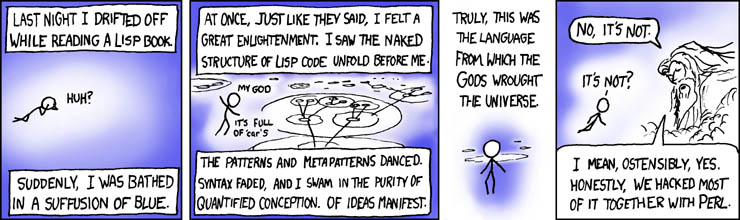
Another way of looking at this is via a famous xkcd cartoon on the relationship between Lisp, Diety and how it was really built:


Maybe it just is that the foundations aren't bad at all, just that we got the layering wrong. Maybe mathematics isn't layered at all...object oriented anyone?

Further in the Google+ discussion started by Baez, a posting by Carsten Führmann quoted Von Neumann:

"As a mathematical discipline travels far from its empirical source, or still more, if it is a second and third generation only indirectly inspired from ideas coming from 'reality', it is beset with very grave dangers...."

The quotation continues but the gist is that the further a discipline goes away from its foundations the more esoteric it becomes. I think in software engineering we see this quite clearly with things like use case modelling and agile methods. Not that there's much wrong with either but their current application is often far from the ideals proposed by their creators.These then get use to develop the architectural layers seen earlier.

In information system privacy we do not have a clear, coherent understanding of the foundations of the discipline and yet we are developing at very high levels of abstraction concepts, laws, ideas without understanding how these are to be architected into the technologies we are building. Contemplate the semantic gap between the European Privacy Directive and the actual C++ (or whatever) code that implements those. I'm not saying that laws, directives etc are wrong, just that even simple ideas such a Do Not Track will expose huge holes in our understanding of the discipline of privacy (and a lot of related subjects too). Actually I think that DNT won't work in its current form because too fee people do not want to address the formalisation of privacy but remain at some esoteric level far removed from what DNT is trying to address and that might have other implications and Von Neumannesque danger signals.

I won't discuss visualisation here, that's for another time, but just to reference the work at the University of Brighton on diagrammatic notation and also to refer to another point in Baez's presentation on the use of diagrams across disciplines (and layers of science) to express concepts to different audiences...presenting Euler diagrams to lawyers, marking people etc is an extremely interesting experience, especially when - as "non-mathematicians" - they start interacting using those notations and at some level we've "accidentally" unified the languages mathematicians and lawyers....